Marcel Breuer: The Visionary of Modernist Architecture and Furniture Design
Marcel Lajos Breuer (1902–1981) was a titan of 20th-century design, bridging the gap between the radical experimentation of the Bauhaus and the monumental scale of American modernism. A Hungarian-born architect and furniture designer, Breuer is celebrated for his ability to translate sculptural forms into functional living spaces and iconic furniture. From the sleek lines of tubular steel to the raw power of Brutalist architecture—a style characterized by massive, monolithic forms and raw concrete—Breuer's influence remains embedded in the fabric of modern cities.
Key Facts
- Birth/Death: Born May 21, 1902, in Pécs, Austria-Hungary; died July 1, 1981, in New York City.
- Education: One of the youngest students at the Bauhaus school under Walter Gropius.
- Furniture Innovations: Pioneered the use of bicycle-handlebar-inspired tubular steel.
- Architectural Style: A leading exponent of the International Style and later Brutalism.
- Major Award: Received the AIA Gold Medal in 1968.
- Notable Works: The Wassily Chair, the Whitney Museum of American Art, and the UNESCO Headquarters.
The Bauhaus Years and Furniture Innovation
Breuer's journey began at the Bauhaus, the radical arts and crafts school founded by Walter Gropius. Recognized early as a prodigy, Breuer was appointed head of the Bauhaus carpentry shop. It was here that he revolutionized furniture design by experimenting with tubular steel, a material inspired by the construction of bicycle handlebars.
Among his most enduring creations are the Cesca Chair and the Wassily Chair. While popular belief suggests the Wassily Chair was designed specifically for the artist Wassily Kandinsky, it was actually named so by an Italian manufacturer in the 1960s after learning Kandinsky had owned one of the earliest models.
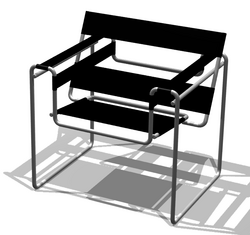
During this period, Breuer's work was influenced by Dutch designers Gerrit Rietveld and Theo van Doesburg. His early architectural ventures, such as the 1932 Harnischmacher house in Wiesbaden, showcased the International Style—a modernist approach emphasizing volume over mass, lightweight materials, and the rejection of ornament.
From London to the United States
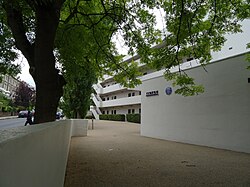
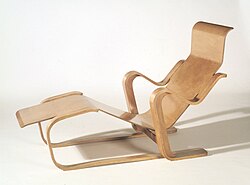
In 1935, Breuer moved to London, where he worked with the Isokon company and the modernist F. R. S. Yorke. During this time, he experimented with bent and formed plywood, drawing inspiration from the Finnish architect Alvar Aalto.
Breuer's career shifted significantly in 1937 when he followed his mentor, Walter Gropius, to the United States to join the faculty of Harvard's Graduate School of Design. Together, they shaped the American approach to modern residential design, mentoring a generation of architects including I. M. Pei and Philip Johnson.
By 1946, Breuer established his own practice in New York City. He introduced the "binuclear" house concept, which separated living and sleeping areas into two distinct wings connected by an entry hall, often topped with a distinctive "butterfly" roof.
Institutional Mastery and the Shift to Concrete
The 1950s marked a turning point as Breuer transitioned from residential projects to massive institutional commissions. He began utilizing concrete as his primary medium, leading to some of his most recognizable works.
His portfolio expanded to include the UNESCO Headquarters in Paris (1955) and the monastic master plan at Saint John's Abbey in Minnesota (1954). Breuer was also a progressive employer, hiring Beverly Lorraine Greene, the first African-American woman licensed as an architect in the U.S., who contributed to projects like the Grosse Pointe Public Library.
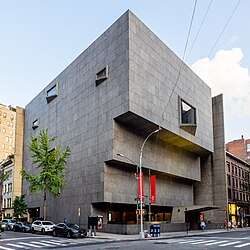
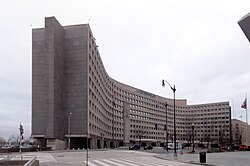
In 1966, he completed the Whitney Museum of American Art at 945 Madison Avenue, a masterpiece of shaped concrete. However, not all his large-scale works were universally loved; the U.S. Department of Housing and Urban Development (HUD) headquarters in Washington, D.C., has faced significant criticism for its stark design.
Architectural Evolution and Legacy
Breuer's work can be categorized into four distinct evolutionary phases:
- The White Box: Early International Style houses featuring glass and white surfaces.
- Punctured Wood: Characterized by wooden walls and cantilevered balconies, seen in his MoMA "House in the Garden."
- Prefabricated Concrete: Modular panel façades used in the IBM Laboratory in La Gaude and the town of Flaine.
- Stone and Shaped Concrete: Unique, heavy commissions like the Met Breuer and the Atlanta Central Library.
Despite his success, Breuer faced a professional setback when his proposal to build an office tower atop Grand Central Terminal was defeated in the U.S. Supreme Court, a case that ultimately helped establish landmark protection laws in New York.
| Category | Key Examples | Defining Characteristic |
|---|---|---|
| Furniture | Wassily Chair, Cesca Chair | Tubular steel, industrial materials |
| Residential | Binuclear houses, Geller House I | Butterfly roofs, separated wings |
| Institutional | Whitney Museum, UNESCO HQ | Brutalist concrete, modular panels |
| Academic | Harvard Graduate School of Design | Mentorship of future modernist architects |
Frequently Asked Questions
Who was Marcel Breuer's primary mentor?
Walter Gropius, the founder of the Bauhaus, was Breuer's lifelong mentor. Gropius recognized Breuer's talent early on, appointed him head of the carpentry shop, and later encouraged his moves to London and the United States.
What is a 'binuclear' house?
A binuclear house is a residential design concept developed by Breuer that separates the home into two distinct wings—one for social activities (living, dining, kitchen) and one for private quarters (bedrooms)—connected by a central entry hall.
Was the Wassily Chair actually designed for Wassily Kandinsky?
No. While Kandinsky admired the design and owned an early version, the chair was not designed for him. The name "Wassily" was given to the chair by an Italian manufacturer during its re-release in the 1960s.
What is the significance of the Grand Central Terminal project?
Although the project was never built, the legal battle over Breuer's proposed office building on top of the terminal led to a U.S. Supreme Court decision that established the right of cities to protect their historic landmarks.
Which architectural styles is Marcel Breuer associated with?
Breuer is primarily associated with the International Style, characterized by minimalism and industrial materials, and Brutalism, known for its use of raw, exposed concrete and massive forms.