Manhattan Project Heavy Water Production Sites
During the height of the Second World War, the United States embarked on a massive industrial effort to secure the materials necessary for nuclear research. In November 1942, Brigadier General Leslie R. Groves, Jr., Director of the Manhattan Project, recruited DuPont as the prime contractor to build a plutonium production complex. While DuPont's primary designs for nuclear reactors utilized graphite as a moderator—a material used to slow down fast neutrons to sustain a nuclear chain reaction—and helium for cooling, the project leadership sought a backup plan. To ensure the project's success should graphite prove infeasible, the U.S. government prioritized the production of heavy water.
The demand for this specialized material was estimated at 3 short tons (2.7 t) per month. With the existing plant at Trail only capable of producing 0.5 short tons (0.45 t) monthly, General Groves authorized the establishment of three additional facilities to bridge the gap.
Key Facts
- Primary Contractor: DuPont managed the construction and operation of the heavy water facilities.
- Production Method: The American plants used distillation, leveraging the higher boiling point of heavy water.
- Target Purity: The facilities aimed for a final concentration of 99.75% heavy water.
- Strategic Locations: Plants were built at existing Ordnance Works in West Virginia, Indiana, and Alabama to save on land and utility costs.
- Final Destination: The finished product was shipped by rail to the University of Chicago for use in early nuclear reactors.
The Infrastructure of the P-9 Project
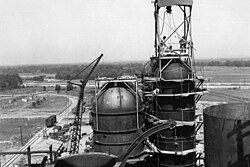
To maximize efficiency, the new facilities were integrated into existing government-owned sites: the Morgantown Ordnance Works in West Virginia, the Wabash River Ordnance Works in Indiana, and the Alabama Ordnance Works in Alabama. Although funded via Ordnance Department contracts, these sites were built and operated by the United States Army Corps of Engineers.
The chosen production method was distillation. While not the most efficient process available, it was selected because it was proven to work and could be scaled to an industrial level, thereby reducing the technical risk associated with the project.
Production Capacity and Costs
Each plant contributed a specific quota toward the monthly goal. The Wabash facility was the largest producer, followed by Alabama and Morgantown. Despite high initial budget allocations, DuPont voluntarily reduced its fixed fees at all three sites because construction costs were significantly lower than estimated.
| Facility | Location | Expected Monthly Output | Actual Construction Cost |
|---|---|---|---|
| Morgantown Ordnance Works | West Virginia | 0.4 short tons (0.36 t) | $3,490,069 |
| Wabash River Ordnance Works | Indiana | 1.2 short tons (1.1 t) | $7,493,157 |
| Alabama Ordnance Works | Alabama | 0.8 short tons (0.73 t) | $3,466,171 |
Detailed Site Overviews
Morgantown Ordnance Works (MOW)
The MOW began in 1940 as an 826-acre chemical facility producing ammonia for explosives, as well as alcohol, hexamine, and formaldehyde. Construction for the heavy water project began on January 7, 1943, and was completed ahead of schedule by September 1. The site became critical for the final stage of production: electrolytic finishing.
At the electrolytic finishing plant, distillation output (approximately 90% purity) was broken down into hydrogen and oxygen. Because light hydrogen is drawn off first, the remaining liquid became increasingly concentrated. This multi-stage process resulted in a final purity of 99.75%.
Post-war, the site transitioned through various chemical leases before being purchased by the Morgantown Community Association in 1962 for $1.25 million and converted into an industrial park. Due to contamination, it was added to the EPA's Superfund National Priorities List in 1986. After remedy construction and long-term monitoring, the EPA removed the site from the list on August 21, 2018.
Wabash River Ordnance Works
Located near Dana and Newport, Indiana, construction at Wabash began on January 23, 1943, and was completed by October 22. The distillation plant became operational in stages between June and September 1943. The project was completed for $7,493,157, well below the allocated $13,665,000.
Alabama Ordnance Works
Situated near Childersburg and Sylacauga, Alabama, this facility saw construction begin on February 11, 1943, and finish on November 15. Its distillation stages were operational between May and September 1943. The total cost was $3,466,171, significantly less than the $8,285,000 budget.
Frequently Asked Questions
Why was heavy water needed if graphite was the primary moderator?
Heavy water was produced as a backup measure. If the graphite-moderated reactor designs proved infeasible, the heavy water facilities ensured the Manhattan Project could still proceed with plutonium production.
How did the distillation process work for heavy water?
The process took advantage of the slightly higher boiling point of heavy water compared to light water, allowing the heavier molecules to be separated and concentrated.
What was the purpose of the electrolytic finishing plant at Morgantown?
The finishing plant increased the purity of the heavy water from roughly 90% to 99.75% by using electrolysis to remove light hydrogen first.
Why were these plants located at existing Ordnance Works?
Locating the facilities at existing sites saved the government the cost of acquiring new land and provided immediate access to existing personnel and utilities, such as steam generating equipment.
What happened to the Morgantown site after the war?
It was leased to chemical companies, later converted into an industrial park, and eventually underwent EPA Superfund remediation for contamination before being removed from the priority list in 2018.