Male Relationships and Homoeroticism in Ancient Greece
The nature of relationships between men in ancient Greece was complex, governed by evolving social norms and varying regional customs. While modern interpretations often seek a binary understanding of sexuality, the Greeks viewed these bonds through the lens of social status, age, and the cultivation of masculinity.
Social Dynamics and the Passive Role
Classicist Kenneth Dover, in his 1978 work Greek Homosexuality, argued that Greek society placed a high premium on the masculinity of adult males. According to Dover, relations between adult men of similar social standing were often viewed as problematic. The primary source of social stigma was not the act itself, but the passive role. In the context of pederasty—a socially structured relationship between an older man and a youth—the youth was expected to transition into the active, dominant role upon reaching manhood.
Dover suggested that adult men who continued to take the passive role were seen as "feminized," citing insults in the plays of Aristophanes as evidence of this ridicule. However, more recent scholarship by James Davidson and Hubbard has challenged this model, arguing that Dover's view is overly reductionist and that evidence exists to contradict the idea of universal stigma for adult male unions.
Regional Variations and Lasting Unions
Not all Greek city-states viewed adult male relationships with suspicion. In Thebes, the legislator Philolaus of Corinth—who was the lover of the Olympic champion Diocles—crafted laws in the 8th century BC that supported male unions. This contributed to a unique culture of Theban pederasty where relationships often continued long after the younger partner reached adulthood.
The most prominent example of this was the Sacred Band of Thebes in the 4th century BC, an elite military unit composed of pairs of male lovers. Similarly, in Athens, the relationship between Pausanias and Agathon, as described in Plato's Symposium, evolved from a pederastic phase into a stable, long-term adult partnership.
Iconic Pairs in Myth and History
Achilles and Patroclus
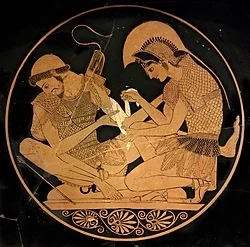
One of the earliest records of a deep emotional bond between men appears in the Iliad (800 BC). While Homer does not explicitly describe the relationship between Achilles and Patroclus as sexual, later Classical writers did. To signify their roles, Athenian artists often depicted Patroclus with a beard (the erastes, or active lover) and Achilles as clean-shaven (the eromenos, or beloved), despite Achilles' godlike strength. This created a scholarly debate among figures like Aeschylus and Pausanias regarding who held which role. Conversely, Socrates argued in Xenophon's Symposium that they were simply close friends.
Theseus and Pirithous
Theseus and Pirithous are depicted as best friends of the same age whose bond carried homoerotic connotations for some ancient authors. Their friendship began after a conflict over cattle, where they were so impressed by each other's courage and beauty that they swore an oath of friendship. According to Ovid, this bond was so intense that Theseus's wife, Phaedra, felt neglected, leading her to pursue her stepson, Hippolytus.
Orestes and Pylades
Orestes and Pylades shared a lifelong intimacy that began in childhood. Roman-era authors often interpreted their bond as romantic. In the dialogue Erotes ("Affairs of the Heart"), attributed to Lucian, the pair are presented as the primary examples of a loving friendship. This tradition of heroic homoeroticism persisted into the 18th century, influencing George Frederic Handel's 1734 opera Oreste.
Alexander the Great and Hephaestion
Alexander the Great shared an exceptionally close bond with his childhood friend and cavalry commander (hipparchus), Hephaestion. The two studied together under Aristotle and frequently compared their relationship to that of Achilles and Patroclus. When visiting Troy, Alexander honored Achilles while Hephaestion honored Patroclus.
While ancient writers were not conclusive about their sexual relationship, modern scholars like Robin Lane Fox believe they may have been lovers. Alexander's grief upon Hephaestion's death in 324 BC was profound; he fasted for days, held an elaborate funeral in Babylon, and attempted to have Hephaestion declared a god. Arrian records that Alexander clung to Hephaestion's body in tears until he was forcibly removed by his companions.
![The emblema of the Stag Hunt Mosaic, c. 300 BC, from Pella; the figure on the right is possibly Alexander the Great due to the date of the mosaic, along with the depicted upsweep of his centrally-parted hair (anastole); the figure on the left wielding a double-edged axe (associated with Hephaistos) is perhaps Hephaestion.[36]](/images/56/89/56899a885db2210f7b52efa60db5b0f276c7a5ebfe709de0ec073b70b49968bd.jpg)
Harmodius and Aristogeiton
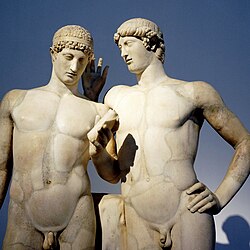
In Classical Athens, Harmodius and Aristogeiton were lovers known as the Tyrannicides. They assassinated Hipparchus, the brother of the tyrant Hippias, and were subsequently executed. Though their actions helped pave the way for the democratic reforms of Cleisthenes in 510 BC, the Athenian democrats later celebrated them as national heroes partly to downplay the role of the Spartan king Cleomenes I in removing the tyranny.
Key Facts
- The Passive Stigma: Some historians argue that adult men who took the passive role in sex were socially stigmatized as "feminized."
- Theban Exception: The Sacred Band of Thebes consisted of elite soldiers paired as male lovers, showing that some regions supported adult male unions.
- Pederasty: A structured relationship between an older erastes and a younger eromenos.
- Heroic Bonds: Pairs like Achilles/Patroclus and Alexander/Hephaestion served as cultural archetypes for intense male intimacy.
- Political Symbolism: The Tyrannicides (Harmodius and Aristogeiton) were used as democratic symbols in Athens.
| Pair | Nature of Relationship | Key Significance |
|---|---|---|
| Achilles & Patroclus | Deep emotional/romantic bond | Archetype for heroic love in the Iliad and later art. |
| Alexander & Hephaestion | Childhood friends/Political allies | Intense grief and divine honors following Hephaestion's death. |
| Harmodius & Aristogeiton | Lovers/Political assassins | Known as the Tyrannicides; symbols of Athenian democracy. |
| Orestes & Pylades | Lifelong intimate friends | Used by Lucian to represent the merits of homoeroticism. |
Frequently Asked Questions
Was homosexuality accepted in Ancient Greece?
Acceptance varied by region and role. While pederasty was a structured social institution, some historians argue that adult men taking a passive role faced social stigma, though this is debated by more recent scholars.
What was the Sacred Band of Thebes?
The Sacred Band was an elite military unit from the 4th century BC composed of 150 pairs of male lovers, based on the belief that soldiers would fight more fiercely to protect their partners.
Were Achilles and Patroclus actually lovers?
Homer's original Iliad does not explicitly describe their bond as sexual, but later Classical Greek writers and artists frequently portrayed them as lovers.
Who were the Tyrannicides?
Harmodius and Aristogeiton were Athenian lovers who assassinated Hipparchus to end the tyranny of Hippias, later becoming national heroes of the Athenian democracy.
How did Alexander the Great react to Hephaestion's death?
Alexander was devastated, refusing to eat for days and clinging to Hephaestion's body in tears. He attempted to secure divine honors for him at the shrine of Ammon.