Lyndon B. JohnsonGreat SocietyCivil Rights Act of 1964Voting Rights Act of 1965Vietnam War

Lyndon B. Johnson: The Great Society and the Vietnam Conflict

Lyndon B. Johnson: The Great Society and the Vietnam Conflict Lyndon B. Johnson served as the 36th President of the United States from November 22, 1963, to January 20, 1969. Ascending to...

Lyndon B. Johnson: The Great Society and the Vietnam Conflict

Lyndon B. Johnson served as the 36th President of the United States from November 22, 1963, to January 20, 1969. Ascending to the presidency following the assassination of John F. Kennedy, Johnson's tenure was defined by a duality of immense domestic achievement and a polarizing foreign conflict. His administration sought to eliminate poverty and racial injustice through an ambitious set of domestic programs known as the Great Society, while simultaneously escalating American involvement in the Vietnam War.
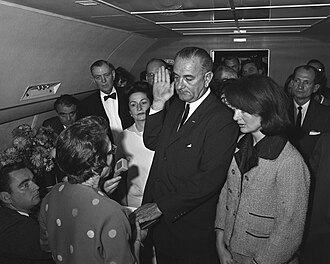
Johnson being sworn in on Air Force One

Key Facts

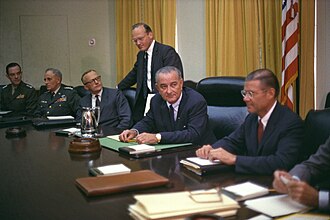
Johnson at a July 1965 Cabinet meeting
  • Presidency: November 22, 1963 – January 20, 1969.
  • Major Legislation: Civil Rights Act of 1964, Voting Rights Act of 1965, and the Economic Opportunity Act of 1964.
  • Healthcare: Established Medicare and Medicaid via the Social Security Amendments of 1965.
  • Foreign Policy: Oversaw the escalation of the Vietnam War and Operation Rolling Thunder.
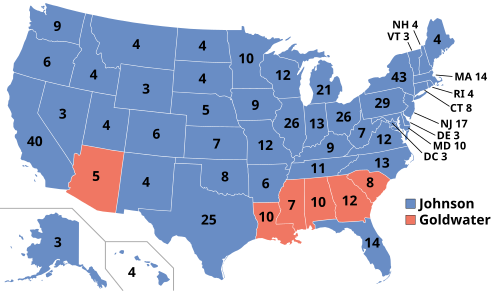
  • 1964 Election: Won a landslide victory against Barry Goldwater with 61% of the popular vote.
  • Judicial Milestone: Appointed Thurgood Marshall as the first African American Supreme Court Justice in 1967.

The Great Society and Domestic Reform
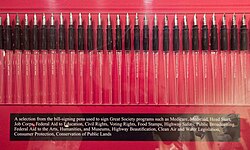
A collection of Esterbrook fountain pens used to sign Great Society legislation by Johnson

President Johnson envisioned a "Great Society" where the government played an active role in ensuring social justice and economic opportunity. Central to this vision was the War on Poverty, launched through the Economic Opportunity Act of 1964. This initiative created programs such as the Job Corps to provide vocational training and Head Start to offer early childhood education.
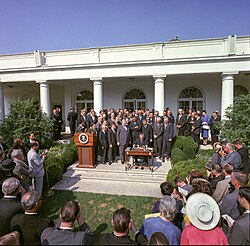
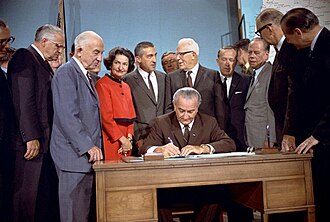
Johnson signing the Economic Opportunity Act of 1964

Civil Rights and Social Justice

Johnson's presidency marked a turning point in the American struggle for equality. He signed the Civil Rights Act of 1964, which outlawed discrimination based on race, color, religion, sex, or national origin. This was followed by the Voting Rights Act of 1965, which aimed to overcome legal barriers at the state and local levels that prevented African Americans from exercising their right to vote.
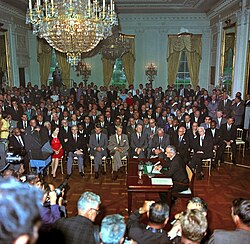
President Johnson speaks to a television camera at the signing of the Civil Rights Act in 1964

Furthering these efforts, Johnson signed the Civil Rights Act of 1968 and appointed Thurgood Marshall to the Supreme Court in 1967, breaking a long-standing racial barrier in the highest court in the land.
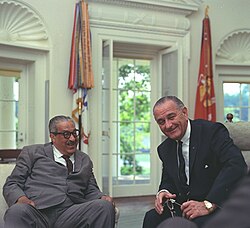
Appointed by Johnson in 1967, Thurgood Marshall (left) became the first African American on the Supreme Court

Healthcare, Education, and the Environment

The administration expanded the social safety net significantly. The Social Security Amendments of 1965 created Medicare (health insurance for the elderly) and Medicaid (health insurance for low-income individuals). In addition to healthcare, Johnson focused on urban renewal through the Department of Housing and Urban Development (HUD) and environmental conservation, signing the National Wild and Scenic Rivers Act in 1968.
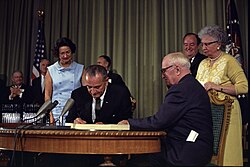
Johnson signs the Social Security Amendments of 1965 while seated next to former President Harry S. Truman

Other notable legislative achievements included the Immigration and Nationality Act of 1965, which reformed the nation's immigration system, and the Public Broadcasting Act of 1967.
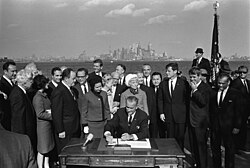
President Johnson signs the Immigration and Nationality Act of 1965 as U.S. Senators Edward Kennedy and Robert F. Kennedy, and others look on

Foreign Affairs and the Vietnam War

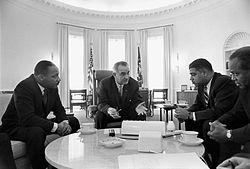
Johnson meeting with civil rights leaders Martin Luther King Jr. (left), Whitney Young, and James Farmer in 1964

While domestic policies flourished, Johnson's foreign policy was dominated by the Cold War and the escalating conflict in Vietnam. Following the Gulf of Tonkin Resolution, the U.S. increased its military presence, leading to massive bombing campaigns such as Operation Rolling Thunder.

Tens of thousands of Vietnamese civilians were killed during the bombing of North Vietnam in Operation Rolling Thunder.[226]

Despite consultations with "the Wise Men" (his group of foreign policy advisors) and National Security Advisor Walt Rostow, the war became a source of intense domestic unrest. The Tet Offensive of 1967 and subsequent military stalemates eroded public support and led to widespread anti-war demonstrations across the United States.
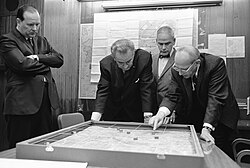
Walt Rostow, Johnson's national security advisor, meeting with Johnson in the Situation Room in 1968, where the two reviewed a map of the region where the Battle of Khe Sanh was being waged

Global Diplomacy

Beyond Vietnam, Johnson maintained active international relations, making eleven trips to twenty different countries. He engaged with Soviet Premier Alexei Kosygin at the Glassboro Summit Conference and met with leaders from Pakistan, Egypt, and various Latin American nations to navigate the complexities of the Cold War era.
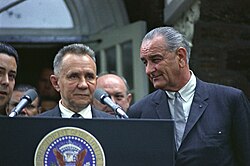
Soviet Premier Alexei Kosygin (left) next to Johnson during the Glassboro Summit Conference

Political Transition and Legacy

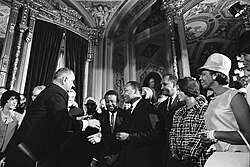
President Lyndon B. Johnson, Martin Luther King Jr., and Rosa Parks at the signing of the Voting Rights Act on August 6, 1965

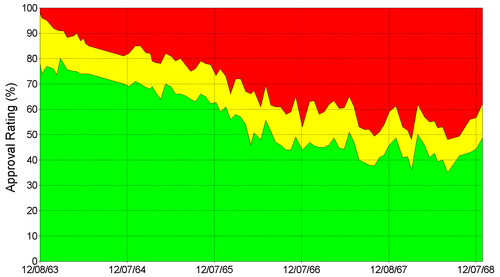
The combination of the Vietnam War and domestic urban riots—such as the 1965 Watts riot and the 1967 Newark riots—severely impacted Johnson's approval ratings. In a surprising announcement in 1968, Johnson declared he would not seek re-election.
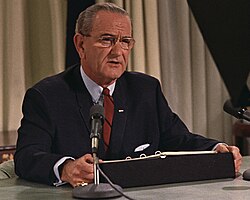
President Johnson's announcement that he would not run for re-election

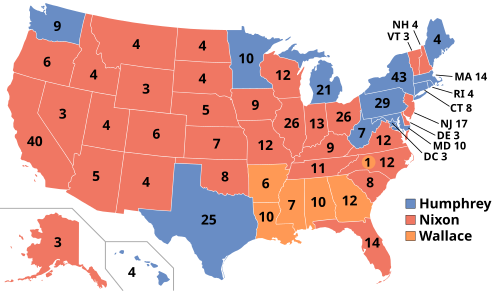
The 1968 election saw Republican Richard Nixon defeat Democrat Hubert Humphrey, marking the end of the Great Society era. Johnson retired to his ranch in Texas, leaving behind a complex legacy of transformative social legislation and a controversial military intervention.
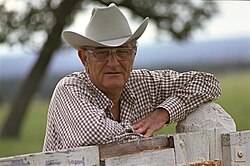
Johnson wearing a cowboy hat at his Texas ranch, c. 1972

Administration Summary

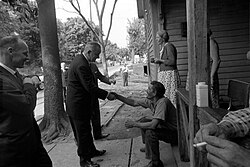
President Johnson's poverty tour in 1964
Overview of the Lyndon B. Johnson Administration
Category Key Details
Term 1963–1969
Political Party Democratic
Vice President Hubert Humphrey (1965–1969)
Primary Domestic Goal The Great Society / War on Poverty
Primary Foreign Conflict Vietnam War
1964 Election Result Landslide victory (61% popular vote)

Frequently Asked Questions
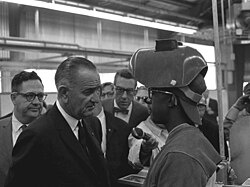
President Johnson speaks with a young welder in San Marcos, Texas, November 1965
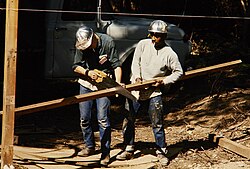
Two men working for Job Corps, a program established by the Economic Opportunity Act of 1964
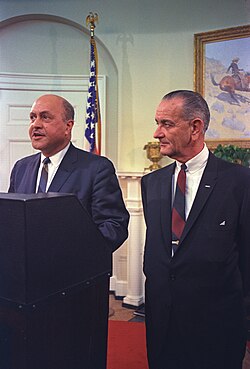
Johnson (right) with HUD Secretary Robert C. Weaver, 1966
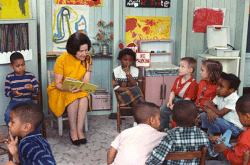
First Lady Lady Bird Johnson visits a Head Start class, 1966
President Johnson signs the National Wild and Scenic Rivers Act into law, c. October 2, 1968
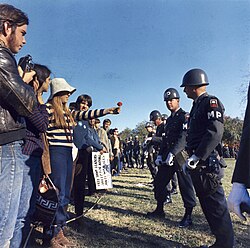
A female demonstrator offers a flower to a soldier during a 1967 anti-war demonstration at the Pentagon, Arlington County, Virginia.
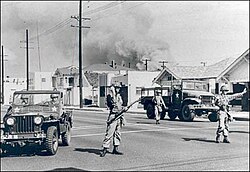
Soldiers direct traffic away from an area of South Central Los Angeles burning during the 1965 Watts riot
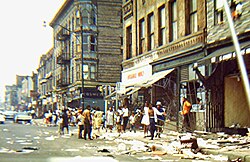
1967 Newark riots
1967 Newark riots
Public Broadcasting Act of 1967 exhibit at the LBJ Presidential Library
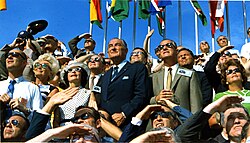
President Johnson and Vice President Spiro Agnew witnessing the liftoff of Apollo 11.
Johnson (center left) and Vice President Spiro Agnew (center right; with sunglasses) witness the liftoff of Apollo 11.
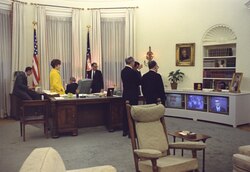
President Johnson and members of his staff watch TV news reports concerning the assassination of Martin Luther King Jr. on April 4, 1968
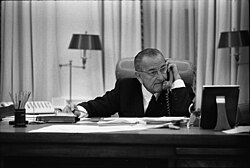
Johnson on a telephone call in the Oval Office.
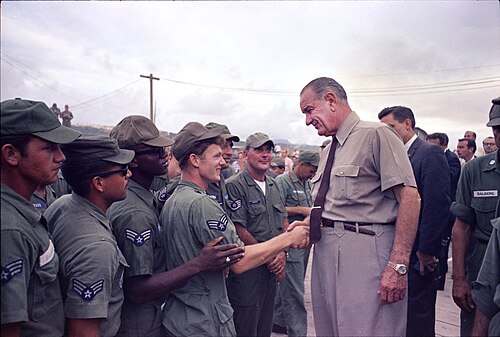
President Johnson shakes hands with U.S. airmen at Cam Ranh Bay in South Vietnam, c. October 1966
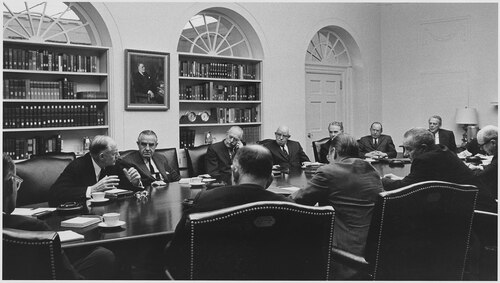
Johnson meets with a group of foreign policy advisors, collectively called "the Wise Men," discuss the Vietnam War effort.
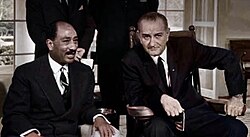
Johnson and Egyptian Parliament Speaker Anwar Sadat at the White House, 1966
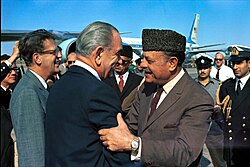
Johnson met with President of Pakistan Ayub Khan.
Johnson made eleven international trips to twenty countries during his presidency.[300]
Graph of Johnson's Gallup approval ratings
President Johnson defeated Republican Barry Goldwater in the 1964 presidential election. President Johnson was elected to a full term in one of the largest landslide election victories in American history, winning 61% of the popular vote, receiving 43,129,040 votes to Goldwater's 27,175,754 votes. President Johnson won an even larger Electoral College victory, winning 486 electoral votes to 52 for Goldwater.
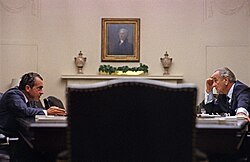
President Johnson meets with Richard Nixon in July 1968
Republican Richard Nixon defeated Democrat Hubert Humphrey in the 1968 presidential election

What was the Great Society?

The Great Society was a set of domestic programs launched by President Lyndon B. Johnson to eliminate poverty and racial injustice. It included the War on Poverty, the creation of Medicare and Medicaid, and significant investments in education and urban development.

Which civil rights laws did LBJ sign?

President Johnson signed three landmark pieces of legislation: the Civil Rights Act of 1964, the Voting Rights Act of 1965, and the Civil Rights Act of 1968.

How did the Vietnam War affect Johnson's presidency?

The war led to a significant decline in Johnson's approval ratings and sparked widespread domestic unrest and anti-war protests. This political pressure was a primary factor in his decision not to run for re-election in 1968.

Who was the first African American Supreme Court Justice?

Thurgood Marshall was appointed to the Supreme Court by President Johnson in 1967, becoming the first African American to serve on the court.

What was the result of the 1964 Presidential Election?

Lyndon B. Johnson defeated Republican Barry Goldwater in one of the largest landslide victories in U.S. history, winning 486 electoral votes to 52 and 61% of the popular vote.

References

  1. Johnson was vice president under John F. Kennedy and became president upon Kennedy's assassination on November 22, 1963. As this was prior to the adoption of the Twenty-fifth Amendment in 1967, a vacancy in the office of vice president was not filled until the next ensuing election and inauguration.
  2. Johnson later signed the Age Discrimination in Employment Act of 1967, which extended protection against age discrimination in employment to individuals over the age of 40. The Pregnancy Discrimination Act of 1978 and the Americans with Disabilities Act of 1990 would prohibit employment discrimination on the basis of pregnancy and disability, respectively.
  3. Patterson (1996), pp. 525–530.
  4. Patterson (1996), pp. 436–439.
  5. Bornet (1983), pp. 4–5