Lyndon B. Johnson: The Architect of the Great Society and the Vietnam Era
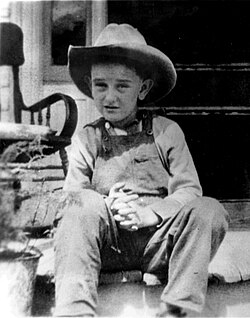
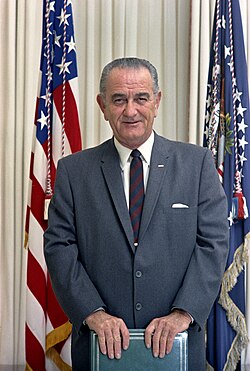
Lyndon Baines Johnson, the 36th President of the United States, remains one of the most complex figures in American political history. From his humble beginnings in the Texas Hill Country to the highest office in the land, Johnson was defined by an unrelenting drive for power and a profound desire to reshape the American social contract. His presidency was a study in contradictions: marked by the triumphant passage of landmark civil rights legislation and the devastating escalation of the Vietnam War.
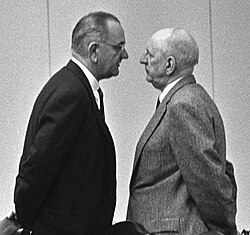
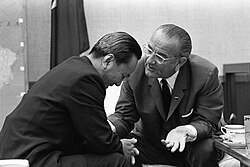
Before ascending to the presidency, Johnson spent decades mastering the machinery of government. He served as a member of the U.S. House of Representatives and later as a U.S. Senator from Texas, where he eventually rose to become the Senate Majority Leader. Known for his intimidating personal style—often referred to as "The Treatment"—Johnson was a master legislator who knew how to manipulate and motivate his colleagues to achieve his goals.
Key Facts
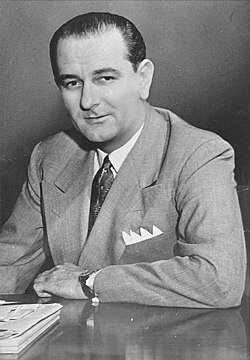
- Presidency: Served as the 36th U.S. President from November 22, 1963, to January 20, 1969.
- Legislative Legacy: Signed the Civil Rights Act of 1964 and the Voting Rights Act of 1965.
- Social Programs: Launched the "Great Society" and the "War on Poverty."
- Military Service: Served in the U.S. Navy during World War II and was awarded the Silver Star.
- Political Rise: Served as U.S. Senator, Senate Majority Leader, and Vice President under John F. Kennedy.
The Path to Power
Johnson's political journey began in Texas, where he served in the House of Representatives from 1937 to 1949. His transition to the Senate was marked by one of the most controversial elections in U.S. history; in 1948, he won the Democratic runoff primary by a mere 87 votes.
![Results of the Democratic runoff primary in the 1948 U.S. Senate election in Texas by county. Johnson squeaked out a controversial victory by 87 votes.[53] Johnson counties appear in blue, and Stevenson counties in green.[54] Johnson Johnson—>90% Johnson—80–90% Johnson—70–80% Johnson—60–70% Johnson—50–60% Stevenson Stevenson—50–60% Stevenson—60–70% Stevenson—70–80% Stevenson—80–90% Stevenson—>90% No vote No vote](/images/e9/d4/e9d4577a5be506a65ff02baa00a40375a6829aefb27f3f3b3425b92e813671fa.webp)
In the Senate, Johnson's ascent was rapid. He moved from freshman senator to Majority Whip and eventually to Senate Majority Leader by 1955. His ability to command the legislative process made him a formidable force in Washington, eventually leading to his selection as John F. Kennedy's running mate in the 1960 presidential election.
![Johnson (right) with President Franklin D. Roosevelt (left) and Texas governor James Burr V Allred (center) in 1937; he later used an edited version of this photo with Allred airbrushed out in his 1941 senatorial campaign.[30]](/images/45/e4/45e44266cf5306a0431280f2419e64204fc7ce1da7e9f7881c69f5b523745aea.png)
Military Service and Early Career
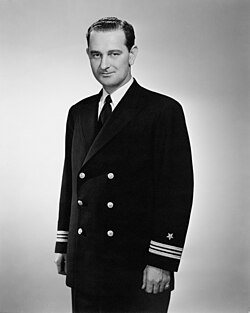
During World War II, Johnson served as a lieutenant commander in the United States Navy Reserve. His active duty from 1941 to 1942 included participation in the Invasion of Salamaua–Lae, for which he received the Silver Star.
The Presidency and the Great Society

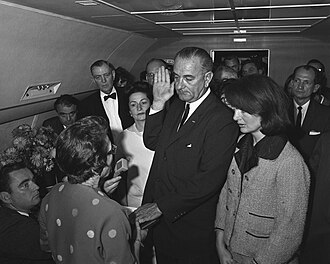
Johnson assumed the presidency on November 22, 1963, aboard Air Force One, following the assassination of President John F. Kennedy. He sought to honor Kennedy's legacy while implementing his own ambitious vision for America, which he termed the Great Society—a set of domestic programs aimed at eliminating poverty and racial injustice.
Civil Rights and Social Reform
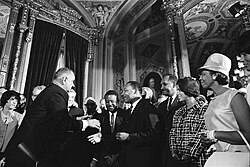
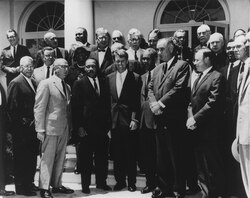
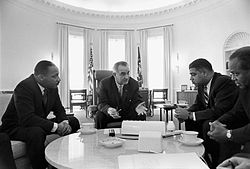
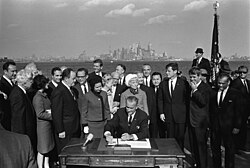
The centerpiece of Johnson's domestic agenda was the fight for civil rights. He worked closely with leaders like Martin Luther King Jr. to pass the Civil Rights Act of 1964, which outlawed discrimination based on race, color, religion, sex, or national origin. This was followed by the Voting Rights Act of 1965, which aimed to overcome legal barriers at the state and local levels that prevented African Americans from exercising their right to vote.
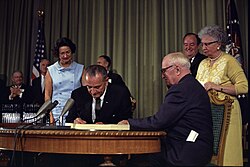
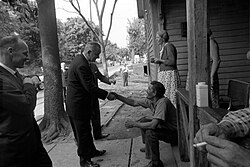
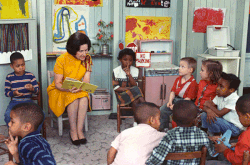
Beyond civil rights, Johnson's "War on Poverty" introduced a variety of initiatives to support the underprivileged, including the creation of Head Start for early childhood education and the establishment of Medicare and Medicaid to provide healthcare for the elderly and low-income individuals.
Environmental and Educational Progress
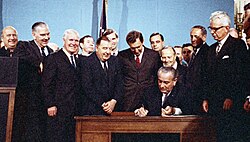
Johnson's legislative reach extended to the environment and education. He signed the Clean Air Act and the Wilderness Act, reflecting an early national commitment to ecological preservation. In education, the Higher Education Act of 1965 expanded access to college for millions of students.
The Vietnam War and Political Decline
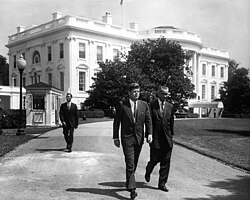
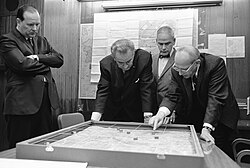
While Johnson achieved historic success domestically, his presidency was increasingly overshadowed by the escalation of the Vietnam War. Beginning with the deployment of troops and the bombing of North Vietnam under Operation Rolling Thunder, the conflict became a source of intense national division.
![Tens of thousands of Vietnamese civilians were killed during the bombing of North Vietnam in Operation Rolling Thunder.[276]](/images/2f/61/2f613f3a9735cdf4f27ae86672ef1a2199d6751ac84e800058e2e830e6bf91d8.jpg)
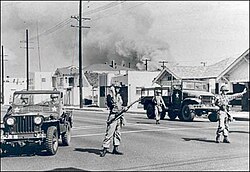
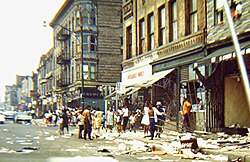
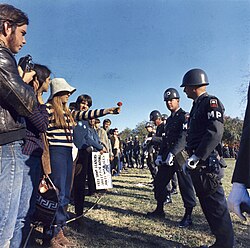
As casualties rose and the Tet Offensive of 1968 revealed the instability of the situation, public support for the war plummeted. The conflict led to widespread protests and urban riots in cities like Los Angeles and Newark, creating a climate of social unrest that eroded Johnson's political capital.
The toll of the war and the growing backlash led Johnson to make the stunning announcement in 1968 that he would not seek re-election. He left office in January 1969, succeeded by Richard Nixon.
Summary of Major Legislation
The following table outlines the most significant laws signed by President Johnson during his tenure.
| Year | Act/Law | Primary Focus |
|---|---|---|
| 1963 | Clean Air Act | Environmental Protection |
| 1964 | Civil Rights Act | Ending Racial Discrimination |
| 1964 | Economic Opportunity Act | War on Poverty |
| 1965 | Voting Rights Act | Expanding Voting Access |
| 1965 | Social Security Act (Medicare/Medicaid) | Healthcare Reform |
| 1965 | Immigration and Nationality Services Act | Immigration Reform |
| 1968 | Gun Control Act | Firearms Regulation |
Frequently Asked Questions
What was the "Great Society"?
The Great Society was a set of domestic programs launched by President Johnson in the 1960s. Its primary goals were the total elimination of poverty and racial injustice through federal funding for education, healthcare, and civil rights.
How did LBJ become President?
Lyndon B. Johnson became the 36th President of the United States upon the assassination of President John F. Kennedy on November 22, 1963. He was sworn in aboard Air Force One.
What was the "Johnson Treatment"?
The "Johnson Treatment" refers to LBJ's unique and aggressive style of persuasion. He would use his physical presence, intense focus, and deep knowledge of his colleagues' weaknesses to pressure them into supporting his legislative goals.
What was the impact of the Vietnam War on his presidency?
The Vietnam War significantly damaged Johnson's popularity and legacy. The escalation of the conflict, high casualty rates, and subsequent civil unrest led to a loss of public trust, eventually prompting him to decline running for re-election in 1968.
Which civil rights laws did LBJ sign?
President Johnson signed the landmark Civil Rights Act of 1964, which prohibited discrimination, and the Voting Rights Act of 1965, which aimed to protect the voting rights of minorities.