Longline Fishing: Techniques, Environmental Impacts, and Mitigation
Longline fishing, or longlining, is a commercial angling technique that utilizes a primary main line equipped with numerous baited hooks. These hooks are attached at regular intervals via shorter branch lines known as snoods or gangions. A snood is typically connected to the main line using a swivel or clip, with the hook positioned at the opposite end.
Depending on the target species, a single longline can hold hundreds or even thousands of baited hooks. This scale of operation allows longliners—specialized fishing vessels—to efficiently target high-value species such as tuna, swordfish, halibut, and sablefish.
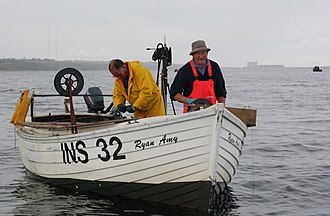
Types of Longline Gear
Longlines are primarily classified by their position in the water column and how they are deployed. The two main categories are:
- Pelagic Longlines: These are set to hang near the ocean surface to capture migratory species like tuna and swordfish.
- Demersal Longlines: These are positioned along the sea floor to target groundfish such as cod or halibut.
Deployment methods vary; lines may be anchored to a specific spot or left to drift with the current. In some deep-water operations, such as those targeting sablefish (also known as black cod), gear is set at depths exceeding 1,100 metres (3,600 ft). Additionally, some longlines are modified with traps instead of hooks for deep-water crab fishing.
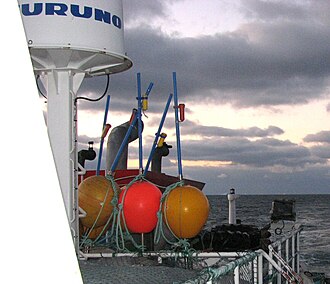
Regional Variations in Scale
The scale of longlining varies significantly based on the stability of the fishery. In unstable fisheries, such as those for Patagonian toothfish, regulations may limit fishermen to just 25 hooks per line. Conversely, in robust fisheries within the North Pacific and Bering Sea, commercial vessels may deploy over 2,500 hand-baited hooks on a single series of connected lines spanning several miles.
Historically, in Hawaii, this practice was known as "flagline fishing" after Japanese immigrants introduced it in 1917. The name derived from the use of flags to mark the floats. The terminology shifted to "longline fishing" as the industry adopted modern monofilament lines, hydraulic reels, and automated line setters.
Key Facts
- Target Species: Primarily tuna, swordfish, halibut, and sablefish.
- Depth Range: From the ocean surface (pelagic) to over 1,100 metres deep (demersal).
- Bycatch Risk: High risk for dolphins, sea turtles, sharks, and seabirds.
- Albatross Impact: Approximately 8,000 albatrosses are killed annually by longlines.
- Pollution: Fishing gear accounts for roughly 10% of the total weight of oceanic plastic.
- Worker Safety: Non-fatal injury rates for longline employees are roughly three times the U.S. average.
The Challenge of Incidental Catch
The most controversial aspect of longlining is bycatch—the incidental capture of non-target species or immature juveniles of the target species. While longlining is generally less damaging than deep-sea trawling, it still poses significant threats to marine wildlife.
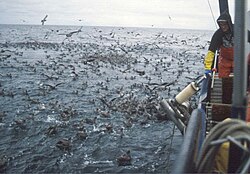
Seabirds are particularly vulnerable during the setting of the line, as they are attracted to the bait or offal (fish waste) discharged by the vessel. Albatrosses are among the most affected; of the 22 recognized species, 15 are threatened with extinction. The IUCN lists the waved albatross and Tristan albatross as Critically Endangered.
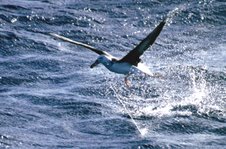
Mitigation Strategies
To reduce incidental mortality, several mitigation techniques have been implemented:
- Weighted Lines: Ensuring lines sink rapidly to move them out of reach of birds.
- Deterrents: Using streamer lines or lasers to scare away seabirds.
- Timing: Setting lines at night or limiting fishing to the southern winter when birds are not feeding young.
- Gear Modification: Switching to large circle-hooks and specific baits (such as mackerel-type) to reduce sea turtle bycatch.
In Hawaii, the swordfish fishery faced closures in 2000 and 2006 due to loggerhead sea turtle bycatch limits. While the tuna fishery is recognized by the UN Code of Responsible Fishing as one of the best managed in the world, it still faces criticism for the bycatch of false killer whales and pressure on bigeye tuna stocks.
Environmental and Safety Concerns
Plastic Pollution
Longline equipment contributes significantly to oceanic pollution. According to Greenpeace, macroplastics (pieces larger than 20 cm) are largely composed of fishing gear like drift nets and longlines. It is estimated that fishing industry equipment makes up about 10% of the total weight of all oceanic plastic, much of which is attributed to illegal and undocumented fishing.
Furthermore, these lines shed microplastics. Research from the University of Plymouth indicates that while new lines shed 20 fragments per yard towed, 10-year-old lines shed 760 fragments. This results in an estimated annual release of between 326 million and 17 billion microplastic fragments from fishing boats.
Occupational Safety
Longlining is a high-risk profession. A U.S. study found that the risk of non-fatal injuries for full-time equivalent employees is 35 per 1,000, which is approximately three times higher than the average U.S. worker, though slightly lower than the risk found in the trawler fleet (43 per 1,000).
Summary of Longline Fishing Characteristics
| Feature | Pelagic Longline | Demersal Longline |
|---|---|---|
| Water Column Position | Surface / Upper layers | Sea floor (Benthic) |
| Primary Targets | Tuna, Swordfish | Halibut, Cod, Sablefish |
| Max Depth | Shallow to Mid-water | Exceeding 1,100 metres |
| Key Bycatch Risks | Seabirds, Sea Turtles, Sharks | Groundfish, Benthic organisms |
Frequently Asked Questions
What is the difference between a main line and a snood?
The main line is the primary long cable deployed by the vessel, while the snoods (or gangions) are the shorter branch lines that attach the actual baited hooks to that main line.
Why is longline fishing dangerous for albatrosses?
Albatrosses are attracted to the bait or fish offal released during the setting of the lines. They often become hooked and subsequently drown.
How do circle-hooks help reduce sea turtle bycatch?
Gear modifications, specifically the transition to large circle-hooks and mackerel-type baits, have been shown to significantly eliminate the incidental capture of sea turtles in certain fisheries.
How does longlining contribute to microplastic pollution?
Fishing lines shed plastic fragments as they are towed through the water. This shedding increases as the gear ages; for example, 10-year-old lines shed significantly more microplastics than new ones.
Is longlining safer than trawling for workers?
Statistically, yes. While longlining has a higher injury rate than the average U.S. worker (35 per 1,000), it is lower than the injury rate found in the trawler fleet (43 per 1,000).