Bottom Trawling: Methods, Environmental Impacts, and Global Regulations
Bottom trawling, often referred to as "dragging," is a commercial fishing method that involves towing a heavy net along the seafloor to capture fish and other marine organisms. Because of its scale and efficiency, it is one of the most productive fishing methods globally, but it is also one of the most controversial due to its physical impact on the ocean floor.
To understand this practice, scientists distinguish between two primary types: benthic trawling, where the net is towed directly on the very bottom of the ocean, and demersal trawling, where the net is towed just above the benthic zone. This differs from midwater (or pelagic) trawling, which targets species like mackerel and anchovies higher in the water column.
Bottom trawling targets groundfish (bottom-living fish) and semi-pelagic species, including cod, shrimp, squid, and rockfish.
Key Facts
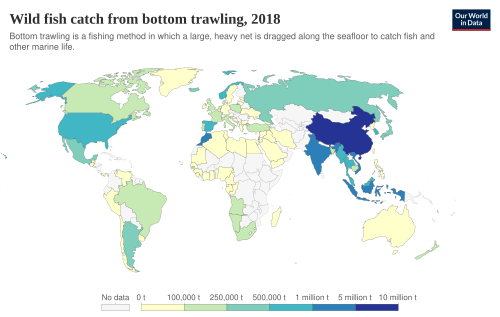
- Global Yield: Estimated at over 30 million tonnes per year, making it the largest fishing method by volume.
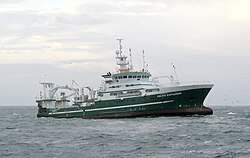
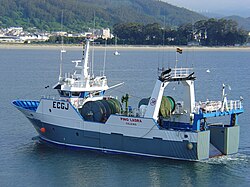
- Vessel Range: Trawlers vary from small 30 hp boats to massive 10,000 hp factory ships.
- Environmental Risk: High-impact gear can remove up to 41% of seabed biota per pass.
- Carbon Footprint: Some estimates suggest it releases 600 to 1,500 million tons of CO2 annually, though these figures are debated.
- Critical Depth: Ecological damage is reported to increase significantly at depths beyond 600 metres (2,000 ft).
The Evolution of Trawling
Trawling has been used for centuries. One of the earliest recorded conservation complaints dates back to 1376, when a petition to the English Parliament sought to ban the "wondyrchoum," an early beam trawl consisting of a wooden beam and a net measuring 6 metres long by 3 metres wide.
By the late 19th century, the UK had over 3,000 sailing trawlers. While steam power eventually emerged, sailing trawlers remained economically viable in the UK until the 1920s and continued to operate in Scandinavia and the Faroe Islands into the 1950s.
Fishing Gear and Techniques
Trawling can be performed by a single vessel or through pair trawling, where two vessels work cooperatively to tow a larger net.
Beam Trawling
Beam trawls use a rigid wooden or metal beam to keep the mouth of the net open as it is dragged across the seabed.
Otter Trawling
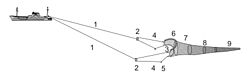
Otter trawls use "otter boards" (heavy plates) that act like wings, using water pressure to spread the mouth of the net horizontally without the need for a rigid beam.
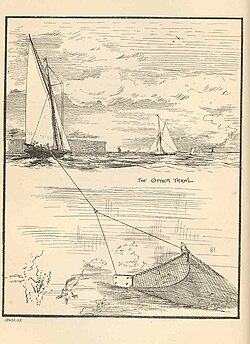
For midwater targets, a pelagic otter trawl is used, which utilizes floats on the headline to keep the net suspended in the water column rather than on the floor.
Environmental Consequences
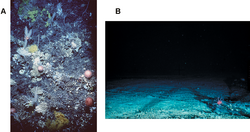
The physical act of dragging heavy gear across the ocean floor causes significant disruption to seabed communities. This is particularly devastating for slow-growing, deep-water corals such as Lophelia pertusa, which provide critical habitats for diverse deep-sea organisms.
Research indicates that the level of damage depends heavily on the gear used. Otter trawls are estimated to remove about 6% of biota per pass, while hydraulic dredges are far more destructive, removing up to 41%.
Biogeochemical Impacts
Beyond the immediate destruction of coral and fauna, bottom trawling alters the chemistry of the ocean floor. Studies have found that trawled canyon sediments contain 52% less organic matter than undisturbed areas, with an 80% reduction in sea worms and a 50% loss in species diversity.
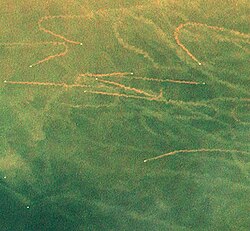
There is also significant concern regarding carbon release. A 2021 paper estimated that disturbing the seafloor releases between 600 and 1,500 million tons of carbon dioxide annually—comparable to the emissions of the global aviation industry or the country of Germany. However, these estimates remain highly uncertain and have been criticized by some as overestimates.
Global Regulations and Restrictions
Due to these impacts, various nations and international bodies have implemented restrictions to protect vulnerable marine ecosystems.
| Region/Entity | Restriction Measure | Primary Goal |
|---|---|---|
| United States | Closed areas (e.g., Rockfish Conservation Area) | Protect overfished rockfish and sensitive habitats |
| Mediterranean (GFCM) | Ban below 1,000 metres; closed areas off Italy, Cyprus, Egypt | Protect deep-sea ecosystems |
| New Zealand | Closed 19 seamounts; proposed ban in 30% of EEZ | Protect seamount biodiversity |
| Hong Kong | Total ban on trawling (effective Dec 2012) | Restore devastated fish stocks and ecosystems |
Despite these regional efforts, international attempts to implement a comprehensive global ban on high-seas bottom trawling have largely been ineffective.
Frequently Asked Questions
What is the difference between benthic and demersal trawling?
Benthic trawling involves towing a net directly on the ocean floor, while demersal trawling involves towing the net just above the benthic zone.
Which fishing gear causes the most seabed damage?
Among the gear types analyzed, hydraulic dredges have the largest impact, removing approximately 41% of biota per pass, whereas otter trawls have a smaller impact at roughly 6%.
How does bottom trawling affect carbon emissions?
Bottom trawling disturbs carbon stored in the seafloor. While some studies suggest emissions equivalent to the aviation industry (600-1,500 million tons of CO2), these figures are subject to scientific debate and uncertainty.
What are turtle excluder devices?
These are modifications to trawl gear designed to reduce bycatch by allowing non-target species, such as sea turtles, to escape the net while retaining the target catch.
Why is the 600-metre depth mark significant?
Research suggests that 600 metres (2,000 ft) is a critical threshold beyond which the ecological damage caused by bottom trawling increases significantly.