Overfishing: Causes, Ecological Impacts, and Global Recovery Efforts
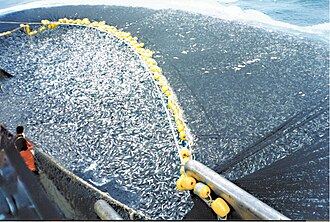
Overfishing occurs when aquatic animals—primarily fish—are removed from a body of water at a rate faster than the species can naturally replenish its population. This overexploitation leads to populations becoming increasingly underpopulated, affecting water bodies of all sizes, from small ponds and rivers to the vast open oceans. When fishing pressure exceeds biological limits, it results in resource depletion, reduced growth rates, and dangerously low biomass levels.
In severe cases, particularly with industrial-scale commercial fishing, populations may hit a point of critical depensation. This is a threshold where a fish population is no longer able to sustain itself, potentially leading to extirpation (local extinction) or total species extinction. Beyond the loss of individual species, the removal of apex predators, such as sharks, can destabilize entire marine ecosystems.
Key Facts
- Global Decline: The fraction of biologically sustainable fish stocks dropped from 90% in 1974 to 66.9% in 2015.
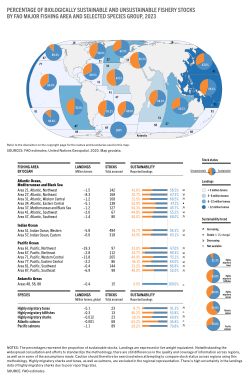
- Current Status: As of 2023, the FAO reported that 62.4% of assessed stocks are biologically sustainable.
- Bycatch Impact: Unintended species capture (bycatch) accounts for approximately 25% of all marine catch.
- Species Loss: Global abundance of oceanic sharks and rays has declined by 71% since 1970.
- Critical Regions: The Mediterranean and Black Seas have historically shown some of the highest percentages of unsustainable stocks.
The Mechanics of Overfishing
Overfishing is not a uniform process; it manifests in several distinct biological forms that impact the population differently:
- Growth Overfishing: Occurs when fish are harvested before they can reach their full growth potential, reducing the total yield.
- Recruitment Overfishing: Happens when the adult population is depleted to a point where there are not enough parents to produce a sufficient next generation.
- Ecosystem Overfishing: The removal of a target species causes a collapse or significant shift in the broader ecosystem's balance.
Ecosystem Shifts and Carrying Capacity
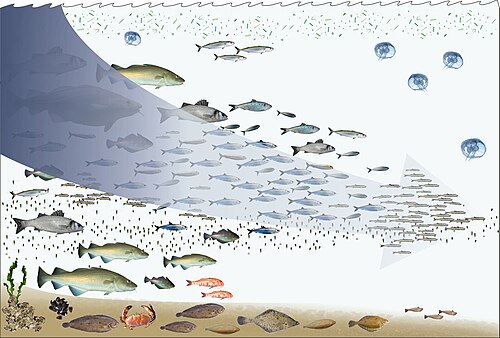
The ability of a fishery to recover depends on its carrying capacity—the maximum population size the environment can sustain—and existing ecological conditions. If a species is depleted too severely, an ecosystem shift may occur. In this scenario, a different species may exploit the vacancy in the competitive equilibrium. For example, if trout are overfished, carp may take over the habitat, making it biologically impossible for the trout population to re-establish itself.
Industrial Impact and Environmental Damage
Since the 1950s, the expansion of global fishing enterprises has intensified pressure on nearly all fisheries. One of the most destructive methods is bottom dragging, where heavy nets scrape the ocean floor. This process devastates slow-growing benthic species (bottom-dwellers) like coral and sponges, which provide essential habitats for many commercial fish species.
Another critical issue is bycatch, the collateral capture of non-target species. These animals are often returned to the ocean already dead or fatally injured. In shrimp fisheries, the mass of bycatch can be five times larger than the mass of the shrimp actually harvested.
Evidence of Population Collapse
Historical data provides stark evidence of the consequences of overexploitation:
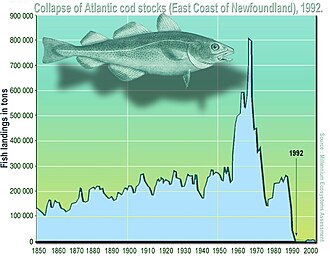
- Atlantic Cod: Severe overfishing in the 1960s and 70s led to a total population collapse in 1992.
- Peruvian Anchoveta: A combination of overfishing and El Niño events caused a crash in the 1970s, with catches dropping from 10.2 million metric tons in 1971 to roughly four million tons over the following five years.
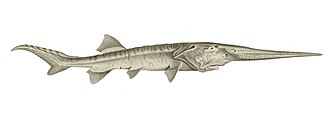
- Blue Walleye: This species became extinct in the Great Lakes during the 1980s due to overfishing, competition with introduced rainbow smelt, and anthropogenic eutrophication (nutrient pollution).
- Scombridae: Between 1970 and 2010, stocks of mackerel, tuna, and bonitos fell by 74%.
![Global trends in the state of the world's marine fish stocks, from FAO's Statistical Yearbook 2020[7]](/images/3c/78/3c788d0ca06c619fe2a5732cdecf4392af97cfae2623d28d1cee17785f050f8e.webp)
![Overfishing can deplete key reef species and damage coral habitat. Coral reef fish are a significant food source for over a billion people worldwide.[14]](/images/35/97/3597db27dcf6ab821a79ea1061cde12d2d627971dd372eb2510bf42eea9c4619.png)
Global Trends and Sustainability
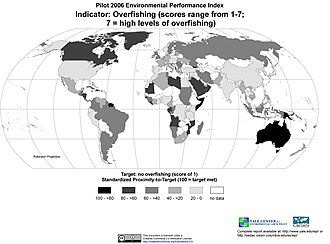
The state of the world's fisheries varies significantly by region. While the Northwest and Southwest Pacific have maintained lower proportions of unsustainable stocks (13% to 17%), other areas like the Southeast Pacific and Southwest Atlantic have struggled with much higher rates of depletion.
| Year | Sustainable Stocks (%) | Unsustainable Stocks (%) |
|---|---|---|
| 1974 | 90% | 10% |
| 2015 | 66.9% | 33.1% |
| 2023 | 62.4% | 37.6% |
Strategies for Mitigation and Recovery
To reverse these trends, several management and consumer-led strategies are employed:
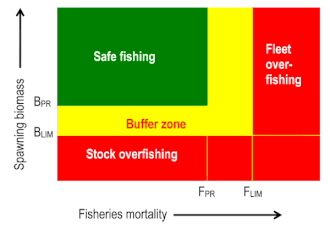
- Government Regulation: Implementing Harvest Control Rules (HCR) to mandate rebuilding plans when biomass falls below specific reference points.
- Subsidy Removal: Eliminating financial incentives that encourage overcapacity in fishing fleets.
- Aquaculture: Developing sustainable fish farming to reduce pressure on wild stocks.
- Consumer Awareness: Utilizing certifications like the Marine Stewardship Council (MSC) blue ecolabel to identify sustainably managed seafood.
![World capture fisheries and aquaculture production by species group, from FAO's Statistical Yearbook 2025[7]](/images/f2/06/f2062448ee75a1e6c4ff65b2fb119b12d3ecbd3bd3484299b168b538267c7887.webp)
Frequently Asked Questions
What is the difference between recruitment and growth overfishing?
Growth overfishing occurs when fish are caught too young, before they reach their maximum size. Recruitment overfishing occurs when the adult population is so depleted that it can no longer produce enough offspring to maintain the population.
How does bycatch affect the ocean?
Bycatch involves the accidental capture of non-target species, which often results in the death of millions of animals, including sharks, turtles, and dolphins, disrupting the food web and reducing biodiversity.
Can an overfished population always recover?
Not necessarily. Recovery depends on the environment's carrying capacity. If an ecosystem shift occurs—where a different species takes over the niche of the overfished species—the original population may be unable to re-establish itself.
What is the "Tragedy of the Commons" in fishing?
It is an economic theory where individual fishers, acting in their own self-interest, deplete a shared resource (the ocean), even though it is clear that it is not in anyone's long-term interest for the resource to disappear.
How can consumers help reduce overfishing?
Consumers can look for independently certified sustainable seafood labels, such as the MSC blue label, and stay informed about which species are currently overexploited in their region.