Lithography: The Evolution of Planographic Printing
Lithography is a planographic method of printing—meaning the printing surface is flat—originally based on the chemical principle that oil and water do not mix. Invented in 1796 by the German author and actor Alois Senefelder, this technique revolutionized the production of musical scores and maps before evolving into a cornerstone of both commercial printing and fine art.
Unlike other methods that rely on physical grooves or raised surfaces, lithography uses chemical properties to determine where ink adheres to a page. While traditional methods used limestone, modern iterations utilize metal plates and sophisticated photographic processes to achieve high-speed, high-volume output.
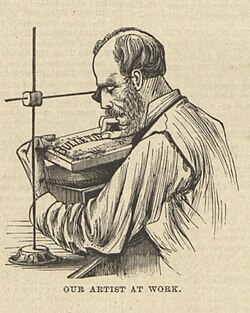
Key Facts
- Inventor: Alois Senefelder in 1796.
- Core Principle: The immiscibility (mutual repulsion) of oil and water.
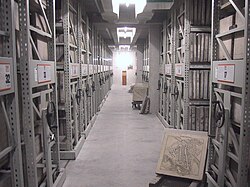
- Traditional Material: Lithographic limestone.
- Modern Standard: Offset lithography using metal plates and rubber cylinders.
- Artistic Impact: Enabled the rise of the modern poster and limited edition fine art prints.
The Traditional Limestone Process
Traditional lithography begins with a smooth, flat slab of lithographic limestone. The artist draws an image onto the stone using a greasy substance, such as wax crayons, oil, or fat. This creates a hydrophobic (water-repelling) area on the stone's surface.
To prepare the stone for printing, it is treated with an "etch"—a mixture of gum arabic and a weak acid (nitric acid). This process makes the non-image areas hydrophilic (water-attracting). When the printer moistens the stone, water adheres only to these etched areas, while the greasy image repels it.
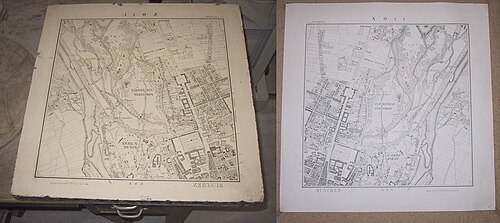
An oil-based ink is then rolled over the surface. Because oil is repelled by water, the ink sticks only to the original greasy drawing. Finally, a sheet of paper is pressed against the stone, transferring the ink to create the final print.
Chromolithography and Color
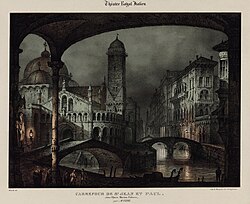
While early lithography was primarily monotone, Godefroy Engelmann introduced chromolithography in 1837. This process involved using a separate stone for each color. The primary challenge was maintaining registration, ensuring that each color layer aligned perfectly with the others. This technique became famous for creating the bold, flat-color poster designs of the late 19th century.
Modern Commercial Lithography
In contemporary industry, heavy stones have been replaced by flexible aluminum, polyester, or mylar plates. These plates are coated with a photosensitive emulsion. Through a process called photolithography, a photographic negative is exposed to ultraviolet light, or a laser is used in a computer-to-plate (CTP) device to create the image directly from digital data.
Offset Printing
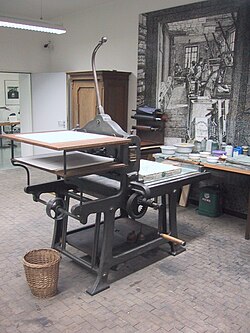
Most modern books and magazines are produced via offset lithography. In this variation, the inked image is not transferred directly from the plate to the paper. Instead, it is "offset" onto a rubber blanket cylinder, which then transfers the ink to the paper. This prevents the paper from becoming too wet and allows for high-speed, automated production.
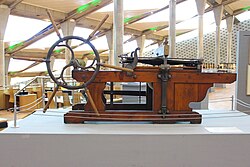
Comparison of Printing Methods
| Method | Surface Type | Mechanism | Common Use |
|---|---|---|---|
| Lithography | Flat (Planographic) | Chemical repulsion of oil/water | Posters, Books, Fine Art |
| Intaglio (Gravure) | Recessed | Ink held in engraved cavities | Banknotes, Fine Art |
| Letterpress/Woodblock | Raised | Ink applied to raised surfaces | Early Books, Stamps |
Lithography as an Artistic Medium
By the 1820s, artists like Delacroix and Géricault adopted lithography for its versatility. In the 1890s, Jules Chéret, the "father of the modern poster," used color lithography to inspire a new generation, including Toulouse-Lautrec. In the 20th century, the Atelier Mourlot in Paris became a hub for masters such as Picasso, Matisse, and Chagall, who worked directly on stones to create original artworks in limited editions.
Some artists also utilize the serilith process, a mixed-media approach combining lithography with serigraphy (screen printing) to create complex, limited-edition prints.

Frequently Asked Questions
What is the main difference between traditional and offset lithography?
Traditional lithography transfers ink directly from a stone or plate to paper. Offset lithography transfers the ink from the plate to a rubber blanket cylinder first, and then to the paper, allowing for faster production and drier paper.
Why is limestone used in traditional lithography?
Lithographic limestone has a specific porosity that allows it to hold both the greasy image and the hydrophilic gum arabic layer, which is essential for the chemical repulsion process to work.
What is a "limited edition" in lithographic art?
A limited edition is a specific number of prints produced from a single stone or plate. Once the edition is complete, the plate is typically destroyed or marked to maintain the rarity and value of the prints.
How does photolithography differ from traditional drawing?
Instead of drawing by hand with wax or grease, photolithography uses light-sensitive chemicals and UV light (or lasers) to transfer a photographic image onto a printing plate.
What is the purpose of gum arabic in the process?
Gum arabic, often mixed with a weak acid, creates a hydrophilic layer on the non-image parts of the stone, ensuring those areas attract water and repel the oily printing ink.