Mikhail Tomsky: The Rise and Fall of a Soviet Trade Union Leader
Mikhail Tomsky was a pivotal figure in the early Soviet labor movement, rising from a childhood of extreme poverty to the highest echelons of political power in the USSR. A master lithographer by trade and a revolutionary by conviction, Tomsky's life mirrored the turbulent trajectory of the Russian Revolution—marked by early idealism, strategic political alliances, and a tragic end during the Stalinist purges.
Early Life and Working-Class Roots
Born in Kolpino, Saint Petersburg Governorate, Tomsky was raised in a poor working-class family. His father was a metal worker and his mother a seamstress. This background made him a hereditary proletarian, a term later favored by Soviet historians to describe those born into the industrial working class.
Tomsky's formal education was minimal. After a single year at a private boarding school and three years at a public elementary school—where he graduated at the top of his class—his education ended. His family could not afford the 50 ruble tuition required for secondary school.
At age 12, Tomsky entered the workforce illegally as an apprentice box maker, earning 5 kopecks a day. After a workplace injury led to his dismissal, he spent several years working in tobacco, metal, and engineering factories. By age 14, he participated in his first strike at the Rouss–Smirnov engineering works, an event that resulted in his unemployment for several months.
Tomsky eventually specialized in chromolithography (the process of color printing). By 1901, at age 21, he became a master lithographer. His skill was so well-regarded that his portrait was featured on a 1903 professional advertisement poster. This success provided him with financial stability, allowing him to rent his own apartment and marry into a prosperous family.
The Path to Revolution (1903–1907)
Tomsky's political awakening began in 1903 through illegal revolutionary literature. By 1904, he joined a kruzhok (a revolutionary socialist study circle) affiliated with the Russian Social Democratic Labour Party (RSDLP). He aligned himself with the Bolshevik wing, the more aggressive and youthful faction of the party.
His political activities quickly cost him his livelihood; in July 1904, he was fired for reading Iskra, the official RSDLP newspaper, and was subsequently blacklisted. This forced him to move to Revel (now Tallinn, Estonia), where he worked as a lithographer at the Zvezda plant.
In Revel, Tomsky emerged as a powerful orator and leader. He was elected to the Council of Factory Elders and helped organize a ten-day general strike in October 1905. Following the October Manifesto issued by Tsar Nikolai II, Tomsky chaired the Revel Metal Workers' Union and served on the Presidium of the Revel Council of Workers' Deputies.
The regime's crackdown in 1906 led to Tomsky's arrest and administrative exile to Parabel in the Tomsk Oblast of western Siberia. After escaping exile, he utilized the RSDLP underground network to return to Saint Petersburg, adopting the pseudonym "Tomsky" (meaning "man from Tomsk").
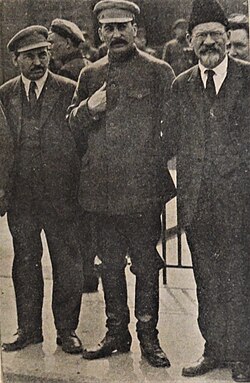
Upon his return, Tomsky focused on trade unionism, establishing the Engravers' and Chromolithographers' Union in 1907 and merging it with the Lithographers' and Printers' Union. By 1907, he was a member of the St. Petersburg Committee of the Bolshevik Party, working alongside leaders like Grigory Zinoviev.
Exile, Revolution, and Political Ascent
The years between 1908 and 1917 were marked by cycles of arrest and exile. Tomsky was exiled to France in 1908, returned in 1909, and was subsequently sentenced to five years of hard labor. He was finally released by the Provisional Government following the February Revolution of 1917 and played an active role in the October Revolution in Moscow.
In 1918, Tomsky advocated for a fundamental shift in labor relations. At the Fourth All Russian Conference of Trade Unions, he argued that the new Commissariat for Labour should no longer act as a neutral arbitrator between labor and capital, but rather as the champion of the working class's economic policy.
His political rise was rapid: he was elected to the Central Committee in 1919, the Orgburo in 1921, and the Politburo in 1922.
Power Struggles and Demise
During the 1920s, Tomsky allied with moderates Nikolai Bukharin and Alexey Rykov. This group initially partnered with Joseph Stalin to purge the United Opposition—led by Leon Trotsky, Lev Kamenev, and Grigory Zinoviev—following Vladimir Lenin's death in 1924.
However, by 1928, Stalin turned against his former allies. At the April 1929 Plenary Meeting of the Central Committee, Tomsky was defeated and forced to resign as the leader of the trade union movement. He was reassigned to manage the Soviet chemical industry until 1930.
Tomsky's influence continued to wane; he lost his Politburo seat in 1930 and was demoted to a candidate member of the Central Committee in 1934. His final role was heading the State Publishing House from 1932 to 1936.
In August 1936, during the First Moscow Trial, Tomsky was accused of having terrorist connections. To avoid arrest by the NKVD (the Soviet secret police), he committed suicide by gunshot at his dacha in Bolshevo. Before his death, he claimed that Genrikh Yagoda had driven him toward the opposition.
Key Facts
- Early Career: A master lithographer whose professional portrait was used in a 1903 industry advertisement.
- Political Identity: A "hereditary proletarian" who rose through the Bolshevik party and the trade union movement.
- Key Roles: Member of the Politburo (from 1922) and leader of the Soviet trade union movement.
- Political Shift: Initially an ally of Stalin against Trotsky, he was later purged by Stalin in 1929.
- Death: Committed suicide in 1936 to avoid arrest during the Great Purge.
- Rehabilitation: Posthumously cleared of all charges and reinstated into the Communist Party in 1988.
| Period | Role/Status | Key Event/Location |
|---|---|---|
| 1894 | Factory Worker | First strike at Rouss–Smirnov works |
| 1901 | Master Lithographer | Achieved professional renown in St. Petersburg |
| 1904-1905 | Revolutionary Leader | Organized general strike in Revel (Tallinn) |
| 1906 | Political Exile | Exiled to Parabel, Tomsk Oblast |
| 1922 | Politburo Member | Reached the highest level of Soviet leadership |
| 1929 | Industry Manager | Forced to resign from trade union leadership |
| 1936 | State Publishing Head | Committed suicide to avoid NKVD arrest |
Frequently Asked Questions
What does the name "Tomsky" signify?
The name was a party pseudonym adopted by Mikhail Yefremov after he escaped administrative exile in the Tomsk Oblast. It literally means "man from Tomsk."
What was Tomsky's professional background before politics?
Tomsky was a highly skilled master lithographer (color printer). He was so successful in this trade that he was once featured on a professional advertisement poster in 1903.
How did Tomsky's relationship with Joseph Stalin change?
Tomsky was initially an ally of Stalin, helping him purge the United Opposition (including Trotsky) in the mid-1920s. However, by 1928, Stalin turned on Tomsky and the moderate wing of the party, forcing him out of power.
Why did Mikhail Tomsky commit suicide?
Tomsky committed suicide in 1936 to avoid being arrested by the NKVD after being accused of terrorist connections during the First Moscow Trial.
Was Tomsky ever exonerated?
Yes. Although he was found guilty of conspiracy posthumously in 1938, the Soviet government cleared him of all charges and reinstated his party membership in 1988 during Perestroika.