Kyushu: The Dynamic Gateway to Southern Japan
Known historically as the gateway to Japan due to its proximity to the Asian continent, Kyushu is the third-largest and most southerly of Japan's four main islands. From its volcanic peaks and steaming hot springs to its cutting-edge semiconductor industry, Kyushu blends ancient traditions with modern innovation. Whether referred to by its native name (meaning "nine provinces") or its historical titles like Chinzei ("West of the Pacified Area"), the region remains a vital cultural and economic hub in East Asia.

Geography and Natural Wonders
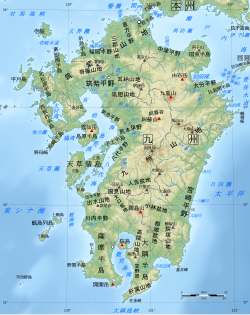
Kyushu is a land of dramatic contrasts, characterized by a mountainous interior and a sprawling coastline of 12,221 kilometers. The island is a center of intense tectonic activity—the movement of the Earth's crust—which has created a landscape rich in volcanic features and geothermal energy.
The region is home to Mount Aso, Japan's largest active volcano, standing at 1,591 meters. However, the highest point on the island is Mount Kujū, reaching an elevation of 1,791 meters. This volcanic nature has gifted Kyushu with numerous hot springs, most notably in Beppu on the east shore and around the central Aso region. In the north, mud hot springs host extremophile microorganisms, which are specialized life forms capable of surviving in extremely hot environments.
Regional Administration
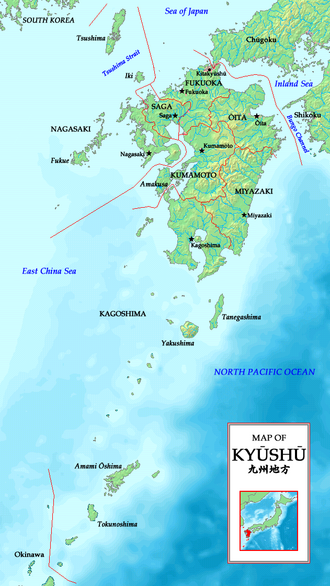
The name Kyushu is derived from the nine ancient provinces of the Saikaidō (West Sea Circuit): Chikuzen, Chikugo, Hizen, Higo, Buzen, Bungo, Hyūga, Ōsumi, and Satsuma. Today, the Kyushu Region is a political entity comprising seven prefectures on the main island and the southern Okinawa Prefecture.
- Northern Kyushu: Fukuoka, Kumamoto, Nagasaki, Ōita, and Saga Prefectures.
- Southern Kyushu: Kagoshima and Miyazaki Prefectures.
- Okinawa: Okinawa Prefecture.
Demographics and Urban Centers
As of October 2025, Kyushu has a population of 12,382,121. The population is heavily concentrated in the northwest, particularly in the major cities of Fukuoka and Kitakyushu, with corridors extending toward Sasebo, Nagasaki, Kumamoto, and Kagoshima. In contrast, the eastern seaboard remains sparsely populated, with the exception of Oita and Miyazaki.
While the region has seen a population decline since 2000, the trend is milder than in other parts of Japan. This is attributed to a relatively high Total Fertility Rate (TFR)—the average number of children born to a woman—among Ryukyuans in Okinawa and Kagoshima, as well as in other Kyushu prefectures.
| Feature | Detail |
|---|---|
| Total Area | 36,782.37 km² |
| Population (2025) | 12,382,121 |
| Highest Point | Mount Kujū (1,791 m) |
| Largest City | Fukuoka |
| Economic Contribution | Approx. 10% of Japan's total output |
| Time Zone | Japan Standard Time (UTC+9) |
Economy and Industrial Power
Kyushu's economy is the fourth largest in Japan, trailing only Tokyo, Osaka, and Nagoya. It maintains a balanced industrial structure that spans primary agriculture, secondary manufacturing, and tertiary services.
The region is a powerhouse for the automobile and semiconductor industries. Additionally, it is a leader in renewable energy research, specifically in solar power and hydrogen. To foster innovation, Fukuoka City, Kitakyushu City, and Okinawa Prefecture have been designated as National Strategic Special Zones to encourage entrepreneurship and start-ups.
Kyushu also maintains deep economic ties with Asia, with a high percentage of its exports and corporate expansions directed toward Asian markets. The ports of Hakata and Kitakyushu serve as critical logistics nodes, and the region handles over a quarter of Japan's cruise ship calls.
Specialized Industries and Space Exploration
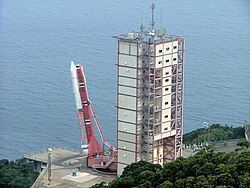
Beyond heavy industry, Kyushu is world-renowned for its porcelain, including styles from Arita, Imari, Satsuma, and Karatsu. The region also looks toward the stars; the island of Tanegashima is home to the Tanegashima Space Center, Japan's largest rocket-launch complex.
Infrastructure and Transportation
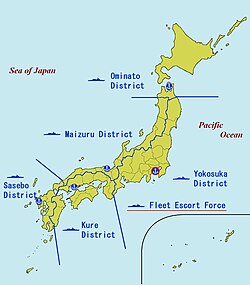
Kyushu is connected to the main island of Honshu via the Kanmon Straits. Travel between the islands is facilitated by the Kanmon Railway Tunnel, the Shin-Kanmon Tunnel (for the San'yō Shinkansen), the Kanmon Bridge, and the Kanmon Roadway Tunnel.
Within the island, the Kyushu Shinkansen provides high-speed rail links between Fukuoka and Kagoshima, with a newer extension reaching Nagasaki as of September 2022. For those seeking leisure, scenic trains like the Yufuin no Mori and Kawasemi Yamasemi offer picturesque journeys. Road travel is anchored by the Kyushu Expressway, while air travel is centered at Fukuoka Airport, the region's primary international and domestic hub.
Culture, People, and Heritage
The people of Kyushu are often characterized as conservative and proud. Men from the region are sometimes called Kyushu danji, a term evoking an image of strength and wildness that dates back to ancient times when it was used to encourage soldiers.
Artistic and Musical Traditions
Kyushu has long maintained strong cultural ties with Okinawa. This is evident in local folk songs and the use of the gottan, a traditional stringed instrument. The gottan is a hybrid between the mainland shamisen and the Okinawan sanshin, often utilizing a pentatonic scale (a musical scale consisting of five notes per octave) typical of Ryukyuan music.

Other notable crafts include Hakata-ori (weaving), Beppu bamboo crafts, Kurume Kasuri, and Sathuma Kiriko (cut glass).
Culinary Specialties
Kyushu cuisine is distinguished by the use of sweet soy sauce and barley miso. While the north focuses on seafood, the south is known for meat-based dishes.
- Fukuoka: Famous for Hakata ramen, motsunabe, and gameni.
- Nagasaki: Known for champon and sara udon.
- Kumamoto: Noted for karashi renkon (mustard lotus root) and dago jiru.
- Kagoshima: Specializes in keihan and abura-zōmen.
- Okinawa: Famous for goyā champurū and Okinawa soba.
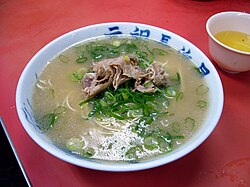
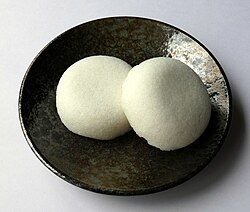
The region's sweets are generally sweeter than those in Honshu due to historical ties with Okinawa, a major sugar producer. Popular treats include Karukan, Umegae Mochi, and Ikinari Dango.
Education and World Heritage
Kyushu is a center of academic excellence, hosting several national universities, including Kyushu University (one of the former Imperial Universities) and the University of the Ryukyus. Private institutions like Ritsumeikan Asia Pacific University also contribute to the region's intellectual landscape.
The region's natural and historical significance is recognized by several UNESCO World Heritage sites:
- Natural Sites: Yakushima and the islands of Amami-Ōshima, Tokunoshima, northern Okinawa, and Iriomote.
- Cultural Sites: The Gusuku sites of the Ryukyu Kingdom, the Meiji Industrial Revolution sites, the Sacred Island of Okinoshima, and the Hidden Christian Sites in Nagasaki.