Higo Province: The Historical Heart of Kumamoto
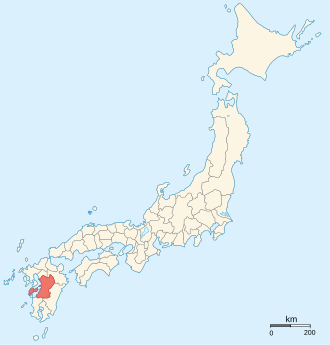
Long before the modern administrative boundaries of Japan were established, the land was divided into ancient provinces. Among these was Higo Province (Higo no Kuni), a region rich in martial history and cultural significance located on the island of Kyūshū. Today, the area once known as Higo corresponds to the modern-day Kumamoto Prefecture.
Geographically, Higo was positioned as a central hub in southern Japan, bordering the provinces of Chikugo, Bungo, Hyūga, Ōsumi, and Satsuma. In certain historical contexts, it was referred to as Hishū when mentioned alongside Hizen Province.
The Political Evolution of Higo
The governance of Higo Province shifted frequently through the centuries, reflecting the volatile nature of feudal Japan. For much of the Muromachi period (an era of Japanese history spanning roughly 1336 to 1573), the region was controlled by the Kikuchi clan. However, the stability of the Muromachi era gave way to the Sengoku period, known as the "Age of Warring States," during which the Kikuchi were dispossessed.
During this chaotic era, Higo became a contested territory occupied by various neighboring lords, including the powerful Shimazu clan of Satsuma. This period of instability ended when Toyotomi Hideyoshi invaded Kyūshū to unify the region. Hideyoshi initially granted Higo to his retainer Sassa Narimasa, and later to Katō Kiyomasa. Eventually, the lands were transferred to the Hosokawa clan, who served as the region's daimyō (powerful feudal lords).
Cultural and Intellectual Landmarks
Beyond its military history, Higo was a significant cultural crossroads. During the Sengoku period, the province emerged as a major center for Christianity in Japan. It also served as a sanctuary for intellectual and artistic pursuit.
One of the most famous figures associated with the province is the legendary swordsman, artist, and philosopher Miyamoto Musashi. At the invitation of Hosokawa Tadatoshi, the third lord of Kumamoto, Musashi stayed in Higo, where he completed his seminal work, The Book of Five Rings.
Transition to the Modern Era
The administrative structure of Japan underwent a radical transformation during the Meiji period, when the ancient province system was abolished and converted into prefectures. While maps were reformed in the 1870s to reflect these changes, the identity of Higo Province persisted in official capacities for several decades. Notably, Higo was still explicitly recognized in international diplomatic treaties signed with the United Kingdom and the United States in 1894.
Spiritual Heritage and Administration
Religion played a central role in the life of the province. The Aso-jinja served as the ichinomiya of Higo, a term referring to the highest-ranking or chief Shinto shrine within a province.
Administratively, Higo was divided into numerous districts. Many of these were reorganized or merged during the late 19th century to streamline local governance.
| District Name | Historical Status / Outcome |
|---|---|
| Akita | Merged with Takuma to become Hōtaku District (April 1, 1896) |
| Amakusa | Maintained as a district |
| Ashikita | Maintained as a district |
| Aso | Maintained as a district |
| Gōshi | Merged into Kikuchi District (April 1, 1896) |
| Kikuchi | Absorbed Gōshi District (April 1, 1896) |
| Kuma | Maintained as a district |
| Mashiki | Maintained as a district |
| Kamimashiki | Maintained as a district |
| Shimomashiki | Maintained as a district |
| Takuma | Merged with Akita to become Hōtaku District (April 1, 1896) |
| Tamana | Maintained as a district |
| Uto | Dissolved |
| Yamaga | Merged with Yamamoto to become Kamoto District (April 1, 1896) |
| Yamamoto | Merged with Yamaga to become Kamoto District (April 1, 1896) |
| Yatsushiro | Maintained as a district |