Kozani: A Journey Through the History and Culture of West Macedonia
Nestled in the heart of West Macedonia, Kozani stands as a vibrant administrative and economic hub that seamlessly blends ancient heritage with modern industrial growth. From its prehistoric roots to its current status as the "City of Books," Kozani's evolution reflects the broader historical currents of the Greek peninsula.
Ancient Roots and Early Settlements
The region surrounding Kozani has been inhabited since prehistoric times, with archaeological evidence spanning from the early Iron Age to the Byzantine period. In the eastern sector of the city, excavations have revealed an ancient necropolis. During the reign of Philip II of Macedon, the area was known as Elimeia, a part of Upper Macedonia, and is believed to have been the site of the town of Tyrissa.
Further evidence of early habitation can be found on Siopoto hill to the southwest, where a settlement called Kalyvia existed between 1100 and 1300. These early sites lay the foundation for the strategic importance the region would hold in later centuries.
The Ottoman Era and Economic Flourishing
Kozani likely began as a refuge for Christian settlers during the 14th and 15th centuries who moved from the Macedonian plains into the mountains following the Ottoman conquest. By 1392, the town attracted further settlers from Epirus, as well as numerous cattle-breeders.
The first official record of the town appears in an Ottoman register from 1528, describing a settlement of 91 houses. By 1530, it was recorded as a village within the kaza (administrative district) of Serfice. A pivotal figure in the town's growth was the chief shepherd Ioannis Trantas, who settled approximately 100 families. His son, Charisios Trantas, secured a firman (a royal decree) from the Sultan in 1664, which placed the town under the protection of the Sultan's mother, granting it special privileges and prohibiting Turkish settlement within the town.
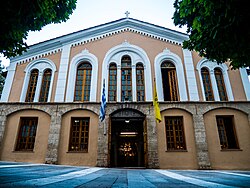
This period of protection sparked a cultural and economic golden age. In 1664, the St. Nicholas Cathedral (Agios Nikolaos) was constructed, followed by the establishment of a library and a renowned school in 1668. Trade with Central Europe further fueled the city's prosperity throughout the 17th and 18th centuries.
However, this growth was not without interruption. In 1770, internal conflicts between local residents and merchants in Central Europe, coupled with pillaging by Turkish beys, devastated the city. Another severe incursion occurred in 1830 under Arslan Bey.
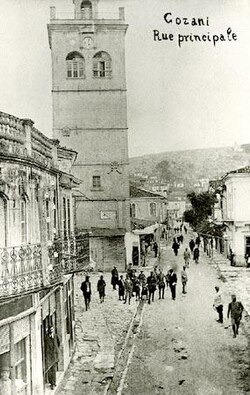
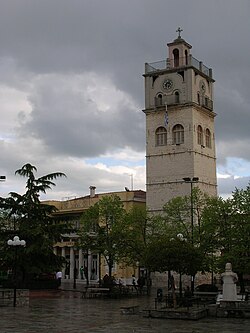
Despite these hardships, the city continued to build its identity. In 1855, a 26-meter bell tower was erected next to St. Nicholas Church. In 1939, this tower received its iconic clock, donated by the Greek-American Konstantinos Mamatsios.
Transition to Modern Greece
The geopolitical landscape shifted during the First Balkan War. Following the victory at the Battle of Sarantaporo, the Greek army entered Kozani on October 11, 1912. At that time, the town's population consisted of 12,000 Orthodox Greeks. The demographic makeup shifted again in 1923 during the population exchange between Greece and Turkey, which brought approximately 1,400 Greek families from Asia Minor and Pontus to the city.
In the 20th century, Kozani underwent a massive industrial transformation. The discovery and utilization of lignite (a soft, brown coal) reserves by the Public Power Corporation turned the city into Greece's primary producer of electrical power, driving rapid urban expansion.
Kozani Today: The City of Books
Modern Kozani is a blend of contemporary architecture and historic landmarks. The city is home to the "Valtadoreio" Gymnasium, the National Bank of Greece building, and the mansions of Grigorios Vourkas and Georgios Lassanis.
A crowning jewel of the city is the "Kovendareios" Municipal Library. As the second-largest library in Greece, it houses 150,000 books and rare documents, including a rare copy of Rigas Feraios' charter. This literary wealth led to the establishment of the Institute of Book and Reading and the city's official designation as the City of Books.
Key Facts
- Administrative Role: Serves as the commercial, economic, and transport center of West Macedonia.
- Literary Status: Known as the "City of Books" due to the Kovendareios Municipal Library.
- Industrial Power: A leading producer of electricity in Greece via lignite reserves.
- Landmark: The Mamatsios clock tower is the city's primary symbol.
- Historic Protection: A 1664 Sultan's firman once forbade Turkish settlement in the town.
| Period/Event | Key Detail | Significance |
|---|---|---|
| Antiquity | Elimeia / Tyrissa | Early Iron Age and Macedonian presence |
| 1528 | First Ottoman Record | Recorded as a settlement of 91 houses |
| 1664 | Sultan's Firman | Granted privileges and protection |
| 1912 | Balkan Wars | Integration into the Greek state |
| 1995 | Earthquake | 6.6 magnitude; caused property damage |
Frequently Asked Questions
Why is Kozani called the City of Books?
Kozani earned this title because of the Kovendareios Municipal Library, the second largest in Greece, and the establishment of the Institute of Book and Reading to promote literacy and culture.
What is the significance of the Mamatsios clock tower?
The tower is the symbol of the city. Originally built as a bell tower in 1855, the clock was added in 1939 through a donation by Konstantinos Mamatsios, a Greek-American.
How did the energy sector impact the city's growth?
The use of local lignite reserves by the Public Power Corporation transformed Kozani into the foremost producer of electrical power in Greece, leading to tremendous urban and economic growth in the 20th century.
Who were the primary settlers of Kozani during the Ottoman period?
The city was founded by Christian settlers from the plains of Macedonia, later joined by refugees from Epirus and cattle-breeders, including 100 families brought by Ioannis Trantas.
What happened to Kozani during the Balkan Wars?
The Greek army liberated the city on October 11, 1912, following their victory over the Ottoman army at the Battle of Sarantaporo.