Kingdom of Serbia
The Kingdom of Serbia (1882–1918) was a unitary parliamentary constitutional monarchy that played a pivotal role in the geopolitical transformation of the Balkans. Emerging from the Principality of Serbia, the kingdom navigated a complex landscape of imperial influences, shifting from a friendly relationship with Austria-Hungary to closer ties with the Russian Empire and France. Its journey was marked by territorial expansion, dynastic upheaval, and the eventual merger into the Kingdom of Serbs, Croats, and Slovenes.
Key Facts
- Duration: 1882 to 1918.
- Capital: Belgrade.
- Government: Unitary parliamentary constitutional monarchy.
- Currency: Serbian dinar.
- Dynasties: Ruled by the Obrenović dynasty until 1903, then the Karađorđević dynasty.
- Major Conflicts: Serbo-Bulgarian War, First and Second Balkan Wars, and World War I.
From Principality to Kingdom
Before becoming a kingdom, Serbia existed as a principality under the suzerainty of the Ottoman Empire. De facto independence was achieved in 1867 when the last Ottoman troops departed from Belgrade. Formal independence was later recognized by the Congress of Berlin in 1878, which also expanded Serbian territory to include the districts of Nišava, Pirot, Toplica, and Vranje.
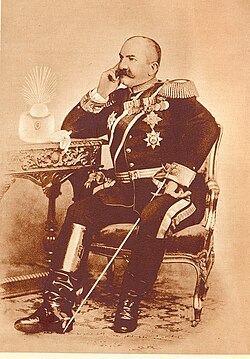
In 1882, the state was elevated to the status of a kingdom. The early years were characterized by the rule of the Obrenović dynasty, starting with King Milan I.
Dynastic Shift and the May Coup
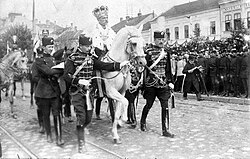
The political landscape shifted violently on the night of May 28–29, 1903, during the May Coup. King Alexander I and Queen Draga were assassinated in the Royal Palace in Belgrade, leading to the extinction of the House of Obrenović. This paved the way for the Karađorđević dynasty to take the throne, beginning with King Peter I.
Territorial Expansion and the Balkan Wars
Between 1912 and 1913, Serbia significantly enlarged its borders through the First and Second Balkan Wars. Following the Treaty of London (May 1913) and the Treaty of Bucharest (August 1913), Serbia annexed the Kosovo Vilayet, Vardar Macedonia, and Sandžak-Raška.
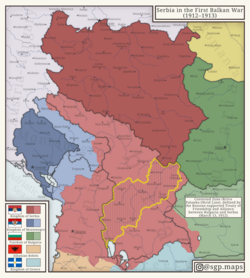
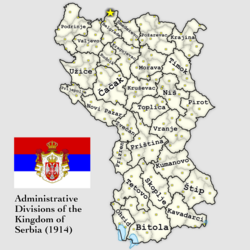
This expansion led to the creation of 11 new districts, including Bitola, Skopje, and Priština, to manage the newly liberated areas.
The Road to World War I
Tensions with Austria-Hungary escalated during the Bosnian Crisis (1908–1909), triggered when Austria-Hungary annexed Bosnia and Herzegovina—a region Serbia hoped to incorporate. Economic tensions also flared during the "Pig War" (1906–1909), a tariff war imposed by Austria-Hungary.
The spark for global conflict occurred on June 28, 1914, with the assassination of Archduke Franz Ferdinand in Sarajevo. The plot was orchestrated by the Black Hand, a secret organization of Serbian officers, with support from a network of civilians and military personnel.
The Great War and Occupation
By 1915, a combined invasion by German, Austro-Hungarian, and Bulgarian forces led to the occupation of Serbia. The Serbian Army, numbering 135,000 soldiers, executed a grueling retreat through Albania to the Greek island of Corfu. By 1916, they joined the Salonika front.
Administration and Economy
The Kingdom of Serbia utilized a parliamentary system, with the National Assembly serving as the legislature. The People's Radical Party, led by figures such as Nikola Pašić, became a dominant political force.
Economically, Serbia leveraged its geography as a trade bridge between Central Europe and the Middle East. A critical infrastructure milestone was the establishment of the Serbian Railways in 1881, with the Belgrade–Niš line opening in 1884 to facilitate strategic terrestrial routes.
| Rank | City/District | Approx. Population |
|---|---|---|
| 1 | Belgrade | 100,000 |
| 2 | Prizren | 60,000 |
| 3 | Bitolj | 54,000 |
| 4 | Skoplje | 50,000 |
| 5 | Niš | 25,000 |
The Formation of Yugoslavia
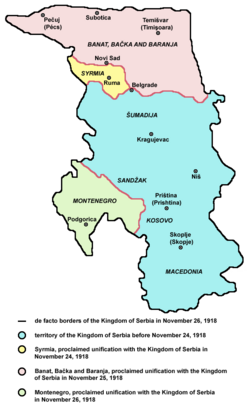
As World War I concluded in 1918, Serbia united with the Kingdom of Montenegro and Vojvodina. On December 21, 1918, the Kingdom of Serbia merged with the State of Slovenes, Croats, and Serbs to form the Kingdom of Serbs, Croats, and Slovenes (later renamed the Kingdom of Yugoslavia), continuing under the Karađorđević dynasty.
Frequently Asked Questions
When did Serbia officially become a kingdom?
Serbia was elevated from a principality to a kingdom in 1882.
What was the May Coup of 1903?
The May Coup was the assassination of King Alexander I and Queen Draga, which ended the rule of the Obrenović dynasty and brought the Karađorđević dynasty to power.
How did the Balkan Wars affect Serbia's size?
The First and Second Balkan Wars (1912–1913) greatly enlarged Serbian territory through the annexation of Vardar Macedonia, the Kosovo Vilayet, and Sandžak-Raška.
What was the "Pig War"?
The Pig War (1906–1909) was a trade conflict where Austria-Hungary imposed a tariff war on Serbia in response to Serbia's customs union with Bulgaria.
What happened to the Serbian Army during World War I?
After the 1915 occupation, 135,000 Serbian soldiers retreated through Albania and were evacuated to Corfu before joining the Salonika front in 1916.