Kaiserpfalz and Königspfalz: The Itinerant Palaces of the Holy Roman Empire
In the Early and High Middle Ages, the Holy Roman Empire did not operate from a single capital city. Instead, the exercise of power was mobile. This system relied on a network of palaces known as Königspfalz (royal palaces) or Kaiserpfalz (imperial palaces). These sites served as temporary seats of government, allowing the monarch to maintain a physical presence across a vast and fragmented territory.
Key Facts
- Itinerant Kingship: The practice of Reisekönigtum meant rulers traveled constantly to maintain personal bonds with vassals.
- Terminology: While often called Kaiserpfalz, the historically accurate term is Königspfalz, as the title of Emperor was only granted after a coronation in Italy.
- Core Components: A typical palace included a palas (main hall/Aula Regia), an imperial chapel, and a supporting estate.
- Strategic Location: Palaces were often placed near Roman urban remnants, navigable rivers, or every 30 kilometers (a day's journey).
- Decline: The system faded in the 13th century as rulers shifted toward heavily fortified hilltop castles for better security.
The Etymology of the Pfalz
The word Pfalz is derived from the Latin palatium, meaning palace. In German, Königspfalz combines König (king) and Pfalz. Although the term Kaiserpfalz (combining Kaiser, from Caesar, and Pfalz) is common today, it is largely a 19th-century designation. Historically, a ruler was first a King of Germany; he only became the Holy Roman Emperor after an Italienzug (expedition to Italy) and a papal coronation, which often occurred years after his accession.
The Tradition of Itinerant Kingship
Unlike the centralized monarchies that later developed in France and England, the Holy Roman Empire functioned as a Personenverbandsstaat—a state based on personal dependency. Sovereignty was not defined by fixed borders but by the personal relationships between the lord and his vassals.
This necessitated Reisekönigtum (travelling kingship) for three primary reasons:
- Political Control: The ruler had to personally renew bonds of loyalty and hold Hoftage (court days) to settle disputes and prove authority.
- Communication: In an era of poor roads and limited long-distance communication, the court had to be physically present to maintain control.
- Logistics: Before the 13th century, it was impossible to transport enough food to support hundreds of courtiers in one location for long periods. Consequently, the court traveled to where the food was produced.
While other European nations developed capitals like the Palace of Westminster or the Palais de la Cité, the Empire's elective monarchy meant kings came from diverse regions. They could not rely on a single home palace if they wished to control rebellious regional rulers. This mobile tradition lasted until the mid-16th century, when Ferdinand I established a main residence at the Vienna Hofburg, though Vienna never became the official imperial capital.
Architecture and Function of the Palaces
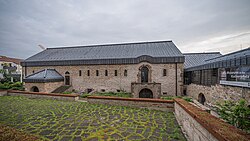
A pfalz was not a permanent home but a temporary stop, often used for only a few days or weeks. While some were modest hunting lodges, most were large manor houses (villa regia or curtis regia) capable of housing hundreds of staff and guests in wooden outbuildings surrounding a stone core.
The essential architecture of a pfalz included:
- Aula Regia: The Great Hall used for state business and imperial court sessions.
- Pfalzkapelle: An imperial chapel for religious services and festivals.
- Gutshof: An estate providing the necessary agricultural supplies.
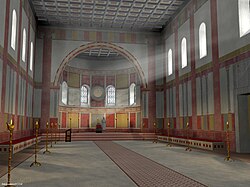
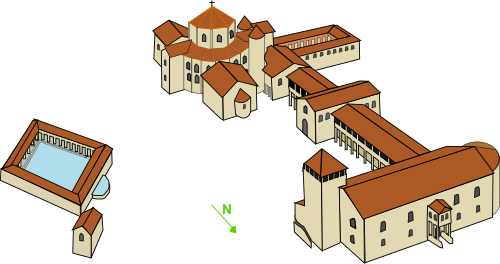
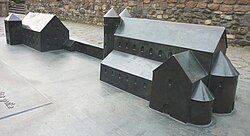
Palaces were categorized by their seasonal or ceremonial use. Winterpfalzen (winter palaces) were more comfortable and resource-rich for longer stays, while Osterpfalzen (Easter palaces), such as Quedlinburg, hosted major festivals. The Palace of Aachen was a notable exception; due to its hot springs which aided Charlemagne's rheumatism, it became his favorite residence and the site where over 30 kings were crowned over 600 years.
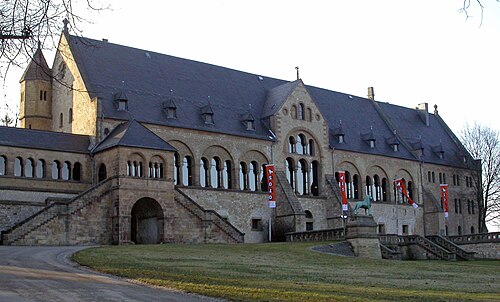
Other significant sites included the Imperial Palace of Goslar and the Royal Pfalz at Frankfurt, the latter serving as a critical location for imperial elections since 1147.
The Transition to Imperial Castles
The system of open, lowland palaces collapsed in the mid-13th century following the fall of the Hohenstaufens. During the subsequent interregnum, central authority weakened, leading to a rise in feuds and the emergence of "robber barons." The lightly fortified pfalzen were no longer secure.
Rulers shifted their preference to Reichsburgen (imperial castles)—heavily fortified hilltop strongholds like Nuremberg Castle or Trifels Castle. Additionally, kings began staying in free imperial cities, where wealthy patricians and bankers, such as Jakob Fugger, provided the luxury and loans necessary to fund imperial wars.
Summary of Imperial Residence Types
| Feature | Königspfalz (Royal Palace) | Reichsburg (Imperial Castle) |
|---|---|---|
| Primary Purpose | Administration and representation | Defense and security |
| Location | Valleys, river banks, or towns | Hilltops and strategic heights |
| Duration of Stay | Temporary/Itinerant | More permanent/Fortified |
| Key Structure | Aula Regia (Great Hall) | Keep and fortifications |
| Era of Dominance | Early to High Middle Ages | Late Middle Ages onwards |
Frequently Asked Questions
What is the difference between a Kaiserpfalz and a Königspfalz?
Historically, Königspfalz is the correct term because the ruler was a King of Germany before being crowned Emperor. Kaiserpfalz is a later term used to describe these sites retrospectively.
Why didn't the Holy Roman Empire have a fixed capital?
The empire used an itinerant system (Reisekönigtum) because the ruler needed to maintain personal relationships with vassals, communication was slow, and local food supplies could not support a permanent large court in one city.
What was the purpose of the Aula Regia?
The Aula Regia, or Great Hall, was the center of political life where the king held court sessions, met with the empire's nobility during Hoftage, and conducted state business.
Why were palaces often located near rivers?
Rivers like the Rhine, Main, and Danube allowed for faster travel and easier transport of supplies, making these locations more practical for a traveling court.
What led to the abandonment of the Pfalzen?
The lack of strong fortifications made them vulnerable during the political instability of the 13th-century interregnum, leading kings to favor hilltop castles for safety.