Duchy of Swabia
The Duchy of Swabia (Middle High German: Herzogtuom Swaben; Latin: Ducatus Allemaniæ) was one of the five primary stem duchies of the medieval German Kingdom. Emerging in the 10th century, it occupied the southwestern region of East Francia, an area originally settled by the Alemanni tribes during Late Antiquity.
While the term Swabia originates from the ancient Suebi people who lived between the Rhine and Danube rivers, the stem duchy encompassed a far more expansive territory. At its height, it stretched from the Alsatian Vosges mountains in the west to the right bank of the river Lech in the east, extending south to the Gotthard Pass and Chiavenna (Kleven). During the High Middle Ages, the names Swabia and Alamannia were often used interchangeably until the former became the dominant term around the 11th century.
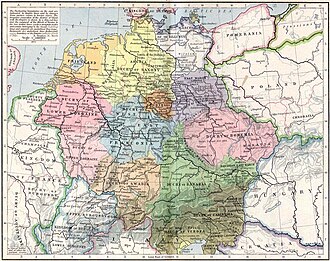
Key Facts
- Period: 915–1313 (with a period of abeyance between 1268 and 1289).
- Status: Stem duchy of East Francia and later a state of the Holy Roman Empire.
- Primary Dynasties: The Hohenstaufen family was the most prominent, ruling from 1079 to 1268.
- Geography: Spanned from the Vosges mountains to the river Lech and south to the Alps.
- Religion: Roman Catholicism.
- Languages: Latin and Swabian.
The Foundations of Alamannia
The roots of the duchy lie with the Alamanni tribes. In 496, King Clovis I defeated the Alamanni, incorporating them into Francia. They were governed by duces (military leaders) who remained dependent on Frankish kings. By the 7th century, the region converted to Christianity, leading to the establishment of bishoprics in Constance and Augsburg, as well as influential abbeys at Saint Gall and Reichenau Island.
Frankish control tightened over time. While the Alamanni maintained some independence in the 7th century, Pepin of Herstal conquered the territory in 709, and Charles Martel reinforced this dependence in 730. The "Blood Court at Cannstatt" in 746 effectively ended the old stem duchy, placing the region under full Frankish administration. Pepin the Short subsequently replaced tribal dukes with counts palatine, known as Kammerboten.
Formation and Early Governance
The duchy's medieval boundaries were defined by the Upper Rhine, Lake Constance, the High Rhine, and the Danube, ending at the Lech tributary. The river Lech served as the border with the Duchy of Bavaria, though the two regions maintained significant cultural and social exchange.
Following the Treaty of Verdun in 843, Alamannia became part of East Francia. As Carolingian power waned, local counts grew more independent, leading to a power struggle between the Hunfriding and Ahalolfing dynasties. In 915, the Ahalolfing count palatine Erchanger proclaimed himself duke after defeating King Conrad I at the Battle of Wahlwies. However, Erchanger was executed two years later.
Burchard II, a Hunfriding count, then assumed the ducal title. He solidified his authority by defeating King Rudolph II of Burgundy at the Battle of Winterthur in 919, preventing Burgundian expansion toward Lake Constance. His rule was eventually recognized by King Henry the Fowler.
The Hohenstaufen Era and Decline
After a period of shifting leadership under the Saxon house, the duchy came under the control of the Hohenstaufen family in 1077, starting with Frederick I. The Hohenstaufen were a powerhouse of medieval Europe, often serving as Holy Roman Emperors while simultaneously holding the Duchy of Swabia.
The duchy's territory gradually diminished. In the 12th century, the Margraviate of Baden detached itself following a long conflict with the House of Zähringen. The Hohenstaufen line eventually faltered; the last duke, Conradin, pledged his inheritance to Ulrich II, count of Württemberg, before his execution in 1268, leaving the duchy in abeyance.
A brief revival occurred when Rudolf of Habsburg, King of the Romans, bestowed the title on his son Rudolf II. This revived title passed to John Parricida, who died without an heir around 1312 or 1313, marking the definitive end of the Duchy of Swabia.
Legacy and Post-Ducal Transition
In 1500, Emperor Maximilian I organized the empire into Imperial Circles. The Swabian Circle largely mirrored the old stem duchy, though it excluded Alsace and territories held by the Old Swiss Confederacy. Upon the dissolution of the Holy Roman Empire, these lands were divided among the Kingdom of Bavaria, the Kingdom of Württemberg, and the Grand Duchy of Baden.
Today, the legacy of the duchy survives in the modern German state of Baden-Württemberg and the Bavarian Swabia Regierungsbezirk (administrative district) centered in Augsburg.
| Attribute | Details |
|---|---|
| Timeline | 915–1313 |
| Key Dynasties | Ahalolfing, Hunfriding, Hohenstaufen, Habsburg |
| Preceded by | Alamannia |
| Succeeded by | Württemberg, Baden, Old Swiss Confederacy, others |
| Major Cities/Centers | Augsburg, Constance, Zürich (early period) |
Frequently Asked Questions
What was a stem duchy?
A stem duchy was one of the primary tribal duchies of the early medieval German kingdom, based on the settlement areas of ancient Germanic tribes, such as the Alemanni in the case of Swabia.
Who were the most influential rulers of Swabia?
The Hohenstaufen family was the most notable dynasty, holding the duchy from 1079 to 1268 and frequently ascending to the position of Holy Roman Emperor.
How did the Duchy of Swabia end?
The original duchy ended in 1268 with the execution of Conradin. A later attempt by the Habsburgs to revive the title ended in 1313 when John Parricida died without an heir.
What modern regions correspond to the old duchy?
The territory is now primarily divided between the German state of Baden-Württemberg and the Bavarian Swabia region in Bavaria.
What was the significance of the Battle of Winterthur?
The 919 battle allowed Duke Burchard II to defeat King Rudolph II of Burgundy, securing the Thurgau region and establishing the duchy's independence from Burgundian claims.