Justin I: The Peasant Who Became Eastern Roman Emperor
The story of Justin I is one of the most remarkable social ascents in antiquity. Born into a peasant family in the province of Dardania, Justin rose from humble beginnings—possibly as a swineherd—to the highest office in the world: the Emperor of the Eastern Roman Empire. Reigning from 518 to 527, Justin not only stabilized the empire but also founded the Justinian dynasty, paving the way for his nephew, the legendary Justinian I.
Justin's journey was defined by military service and strategic political maneuvering. Despite speaking only rudimentary Greek and primarily Latin, he climbed the ranks of the army to become the commander of the imperial guard. When Emperor Anastasius I died in July 518, Justin outmaneuvered his rivals to be elected as the new emperor at the age of approximately 68.
Key Facts
- Reign: 9 July 518 – 1 August 527.
- Origin: Born c. 450 in Bederiana, near Naissus (modern Niš, Serbia).
- Dynasty: Founder of the Justinian dynasty.
- Religion: Fervent Chalcedonian Christian.
- Successor: His nephew and co-emperor, Justinian I.
- Major Achievement: Resolved the Acacian schism between the Eastern and Western churches.
Early Life and Rise to Power
Justin was of Thraco-Roman or Illyro-Roman descent. His early life in the hamlet of Bederiana provided little indication of his future imperial status. However, his entry into the military allowed him to gain the influence necessary to enter the inner circles of power in Constantinople.
His family ties were crucial to his legacy. His sister, Vigilantia, was the mother of Petrus Sabbatius Justinianus (later known as Justinian I). This familial connection ensured that Justin had a capable and ambitious protégé to help manage the complexities of the empire as he aged.
The Imperial Succession
The transition of power in 518 was swift. Following the death of Anastasius I, the high officials of the Great Palace and the citizens gathered in the Hippodrome of Constantinople to await the proclamation of a new leader. Justin's election was supported by those who favored his strong Chalcedonian position—a branch of Christianity that affirmed the dual nature of Christ—which stood in contrast to the Miaphysite leanings of his predecessor.
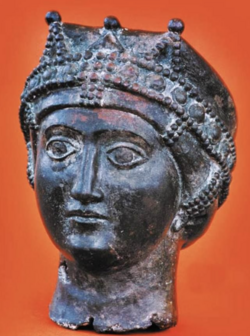
Upon his accession, his wife took the name Euphemia, likely chosen to honor a Christian martyr and signal the couple's religious devotion.
Foreign Affairs and Strategic Diplomacy
Justin's foreign policy was often a blend of religious motivation and strategic necessity, with his nephew Justinian increasingly taking the lead in later years.
Relations with the West and the Ostrogoths
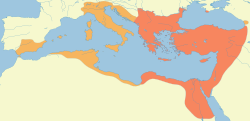
Initially, relations with Theodoric, the Ostrogothic king of Italy, were friendly. However, as Justin's anti-Arian (a sect considered heretical by Chalcedonians) policies intensified, stability decreased. By the time of Theodoric's death in 526, the relationship between the Empire and the Ostrogoths had become strained.
The Sassanid Frontier and Border States
The empire faced constant friction with the Sassanian Persians. Justin engaged in a complex game of influence over border states:
- Aksum: Justin likely encouraged Kaleb I of Aksum to expand into Himyar (modern Yemen) to remove Sassanian influence and protect Christian merchants.
- Iberia: The Georgian Principality of Iberia was encouraged to resist the Sassanians, though it was eventually subjugated as a Sassanian province in 522.
- Lazica: King Tzath of Lazica submitted to Justin, converted to Christianity, and married a Byzantine noblewoman to secure imperial protection.
Tensions with the Sassanids peaked when Justin refused to formally adopt the Persian prince Khosrow according to Roman custom, fearing it would give the prince a claim to the Byzantine throne. This led to a breakdown in negotiations and subsequent raids in Persian Armenia led by the generals Sittas and Belisarius.
Religious Reform and the Acacian Schism
One of Justin's most enduring legacies was the resolution of the Acacian schism, a long-standing rift between the Eastern church in Constantinople and the Western church in Rome. By endorsing the views of Pope Hormisdas regarding the nature of Christ, Justin ended the schism in 519.
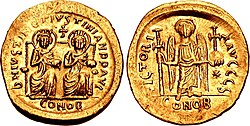
Justin also sought to explicitly redefine the Empire as a Christian state. He replaced pagan symbols, such as the goddess Victory, with images of angels on coins and seals, and declared that his election to the throne was by the favor of the Trinity.
Later Years and the Rise of Justinian
The final years of Justin's reign were marked by natural disasters and the gradual transfer of power. In 526, a massive earthquake destroyed Antioch, killing an estimated 250,000 people. Justin provided significant funding for the city's reconstruction.
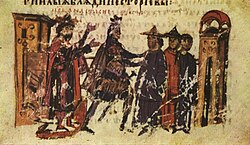
As his health declined, Justin focused on securing his succession. He issued an edict allowing repentant actresses to marry senators, which enabled Justinian to marry Theodora. In 525, Justinian was named caesar, and by April 527, he was formally named co-emperor. Justin I died on 1 August 527, leaving the empire to his nephew.
| Category | Details |
|---|---|
| Full Regnal Name | Imperator Caesar Flavius Iustinus Augustus |
| Reign Period | 518 – 527 AD |
| Primary Religion | Chalcedonian Christianity |
| Key Successor | Justinian I |
| Major Conflict | Sassanid Persians / Ostrogoths |
| Notable City Renaming | Caesarea to Justinopolis (525) |
Frequently Asked Questions
How did a peasant become the Eastern Roman Emperor?
Justin rose through the military ranks due to his competence and loyalty, eventually becoming the commander of the imperial guard. His position of power and his alignment with the Chalcedonian faith allowed him to be elected emperor after the death of Anastasius I.
What was the Acacian schism?
The Acacian schism was a religious divide between the Eastern and Western branches of the Christian church. Justin I resolved this by accepting the orthodox position of the papacy in Rome, reuniting the two branches in 519.
What was the relationship between Justin I and Justinian I?
Justin I was the uncle of Justinian I. He mentored Justinian, elevated him to various high offices (including consul and caesar), and eventually named him co-emperor and successor.
How did Justin I change the empire's coinage?
To emphasize the empire's Christian identity, Justin I removed pagan symbols from the reverse of coins and seals, replacing the figure of Victory with that of an angel.
What happened to the city of Justinopolis?
The city of Caesarea in Cilicia was renamed Justinopolis in 525 in honor of Justin I. It kept this name until the 12th century, when it was renamed Anazarbus by Thoros I.