Joseph Goebbels: The Architect of Nazi Propaganda
Joseph Goebbels was one of the most influential and destructive figures of the Third Reich. A skilled philologist and orator, he served as the chief propagandist for the Nazi Party and later as the Reich Minister of Public Enlightenment and Propaganda. His unwavering devotion to Adolf Hitler and his mastery of mass communication allowed him to shape the public consciousness of Nazi Germany, fueling extreme antisemitism and orchestrating the psychological machinery of the Holocaust.
Key Facts
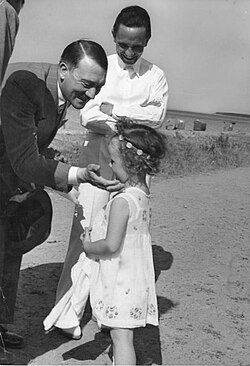
- Role: Reich Minister of Public Enlightenment and Propaganda (1933–1945).
- Education: PhD in philology from Heidelberg University.
- Influence: Centralized control over all German news, arts, and media.
- Ideology: Fierce advocate for the extermination of Jews and other targeted groups.
- Final Position: Chancellor of Germany (briefly, April 30 – May 1, 1945).
- Death: Committed suicide via cyanide poisoning or gunshot on May 1, 1945.
Early Life and Academic Foundations
![Old Synagogue Ohel Jakob [de], Munich, after Kristallnacht](/images/b1/8c/b18c6c9dd2fefaa517f6e7f88453b0cddb88aea17f0e753b0b59b54e478a83be.jpg)
Born on October 29, 1897, in Rheydt, Goebbels initially pursued a career as an author. He was highly educated, attending the universities of Bonn, Würzburg, and Freiburg before completing his doctorate in philology (the study of language in oral and written historical sources) at Heidelberg University in 1922. Interestingly, his doctoral thesis on the romantic dramatist Wilhelm von Schütz was guided by two Jewish professors, Friedrich Gundolf and Max Freiherr von Waldberg.
Despite his academic background, Goebbels joined the Nazi Party in 1924. By 1926, he was appointed Gauleiter (district leader) of Berlin, a position that allowed him to experiment with propaganda techniques to promote the party's agenda in the capital.
The Machinery of Propaganda
Following the Nazi seizure of power in 1933, Goebbels established the Ministry of Public Enlightenment and Propaganda. His primary objective was to centralize control over every aspect of German cultural and intellectual life. He aimed to move popular support for the party from 37 percent to a total of 100 percent, creating an illusion of absolute national unity for the rest of the world.
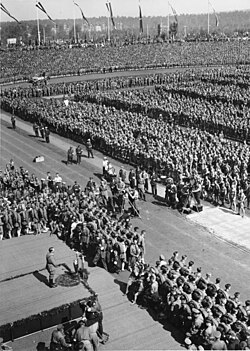
Goebbels was a pioneer in using modern technology for political manipulation. He leveraged the radio and film to cultivate a cult of personality around Adolf Hitler, presenting the Führer as an infallible, heroic leader. One of the most famous examples of this was the 1934 Nuremberg Rally, captured in Leni Riefenstahl's film Triumph of the Will.
His propaganda was not merely about glorification but also about dehumanization. He used the death of Horst Wessel in 1930 as a tool to attack "Communist subhumans" and later declared that Bolshevism was a war waged by "Jewish-led international subhumans" against culture.
![Goebbels used the death of Horst Wessel (pictured) in 1930 as a propaganda tool[86] against "Communist subhumans".[87]](/images/95/68/956807026fdd590b8aea02e9c335f0166726828dc86636ee1e1b194affac1921.jpg)
Control of Information and Culture
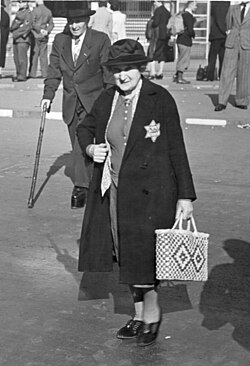
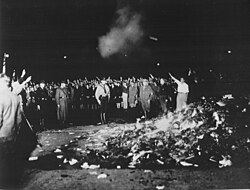
The ministry's reach extended to the burning of books and the strict censorship of the press. Goebbels orchestrated the 1933 boycott of Jewish businesses and utilized the media to justify the progressively harsher discrimination that led to the Holocaust.
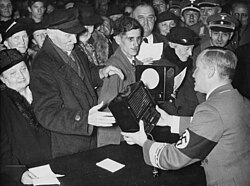
To ensure the message reached every household, the regime distributed free radios, particularly during high-profile events like Goebbels' own birthday in 1938.
World War II and the Drive for "Total War"
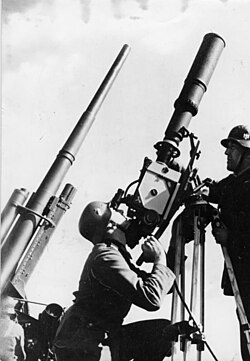
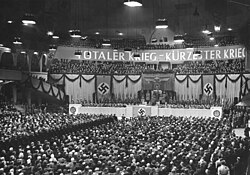
As the tide of World War II turned against Germany, Goebbels shifted his focus toward maintaining civilian and troop morale. In February 1943, he delivered the famous Sportpalast speech, calling for "Total War" (Totaler Krieg). This concept involved mobilizing every available resource for the war effort, including closing non-essential businesses and conscripting women into the workforce.
In July 1944, Hitler appointed him Reich Plenipotentiary for Total War. In this role, Goebbels attempted to increase the number of personnel available for the Wehrmacht (the German armed forces) and armaments production, though these efforts were largely unsuccessful.
The Volkssturm
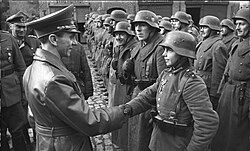
In the final months of the war, Goebbels helped launch the Volkssturm (People's Storm), a national militia consisting of men aged 45 to 60 who were previously unfit for service. Despite swearing in 100,000 recruits in Berlin alone, the militia was poorly armed and inadequately trained, making their deployment against Soviet tanks unrealistic.
Final Days and Legacy
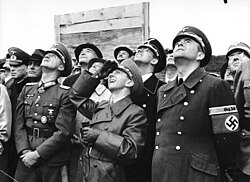
As Berlin fell, Goebbels remained one of Hitler's most loyal adherents. He briefly served as Chancellor of Germany for a single day on April 30, 1945, following Hitler's death. On May 1, 1945, Goebbels committed suicide, likely via cyanide poisoning or a gunshot wound.
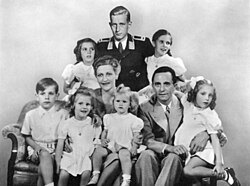
His personal life was as curated as his public image. He married Magda Quandt in 1931, and together they had six children. Only Magda's son from a previous marriage, Harald Quandt, survived the war.
| Category | Details |
|---|---|
| Academic Degree | PhD in Philology (Heidelberg University) |
| Key Political Roles | Gauleiter of Berlin, Minister of Propaganda, Chancellor of Germany |
| Primary Tools | Radio, Film, Mass Rallies, Censorship |
| Major Initiatives | Total War, Volkssturm, Cult of Personality for Hitler |
| Death Date | May 1, 1945 |
Frequently Asked Questions
![Post-reconciliation photo commissioned by Hitler, 1938[287]](/images/08/20/08204e22d27507899d3debf5e38724563221fdb9b33ed0a26514c9204e8490b7.jpg)
What was Goebbels' primary goal as Minister of Propaganda?
His primary goal was to centralize all German cultural and intellectual life under Nazi control, ensuring that the population provided 100 percent support for the party and presenting an image of total national unity to the world.
How did Goebbels use technology to influence the public?
He was an early adopter of radio and film, using them to broadcast Nazi ideology into homes and create carefully choreographed cinematic experiences, such as Triumph of the Will, to glorify Adolf Hitler.
What did "Total War" mean in the context of Goebbels' policies?
Total War referred to the complete mobilization of society for the war effort, which included conscripting women into labor, enlisting men from exempt occupations, and shutting down any business not essential to military production.
What was the Volkssturm?
The Volkssturm was a last-ditch national militia formed in 1944, consisting of men aged 45 to 60. It was largely ineffective due to a lack of proper training and weaponry.
What was Goebbels' academic background?
Goebbels was a trained philologist with a PhD from Heidelberg University, where he wrote his thesis on the 19th-century dramatist Wilhelm von Schütz.