Jonah: The Prophet of the Great Fish Across Faiths and History
The story of Jonah is one of the most enduring narratives in human history, transcending the boundaries of Judaism, Christianity, and Islam. Known for his reluctant mission to the city of Nineveh and his miraculous survival inside a massive sea creature, Jonah serves as a complex figure of faith, disobedience, and divine mercy. From ancient scriptures to modern cinema, his journey continues to captivate the global imagination.
Historically, Jonah is identified as a prophet born in Gath-hepher within the Kingdom of Israel during the 9th century BCE. While he is primarily known through the Book of Jonah, he is also briefly mentioned in the Second Book of Kings, suggesting a historical basis for his existence.
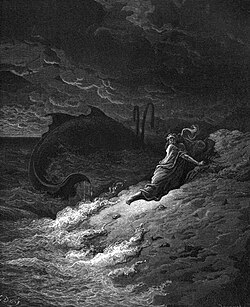
Key Facts
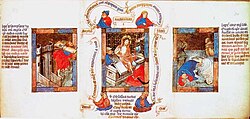
- Origins: Born in 9th century BCE Gath-hepher, Kingdom of Israel.
- Cross-Faith Status: Venerated in Judaism, Christianity, Islam, Baháʼí Faith, and Rastafari.
- Islamic Name: Known as Yunus or Dhul-Nūn ("The One of the Fish").
- Primary Location: Associated with the ancient Assyrian city of Nineveh.
- Major Shrine: The Tomb of Jonah in Mosul, Iraq (destroyed by ISIL in 2014).
Religious Perspectives on Jonah

Judaism
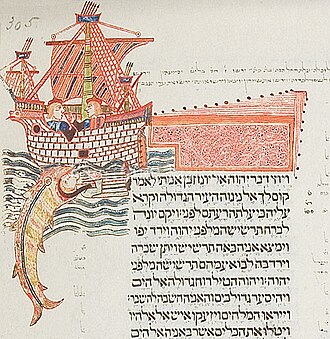
Interpretations within Jewish scholarship vary. The medieval rabbi Abraham ibn Ezra argued that the events were visions rather than literal actualities. Conversely, Isaac Abarbanel suggested that survival inside a fish for three days was biologically possible, comparing the experience to a fetus developing in the womb without fresh air.
Christianity
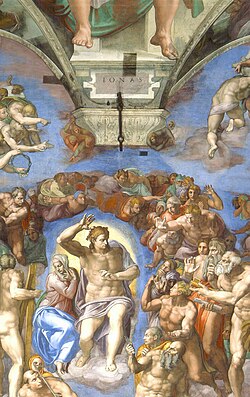
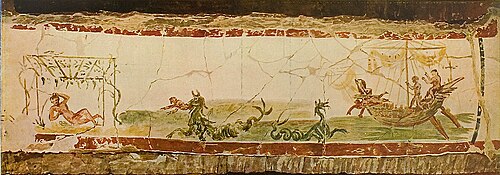
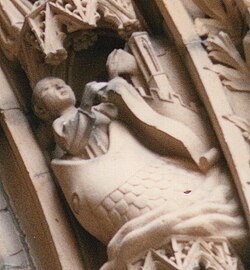
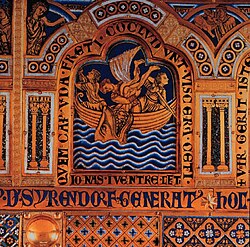
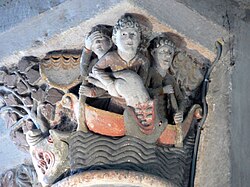
In the New Testament, Jonah is cited as a precursor to Christ, with his three days in the belly of the fish paralleling the three days before the Resurrection. This theological link is prominently featured in Christian art, including Michelangelo's frescoes.
Islam
In the Quran, Jonah (Yunus) is a highly esteemed prophet and an "apostle of Allah." He is the only one of the Twelve Minor Prophets from the Hebrew Bible to be named in the Quran. The tenth chapter of the Quran is titled after him, and his story is further detailed in Surah 37.
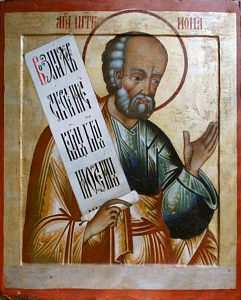
The Mystery of the "Great Fish"
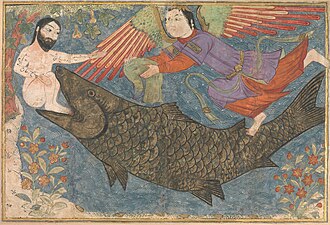
One of the most debated aspects of the narrative is the nature of the creature that swallowed Jonah. The original Hebrew and Greek texts use terms that translate to "great fish" or "sea monster" (cetus). It was not until later translations, such as William Tyndale's 1534 version and the 1611 Authorized Version, that the word "whale" became the standard English term.
Scientific and Biological Speculation
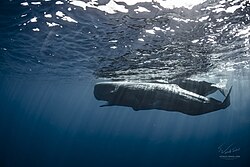
Modern discussions often speculate on which species could have performed such a feat. Candidates often mentioned include the whale shark, the largest known fish species, or the sperm whale, the largest toothed predator.
![Photograph of a whale shark, the largest known species of fish[136]](/images/fc/c2/fcc29aab24351c16118cf0a682de84a663ec08c0b4c346fc0fa41a69343d9f03.jpg)
Archaeology and the Tomb of Jonah
![Jonah trying to hide his nakedness in the midst of bushes; Jeremiah in the wilderness (top left); Uzeyr awakened after the destruction of Jerusalem. Zubdat al-Tawarikh, Ottoman miniature, 1583.[84]](/images/31/4c/314c7ca194c5b4138974b6a8050c7baad0b508ecbd0c368e806be63ff03d139e.jpg)
For centuries, the Al-Nabi Yunus Mosque in Mosul, Iraq, served as a major pilgrimage site for Muslims and Christians, believed to house the tomb of the prophet. However, on July 24, 2014, the Islamic State of Iraq and the Levant (ISIL) destroyed the mosque and the shrine.
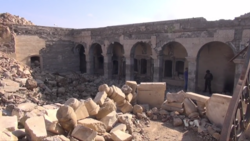
Following the liberation of Mosul in 2017, archaeologists discovered an ancient Assyrian palace built by Esarhaddon (7th century BCE) beneath the ruins of the mosque. Other reputed tomb locations include the village of Mashhad in Israel and a sanctuary near Sarafand in Lebanon.
![Modern restoration of the Adad gate at Nineveh in a photograph taken prior to the gate's total destruction by ISIL in April 2016.[116] The Book of Jonah exaggerates the size of Nineveh far beyond what it actually was historically.[1][28]](/images/55/45/554558bccd93c11ab76456122e43e9d5f7e80bef453c0f131047a2a4075bbe8d.jpg)
Cultural Legacy and Influence
The narrative of Jonah has permeated global literature and art. In Herman Melville's Moby-Dick, the character Father Mapple delivers a sermon on Jonah's just punishment. In children's literature, Carlo Collodi's The Adventures of Pinocchio alludes to the story when Pinocchio and Geppetto are swallowed by a "Terrible Dogfish." More recently, the story was adapted into the animated Jonah: A VeggieTales Movie.
| Tradition | Name/Title | Key Interpretation | Primary Source |
|---|---|---|---|
| Judaism | Jonah | Prophetic mission/Visionary experience | Book of Jonah |
| Christianity | Jonah | Precursor/Sign of the Resurrection | New Testament |
| Islam | Yunus / Dhul-Nūn | Faithful Apostle of Allah | Quran |
Frequently Asked Questions
Was Jonah actually swallowed by a whale?
The original biblical texts refer to a "great fish" or "sea monster." The specific term "whale" became popular through later English translations, though scientific speculation often points to large species like the sperm whale or whale shark.
Where was Jonah's tomb located?
The most prominent site was the Al-Nabi Yunus Mosque in Mosul, Iraq, though it was destroyed by ISIL in 2014. Other traditional sites are located in Mashhad, Israel, and Sarafand, Lebanon.
How is Jonah viewed in Islam?
In Islam, Yunus is regarded as a faithful prophet and an apostle of Allah. He is highly respected, and a dedicated chapter of the Quran (Surah Yunus) is named after him.
Is the Book of Jonah considered historical?
Scholars are divided. Some view it as a historical account, while many modern scholars suggest it contains parodic or fictional elements, noting that the language used in the book often reflects postexilic Aramaic rather than 9th-century BCE Hebrew.
What is the significance of Jonah in Christian art?
Jonah is often depicted as a symbol of Christ's death and resurrection. For example, Michelangelo placed Jonah below Christ in The Last Judgment to qualify the prophet as a precursor to the Savior.