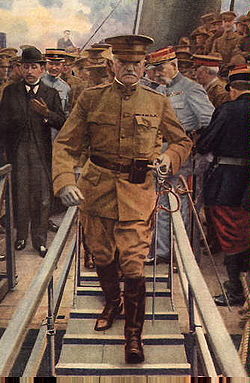
John J. PershingBlack JackAmerican Expeditionary ForcesWorld War IGeneral of the Armies

John J. Pershing: The Legacy of 'Black Jack' and the AEF

John J. Pershing: The Legacy of 'Black Jack' and the AEF John Joseph Pershing, widely known by his nickname "Black Jack," stands as one of the most influential figures in United States mi...

John J. Pershing: The Legacy of 'Black Jack' and the AEF

John Joseph Pershing, widely known by his nickname "Black Jack," stands as one of the most influential figures in United States military history. As the commander of the American Expeditionary Forces (AEF) during World War I, Pershing not only led American troops to victory in Europe but also served as a critical mentor to the generation of generals who would later lead the U.S. Army through World War II, including George C. Marshall and Dwight D. Eisenhower.

From his early days as a cadet to his ultimate rank as General of the Armies, Pershing's career spanned over four decades of conflict, diplomacy, and institutional leadership.
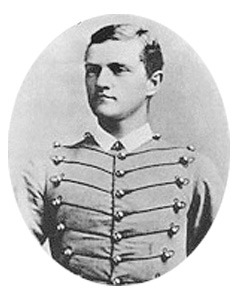
Pershing as a cadet in 1886

Key Facts

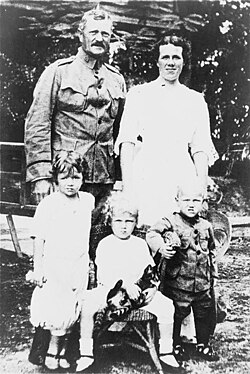
Pershing with his wife Helen and three of their children
  • Highest Rank: General of the Armies (the highest rank in the U.S. Army).
  • Primary Command: Commander-in-Chief of the American Expeditionary Forces (AEF) from 1917 to 1920.
  • Notable Conflicts: Indian Wars, Spanish-American War, Philippine-American War, and World War I.
  • Mentorship: Influenced future leaders like Omar Bradley, George S. Patton, and Douglas MacArthur.
  • Founder: Established the Pershing Rifles.

Early Career and Rise to Command
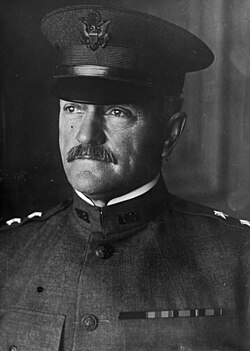
Major General Pershing of the National Army

Pershing's military journey began at the United States Military Academy at West Point, where he entered as a cadet in 1882. His early assignments placed him in the Cavalry Branch, where he developed the tactical skills that would define his early career. He served in various capacities, including a stint as a professor of tactics at the University of Nebraska and as an instructor at West Point.
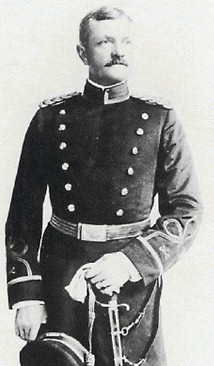
Captain John J. Pershing, c. 1902

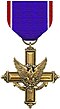
His operational experience grew through participation in the Indian Wars, the Spanish-American War (including the Battle of San Juan Hill), and the Philippine-American War. In the Philippines, he demonstrated significant bravery, later receiving the Distinguished Service Cross for his heroism during an assault against hostile Moros at Mount Bagsak in 1913.
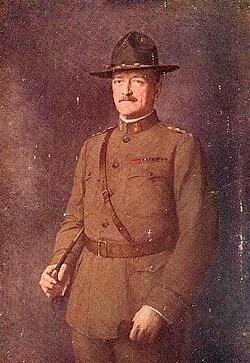
Portrait of Captain Pershing by Léon Hornecker (1903)

The Pancho Villa Expedition

In 1916, Pershing was appointed as the commanding general of the Mexican Punitive Expedition. This mission was launched to chase Pancho Villa into Mexico following Villa's raids on U.S. soil. This period was marked by extreme personal tragedy; in 1915, Pershing's wife, Helen Frances Warren, and three of their children passed away.
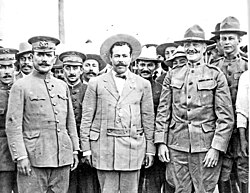
Generals Obregón, Villa, and Pershing, August 1914. A year later, Pershing's wife and three of his children died, and Villa sent him condolences. Six months later, Pershing chased Villa in Mexico.

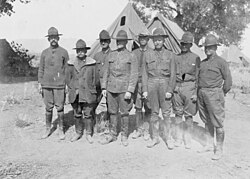
Pershing with members of his headquarters staff in Mexico, 1916.

Commanding the American Expeditionary Forces (AEF)
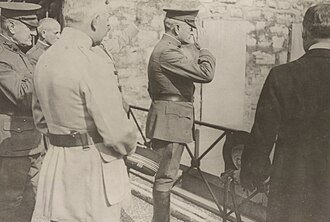
Pershing saluting the Marquis de Lafayette's grave in Paris

The pinnacle of Pershing's career came with the U.S. entry into World War I. In 1917, he was appointed Commander-in-Chief of the AEF. Pershing was adamant that the American army should operate as a distinct, independent force rather than being absorbed into British and French units.
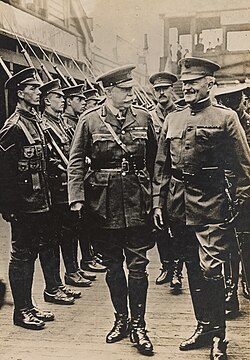
Major General John J. Pershing, the newly appointed Commander-in-Chief (C-in-C) of the American Expeditionary Forces (AEF), pictured here together with Major General Tom Bridges of the British Army, inspecting a Guard of Honor on Pershing's arrival at Liverpool, June 1917

Under his leadership, the AEF participated in several pivotal engagements, including the Battle of Hamel, the Second Battle of the Marne, and the Meuse-Argonne Offensive. Pershing's strategic organization and insistence on full American participation were instrumental in the Allied victory.
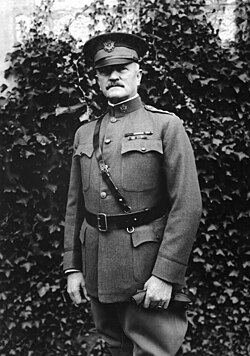
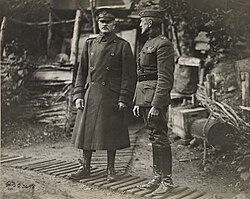
Pershing at General Headquarters in the Château du Val des Écoliers in Chaumont, France, October 1918

General John J. Pershing (left), C-in-C of the AEF in France, and Major General William H. Johnston, commanding the 91st Division, in the Argonne forest, 26 October 1918

Allied Relations and Recognition

Pershing worked closely with other high-ranking Allied commanders, such as Ferdinand Foch and Douglas Haig, to coordinate the final pushes against the Central Powers. His leadership earned him immense international respect and a vast array of foreign decorations from nations including Britain, France, Belgium, and Japan.
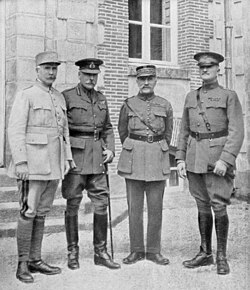
From left to right: General Philippe Pétain, British Field Marshal Sir Douglas Haig, General Ferdinand Foch and General John J. Pershing, all pictured here sometime in 1918

Later Years and Lasting Influence

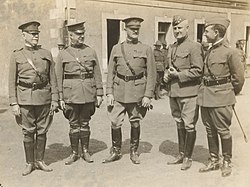
From left to right: Major General Francis J. Kernan, Major General James W. McAndrew, General John J. Pershing, Major General James Harbord and Brigadier General Johnson Hagood in Tours, France, July 1918

Following the war, Pershing reached the unprecedented rank of General of the Armies on September 3, 1919. He served as the Chief of Staff of the United States Army in 1921 before retiring from active service in 1924. Even in retirement, he remained a respected elder statesman of the military, providing guidance during the lead-up to World War II.
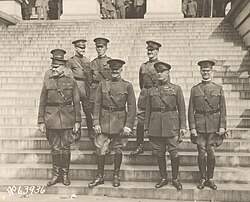
General of the Armies John J. Pershing and members of his staff standing outside the State, War, and Navy Building in Washington, D.C., 23 September 1919. Stood directly behind Pershing is his aide, Colonel George C. Marshall.

Pershing passed away on July 15, 1948, at the age of 87 and was buried with full honors at Arlington National Cemetery.
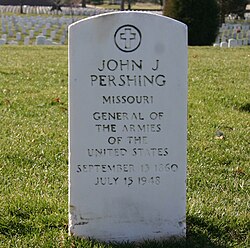
Pershing's tombstone at Arlington National Cemetery

Summary of Military Service

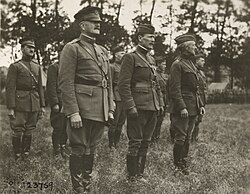
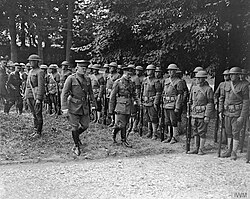
General John J. Pershing, Major General Beaumont B. Buck and Brigadier General Fred W. Sladen inspecting the Guard of Honor of the 3rd Battalion, 7th Infantry Regiment, 3rd Division, Vaucouleurs, France, 1918
Career Overview of General John J. Pershing
Category Details
Service Years 1882–1924
Highest Rank General of the Armies
Key Command American Expeditionary Forces (AEF)
Major Awards Distinguished Service Cross, Silver Star, Congressional Gold Medal
Key Battles San Juan Hill, Meuse-Argonne Offensive, Battle of Hamel

Frequently Asked Questions

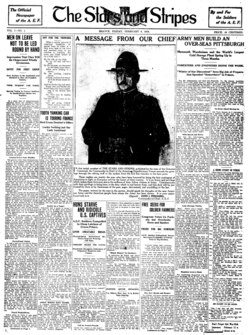
Pershing on the front page of the first issue of Stars and Stripes, 8 February 1918
British King George V and General John J. Pershing inspecting men from every unit of the U.S. 33rd Division which took part in the fighting at Hamel on 4 July and Chipilly on 8 August. Molliens, 12 August 1918.
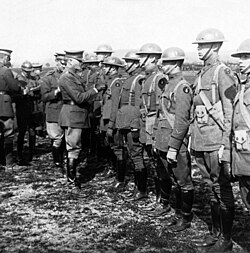
Officers of the 89th Division being decorated by General John J. Pershing in Trier, Germany, April 1919
ภาพประกอบบทความ
ภาพประกอบจากบทความต้นฉบับ
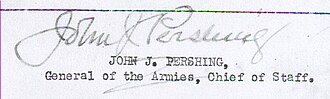
Signature of John Pershing as General of the Armies
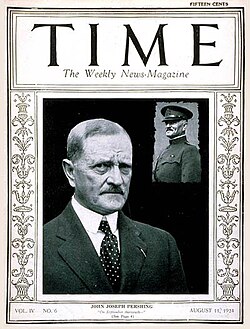
Time cover, 11 August 1924.
Francis Warren Pershing (c. 1927)
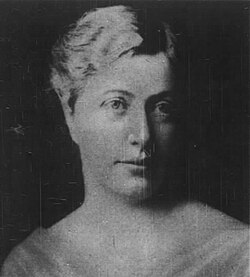
Nita Patton was engaged to Pershing in 1917–18.
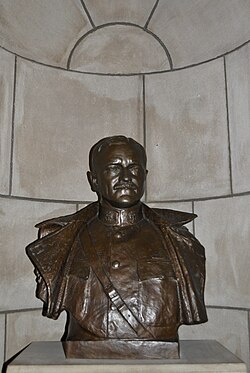
Bust of Pershing created by Bryant Baker in 1921, in the Nebraska Hall of Fame.
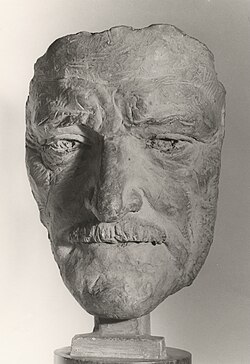
Jo Davidson, Mask of General John J. Pershing, 1919, photo by David Finn, ©David Finn Archive, Department of Image Collections, National Gallery of Art Library, Washington, DC
ภาพประกอบบทความ
ภาพประกอบจากบทความต้นฉบับ
ภาพประกอบบทความ
ภาพประกอบจากบทความต้นฉบับ
ภาพประกอบบทความ
ภาพประกอบจากบทความต้นฉบับ
ภาพประกอบบทความ
ภาพประกอบจากบทความต้นฉบับ
ภาพประกอบบทความ
ภาพประกอบจากบทความต้นฉบับ
ภาพประกอบบทความ
ภาพประกอบจากบทความต้นฉบับ
General Pershing lands in France in 1917
Pershing's ribbons as worn during World War I
ภาพประกอบบทความ
ภาพประกอบจากบทความต้นฉบับ
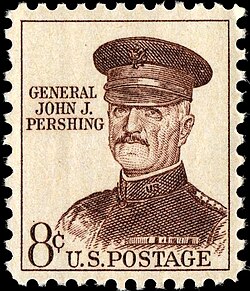
General Pershing postage stamp

Why was John J. Pershing nicknamed "Black Jack"?

While the source does not explicitly detail the origin of the nickname, "Black Jack" became the widely recognized moniker for General Pershing throughout his military career.

What was Pershing's most significant contribution to World War I?

His most significant contribution was serving as the Commander-in-Chief of the American Expeditionary Forces (AEF), where he ensured that U.S. forces fought as an independent army, contributing to the eventual Allied victory.

Which future generals did Pershing mentor?

Pershing mentored a generation of leaders who became pivotal in World War II, including George C. Marshall, Dwight D. Eisenhower, Omar Bradley, George S. Patton, and Douglas MacArthur.

What was the Pancho Villa Expedition?

The Pancho Villa Expedition (or Mexican Punitive Expedition) was a military operation led by Pershing in 1916 to capture the Mexican revolutionary Pancho Villa after he attacked U.S. territory.

What is the highest rank Pershing achieved?

Pershing achieved the rank of General of the Armies, which is the highest rank in the history of the United States Army.