Eighth Army: A Legacy of Service from World War II to the Korean Peninsula
Since its activation in 1944, the Eighth Army has stood as a cornerstone of United States military operations in the Pacific. From the intense amphibious landings of World War II to its continuous presence on the Korean Peninsula, this field army has played a pivotal role in shaping global security. Today, headquartered at Camp Humphreys, the Eighth Army remains an active and vital component of the United States Army Pacific (USARPAC).

Key Facts
- Activated: 10 June 1944
- Motto: Pacific Victors
- Primary Colors: White and red
- Current Headquarters: Camp Humphreys, South Korea
- Major Conflicts: World War II, Korean War
- Branch: United States Army
Historical Foundations: World War II
The Eighth Army was first activated on 10 June 1944, in Memphis, Tennessee, under the command of Lieutenant General Robert L. Eichelberger. Its early years were defined by the high-stakes environment of the Southwest Pacific Theater during World War II.
The unit demonstrated exceptional versatility, participating in no fewer than sixty amphibious landings. In September 1944, the Eighth Army assumed responsibility for operations in New Guinea, New Britain, the Admiralty Islands, and Morotai. This strategic move allowed the U.S. Sixth Army to focus its resources on the critical Philippines Campaign (1944–45).

Campaign Participation and Honors
The Eighth Army's combat record is distinguished by its involvement in several major campaigns, including New Guinea, Leyte, and Luzon. These efforts earned the unit numerous decorations, such as the Philippine Presidential Unit Citation and multiple Presidential Unit Citations during the Korean War.
The Korean War and Beyond
The Eighth Army's relationship with South Korea began in earnest in July 1950. As Lieutenant General Thomas S. Vandal noted, once the army arrived, it "never left." The conflict evolved from a rapid war of movement into a grueling war of attrition.
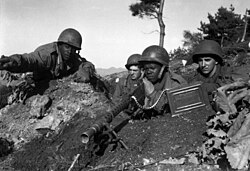
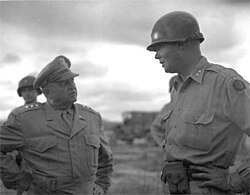
During the war, several notable commanders led the Eighth Army, including Lieutenant Generals Matthew Ridgway, James Van Fleet, and Maxwell D. Taylor. Following the signing of the Korean Armistice Agreement and the establishment of the Military Demarcation Line, the Eighth Army remained in South Korea to maintain stability.
Evolution of Presence in Korea
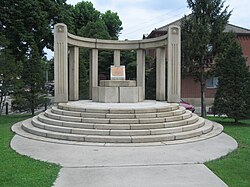
The post-war era saw shifts in the army's structure. In the 1960s, the I Corps—comprising the 7th and 2nd Infantry Divisions—was part of the Eighth Army. While the 7th Infantry Division was eventually withdrawn in 1971, the Eighth Army maintained a significant footprint. Despite political discussions regarding troop withdrawals in the late 1970s, the core combat presence remained essential to regional security.
Organizational Structure and Modern Role
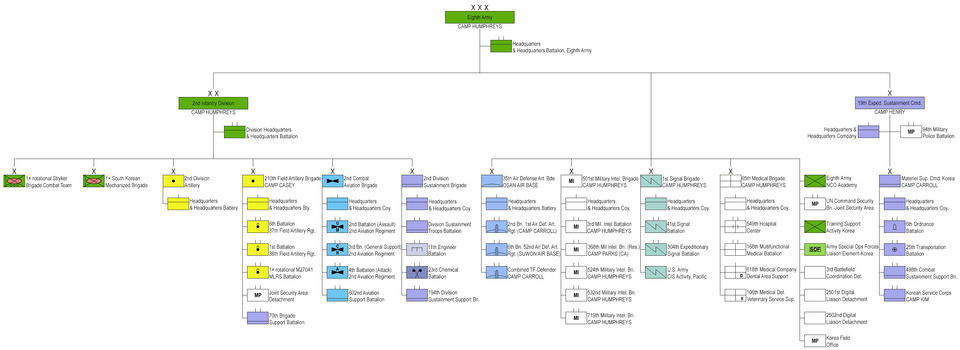
The Eighth Army has undergone numerous reorganizations to meet modern warfare requirements. By the end of the Cold War in 1989, the army was a massive organization based at the Yongsan Garrison, encompassing aviation, signal, military intelligence, and medical brigades.
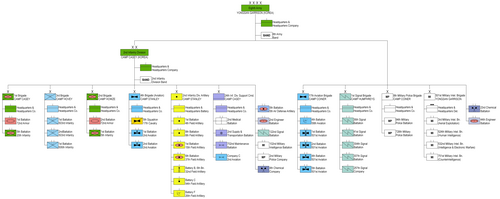
In recent years, the headquarters has transitioned to Camp Humphreys. The modern organization includes the 2nd Infantry Division (a ROK-US Combined Division), the 501st Military Intelligence Brigade, and various support commands such as the 19th Expeditionary Sustainment Command. This structure ensures seamless coordination between U.S. and Republic of Korea (ROK) forces.
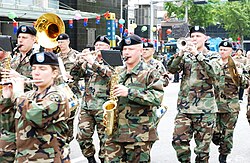
The Eighth Army Band
Beyond combat and logistics, the Eighth Army maintains a cultural presence through the 8th Army Band, which performs at various official and community events, including parades in downtown Seoul.
Summary of Eighth Army Profile
| Category | Details |
|---|---|
| Type | Field Army |
| Parent Command | USARPAC |
| Current Commander | LTG Joseph Hilbert |
| Primary Garrison | Camp Humphreys |
| Key Decorations | Presidential Unit Citation, Army Superior Unit Award |
Frequently Asked Questions
When was the Eighth Army first activated?
The Eighth Army was activated on 10 June 1944 in Memphis, Tennessee.
What is the motto of the Eighth Army?
The official motto of the Eighth Army is "Pacific Victors."
Where is the Eighth Army currently headquartered?
The Eighth Army is currently headquartered at Camp Humphreys in South Korea.
Which major wars has the Eighth Army participated in?
The Eighth Army has participated in World War II and the Korean War.
Who are some of the notable commanders of the Eighth Army?
Notable commanders include LTG Robert Eichelberger, LTG Walton H. Walker, LTG Matthew Ridgway, LTG James Van Fleet, and LTG Maxwell D. Taylor.