Korean Division: From Post-War Partition to the Modern DMZ
The division of the Korean Peninsula is one of the most enduring legacies of the 20th century. What began as a temporary administrative arrangement following the end of World War II has evolved into a permanent geopolitical boundary, separating two distinct nations with vastly different political systems. To understand the current state of the peninsula, one must look back to the collapse of Japanese colonial rule and the onset of the Cold War.
Before the mid-20th century, Korea was a unified nation, known as the Korean Empire, until it was annexed by the Empire of Japan in 1910. The end of Japanese rule in 1945 did not immediately bring unity; instead, it ushered in a period of intense international negotiation and internal conflict.
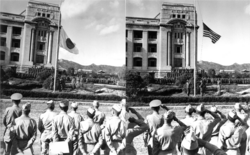
Key Facts
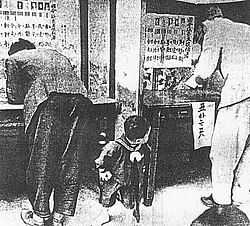
![South Korean demonstration in support of the U.S.-Soviet Joint Commission [ko] in 1946](/images/a5/59/a55985b6fc7409aadaf381906c778850caa1fa347ebc821785cc3bb50bc3f9ef.jpg)
- Initial Division: The peninsula was divided into US and Soviet occupation zones along the 38th parallel in 1945.
- Two Governments: The Republic of Korea (South) and the Democratic People's Republic of Korea (North) were established in 1948.
- The Korean War: A major conflict occurred from 1950 to 1953, attempting to reunify the peninsula by force.
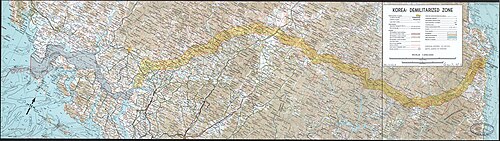
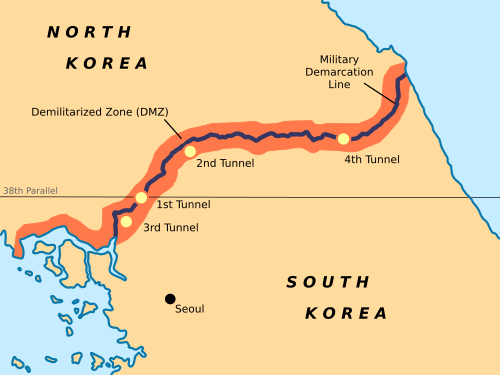
- Current Boundary: The peninsula remains divided by the Korean Demilitarized Zone (DMZ) following a 1953 armistice.
The Post-War Partition (1945)
As World War II drew to a close, Allied leaders sought a framework for Korea's future. The initial plan involved an international trusteeship—a period of temporary administration by foreign powers—until the Korean people were deemed ready for self-rule. In the final days of the war, the United States proposed dividing the peninsula into two occupation zones using the 38th parallel as the dividing line. The Soviet Union accepted this proposal, leading to the implementation of General Order No. 1.
US and Soviet Occupation Zones
The division was intended to be temporary, but the burgeoning Cold War quickly complicated matters. In the north, the Soviet Union established an occupation zone, while in the south, the United States took control. The US occupation was managed by the United States Army Military Government in Korea (USAMGIK), led by Lieutenant General John R. Hodge, who landed in Incheon in September 1945.
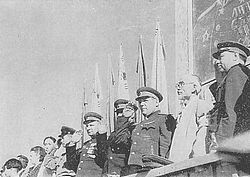
The period following liberation was marked by significant instability. In the south, the USAMGIK faced various left-wing insurgencies. This era of transition was also characterized by internal violence, including the Jeju uprising, which resulted in significant casualties.
![Anti-trusteeship Movement [ko] protests in the South (December 1945)](/images/2e/49/2e49744e9c16c701644279542c268bbb3fe427bb6b2b10a34081ddf172c37112.jpg)
Failed Negotiations and the Rise of Separate States
Efforts to create a unified administration through the US-Soviet Joint Commission failed between 1946 and 1947. Increasing antagonism between the two superpowers and domestic Korean opposition to the proposed trusteeship made a unified government impossible. The assassination of Lyuh Woon-hyung, a politician who sought left-right dialogue, further deepened the political polarization.
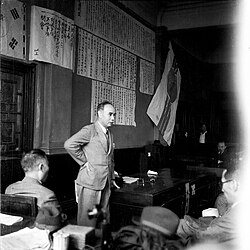
With the failure of international negotiations, the "Korean question" was referred to the United Nations. In 1948, after the Soviet Union rejected UN outcomes, elections were held only in the US-occupied south. This led to the formal establishment of two separate entities:
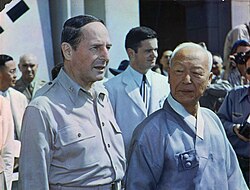
- The Republic of Korea (South): Established on 15 August 1948, with Syngman Rhee as leader.
- The Democratic People's Republic of Korea (North): Established on 10 July 1948, with Kim Il Sung consolidating power.
The Korean War (1950–1953)
The tension between the two regimes culminated in full-scale war on 25 June 1950, when North Korean forces invaded the South in an attempt to reunify the peninsula under communist rule. The conflict saw massive international involvement, with the United Nations sending a US-led force to support the South. The war was a brutal struggle that saw territory shift dramatically, including a massive Chinese counter-attack that pushed UN forces back toward the south.
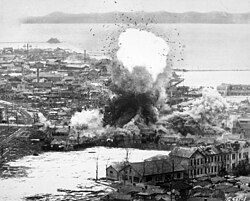
The war ended in a stalemate. Rather than a formal peace treaty, an armistice was signed, which established the Korean Demilitarized Zone (DMZ). This buffer zone remains the boundary between the two nations to this day.
Summary of the Korean Division
| Year | Event | Significance |
|---|---|---|
| 1910 | Japanese Annexation | Korea becomes part of the Japanese Empire. |
| 1945 | End of WWII / Partition | Division into US and Soviet zones along the 38th parallel. |
| 1948 | Formation of Two States | Establishment of the ROK (South) and DPRK (North). |
| 1950–1953 | Korean War | Armed conflict resulting in a stalemate and the DMZ. |
| Present | Continued Division | The peninsula remains divided by the DMZ. |
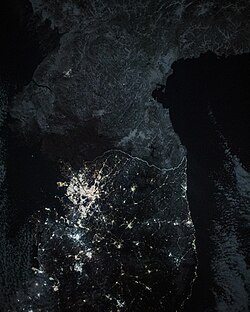
Today, the division is starkly visible, not just on maps, but in the economic and social realities of the two nations. Satellite imagery even highlights the disparity in light emission between the brightly lit South and the darker North.
Frequently Asked Questions
What was the original dividing line between North and South Korea?
Initially, the peninsula was divided along the 38th parallel following the end of World War II in 1945.
What is the DMZ?
The Demilitarized Zone (DMZ) is a buffer zone established following the 1953 armistice to separate the North and South Korean forces and end the active fighting of the Korean War.
Why did the US and Soviet Union divide Korea?
The division was intended as a temporary administrative arrangement to manage the transition from Japanese colonial rule to independence, but it became permanent due to the onset of the Cold War.
When did the Korean War begin?
The Korean War began on 25 June 1950, when North Korean forces invaded South Korea.
Are the two Koreas officially at war?
Because the conflict ended in an armistice (a ceasefire) rather than a formal peace treaty, the two nations technically remain in a state of conflict.