George S. PattonWorld War IIThird ArmyUS Army GeneralBattle of the Bulge

George S. Patton: The Life and Legacy of Old Blood and Guts

George S. Patton: The Life and Legacy of Old Blood and Guts George Smith Patton Jr. was one of the most storied and controversial figures in the history of the United States Army. Known b...

George S. Patton: The Life and Legacy of Old Blood and Guts

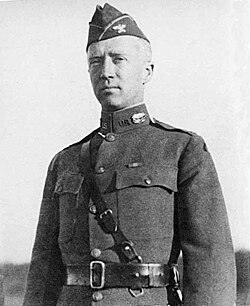
George Smith Patton Jr. was one of the most storied and controversial figures in the history of the United States Army. Known by the nicknames "Bandito" and "Old Blood and Guts," Patton was a master of mobile warfare who commanded the Seventh Army in the Mediterranean and the Third Army during the liberation of France and the push into Germany. His career spanned from the early 20th-century cavalry to the birth of modern armored combat.

Key Facts
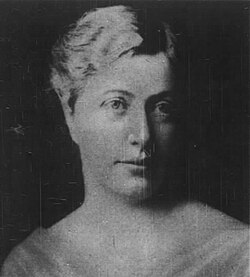
Anne Wilson "Nita" Patton, Patton's sister. She was engaged to John J. Pershing in 1917–1918.
  • Full Name: George Smith Patton Jr.
  • Highest Rank: General (United States Army)
  • Major Commands: Third Army, Seventh Army, and II Corps.
  • Key Conflicts: Pancho Villa Expedition, World War I, and World War II.
  • Notable Achievements: Led the Third Army during the Battle of the Bulge and the advance into Central Europe.
  • Death: Died December 21, 1945, in Heidelberg, Germany, following a car accident.

Early Life and Military Foundations
ภาพประกอบบทความ
ภาพประกอบจากบทความต้นฉบับ

Born on November 11, 1885, Patton was destined for a military life. He attended the Virginia Military Institute and later graduated from the United States Military Academy at West Point in 1909, ranking 46th out of 103 cadets. He began his career as a second lieutenant in the Cavalry branch.
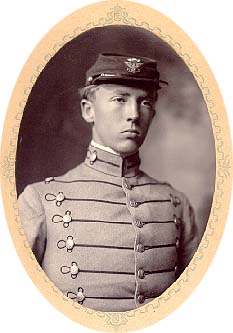
Patton at the Virginia Military Institute

Beyond his formal training, Patton was a man of diverse interests and athletic prowess. In 1912, he competed in the modern pentathlon at the Summer Olympics, showcasing his skill in fencing.
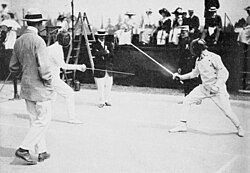
Patton (right) fencing in the modern pentathlon of the 1912 Summer Olympics

The Pancho Villa Expedition

One of Patton's earliest opportunities for field command came during the Pancho Villa Expedition. During this conflict, the durability of the 1915 Dodge Brothers Model 30-35 touring car became well-known due to its use in the expedition, marking a shift toward motorized transport in the military.

The durability of the 1915 Dodge Brothers Model 30-35 touring car won renown for the new automaker following its use in the 1916 Pancho Villa Expedition.[62]

World War I and the Rise of the Tank

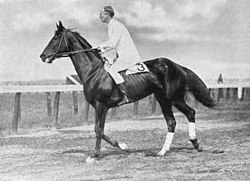
Patton on his steeplechase horse, Wooltex, in 1914

During World War I, Patton played a pivotal role in the development of armored warfare. He served in the Saint Mihiel and Meuse-Argonne campaigns. By October 1918, he had risen to the rank of Colonel in the National Army, commanding the 304th Tank Brigade.
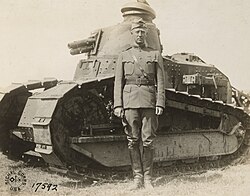
Patton at Bourg in France in 1918 with a Renault FT light tank

Patton's expertise in tanks was not just practical but academic. During the inter-war years, while serving as a staff officer at Fort Myer, he spent significant time writing technical papers and delivering speeches on combat experiences at the General Staff College.
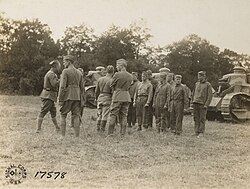
Tank Corps School near Langres, France, 15 July 1918. Tank crew receiving instruction from officers, from left to right: Captain Ranulf Compton, Chief Instructor, and Lieutenant Colonel George S. Patton (center, with back towards the camera), the Commanding Officer

World War II: From North Africa to Germany
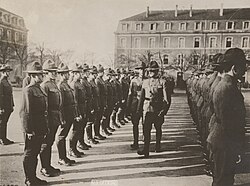
Major General John J. Pershing, accompanied by Captain George S. Patton, inspecting men of Patton's headquarters troop at American Expeditionary Forces (AEF) headquarters, Chaumont, France, 1917

Patton's fame reached its peak during World War II, where he led several major operations across two primary theaters.

The Mediterranean Theater

Patton first gained prominence in the North African campaign, participating in Operation Torch. He later commanded the Seventh Army during the invasion of Sicily (Operation Husky), where he led forces through the Battle of Gela and the Battle of Troina.
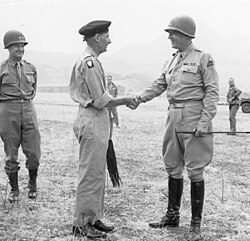
General Sir Bernard Montgomery shakes hands with Lieutenant General George S. Patton at an airport at Palermo, Sicily, 28 July 1943. Major General Geoffrey Keyes, deputy commander of Patton's Seventh Army, stands to the far left of the picture.

The European Theater and the Third Army

Following the Allied invasion of Normandy in June 1944, Patton took command of the Third Army. He was instrumental in the breakout offensive, the liberation of Paris, and the grueling Lorraine campaign, including the battles of Nancy, Arracourt, and Metz.
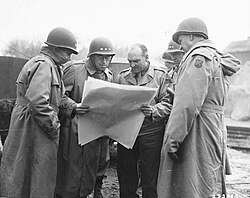
From left to right: Major General Leven C. Allen, Lieutenant General Omar Bradley, Major General John S. Wood, Lieutenant General George S. Patton and Major General Manton S. Eddy being shown a map by one of Patton's armored battalion commanders during a tour near Metz, France, November 1944

One of his most celebrated achievements was during the Battle of the Bulge. Patton rapidly pivoted his army to relieve the besieged forces at Bastogne, a maneuver that remains a study in military logistics and speed.
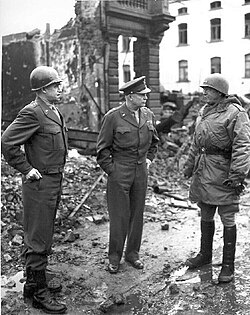
From left to right, Bradley, Eisenhower and Patton in Bastogne, Belgium, 1945

Patton continued his advance into Germany, leading the Danube and Western Bohemia offensives until the end of the war in Europe.
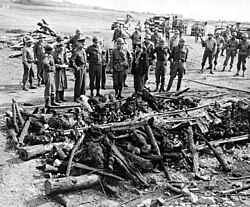
Eisenhower, Bradley and Patton inspect a cremation pyre at the Ohrdruf concentration camp on 12 April 1945, after liberation.

Postwar Years and Death

Patton as a temporary colonel at Camp Meade, Maryland, 1919

After the war, Patton's career was marred by controversy. He was relieved of command following disputes regarding denazification and accusations of antisemitism. His life came to an abrupt end on December 21, 1945, when he died in Heidelberg, Germany, following a vehicle accident.
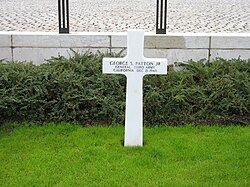
Patton's grave at the Luxembourg American Cemetery

Military Career Summary

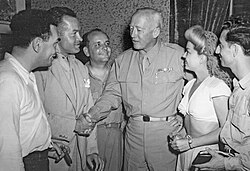
Writer Hal Block (far left), comedian Bob Hope (second from left), writer/actor Barney Dean, singer Frances Langford and musician Tony Romano meet George Patton in Sicily during World War II.
Overview of General George S. Patton's Service
Category Details
Service Years 1909–1945
Highest Rank General
Key Units Third Army, Seventh Army, II Corps, 2nd Armored Division
Major Awards Distinguished Service Cross (2), Army Distinguished Service Medal (3), Silver Star (2), Purple Heart
Education West Point (Class of 1909)

Frequently Asked Questions
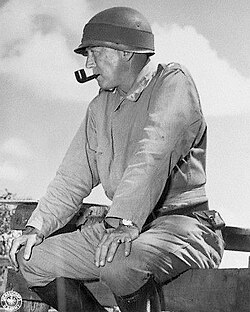
Major General George S. Patton sitting on a fence and smoking a pipe while observing 1941 maneuvers in Louisiana
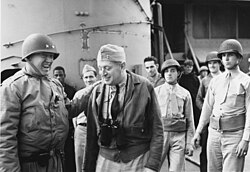
Patton (left) with Rear Admiral Henry Kent Hewitt aboard USS Augusta, off the coast of North Africa, November 1942
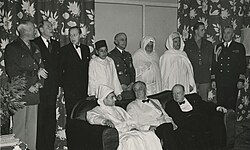
George S. Patton at the Casablanca Conference
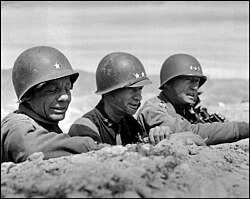
From left to right, Brigadier General Theodore Roosevelt Jr., Major General Terry Allen and Lieutenant General George S. Patton, March 1943
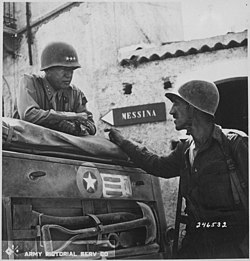
Lieutenant Colonel Lyle W. Bernard, commanding the 2nd Battalion, 30th Infantry Regiment, in conversation with Patton, near Brolo, Sicily, July 1943
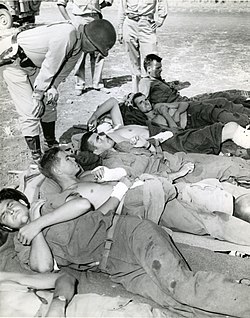
Patton talks to wounded soldiers preparing for evacuation.
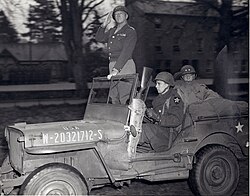
Major General Walter M. Robertson (back seat), commanding the 2nd Infantry Division, with Lieutenant General Patton pass in review of elements of Patton's Third Army in April 1944, prior to the Normandy invasion in June
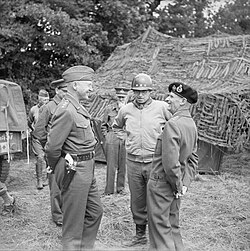
Bradley (center) with Patton (left) and Montgomery (right) at Montgomery's 21st Army Group HQ, Normandy, 7 July 1944
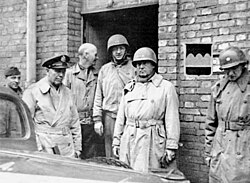
Shown from left to right are: an unidentified driver, General George C. Marshall, Major General Horace L. McBride, Major General Manton S. Eddy, Lieutenant General George S. Patton, and an unidentified aide.
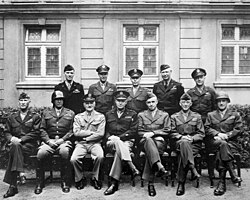
Senior American commanders of the European theater of World War II. Seated, from left to right, are William H. Simpson, George S. Patton, Carl A. Spaatz, Dwight D. Eisenhower, Omar Bradley, Courtney Hodges, and Leonard T. Gerow; standing are (from left to right) Ralph F. Stearley, Hoyt Vandenberg, Walter Bedell Smith, Otto P. Weyland, and Richard E. Nugent.
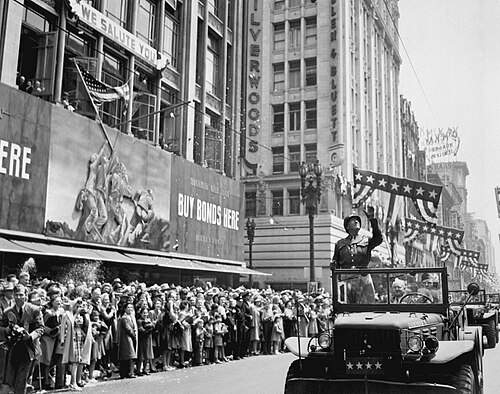
Patton during a welcome home parade in Los Angeles, 9 June 1945
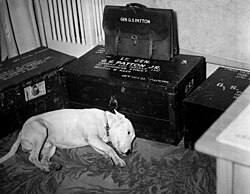
Patton's dog, Willie
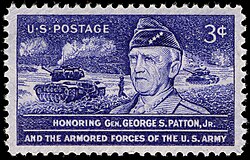
General Patton U.S. commemorative stamp, issued in 1953
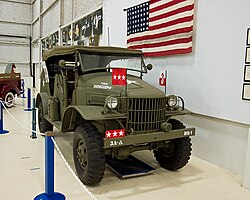
A replica of Patton's World War II command vehicle on display at the Lone Star Flight Museum in Houston, Texas
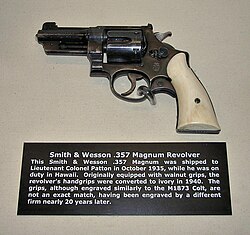
Patton's well-known custom ivory-handled revolver
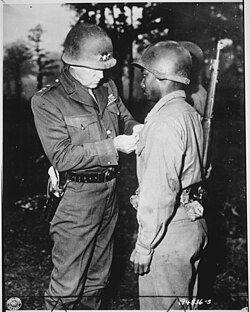
Patton pins a Silver Star Medal on Private Ernest A. Jenkins, a soldier under his command, October 1944
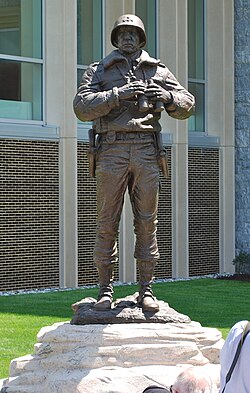
A statue of Patton at the US Military Academy at West Point
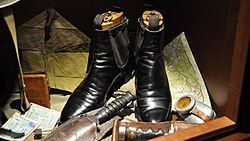
Patton's boots at a museum in Malmedy
ภาพประกอบบทความ
ภาพประกอบจากบทความต้นฉบับ
ภาพประกอบบทความ
ภาพประกอบจากบทความต้นฉบับ
ภาพประกอบบทความ
ภาพประกอบจากบทความต้นฉบับ
ภาพประกอบบทความ
ภาพประกอบจากบทความต้นฉบับ
ภาพประกอบบทความ
ภาพประกอบจากบทความต้นฉบับ
ภาพประกอบบทความ
ภาพประกอบจากบทความต้นฉบับ
ภาพประกอบบทความ
ภาพประกอบจากบทความต้นฉบับ
ภาพประกอบบทความ
ภาพประกอบจากบทความต้นฉบับ
ภาพประกอบบทความ
ภาพประกอบจากบทความต้นฉบับ

What was Patton's role in the Battle of the Bulge?

Patton commanded the Third Army and executed a rapid counter-offensive to relieve the besieged American forces at Bastogne, Belgium, turning the tide of the battle.

What were some of Patton's most significant awards?

He received numerous high-level decorations, including two Distinguished Service Crosses, three Army Distinguished Service Medals, and two Silver Stars, along with the Purple Heart and Legion of Merit.

Why was Patton relieved of command after World War II?

Patton was relieved of command due to controversies surrounding his views on denazification and accusations of antisemitism during the postwar administration of Germany.

Where is General Patton buried?

General Patton is buried at the Luxembourg American Cemetery and Memorial.

What was Patton's contribution to tank warfare?

Patton was a pioneer of armored warfare, starting with his command of the 304th Tank Brigade in World War I and later implementing high-mobility armored strategies with the Third Army in World War II.