John E. Mellish: The Self-Taught Astronomer and Comet Hunter
The history of astronomy is often defined by institutional giants, but it has also been shaped by determined amateurs. John E. Mellish was one such figure—a self-taught observer from Wisconsin who rose to international recognition through his skill in telescope construction and his keen eye for the celestial heavens.
Early Life and Self-Education
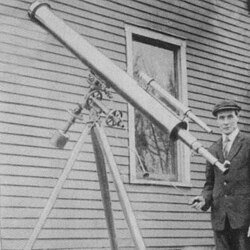
Born in Wisconsin to Arthur Mellish and Judith Sedora Stimson Mellish, John grew up in Cottage Grove, just outside of Madison. His early life was marked by a strong drive for independence and learning. While assisting with farming, Mellish pursued his education autonomously, completing a four-year normal school curriculum—a standard teacher-training program—in only two years.
His fascination with the cosmos began in earnest at age 14 when he purchased a small Bardou refractor, a type of telescope that uses a lens to gather light. Driven by a desire for greater clarity and reach, he utilized instructions from Scientific American written by George Willis Ritchey to build his own larger telescope.
Astronomical Achievements and Comet Discoveries
Mellish's dedication to home-built instrumentation paid off rapidly. By the age of 24, he had gained international acclaim for his discoveries. Using his own equipment, he was credited with the discovery or co-discovery of two comets: C/1907 G1 (Grigg–Mellish) and C/1907 T1 (Mellish). These achievements earned him astronomical medals from both the United States and Mexico.
His success continued over the following decade, as he identified three additional comets: C/1915 C1, C/1915 R1, and C/1917 F1. Beyond his own observations, Mellish was a proponent of amateur science. After writing to Popular Mechanics about his telescope, he became a mentor to others, handling roughly 300 letters from aspiring builders by 1908 and maintaining a professional correspondence with A. R. Hassard of Toronto.
Observations of Mars
In November 1915, Mellish announced that he had observed craters on Mars. While he claimed to be only the second person to do so after E. E. Barnard, both claims remain disputed by the scientific community. Despite this controversy, Mellish is credited as the first person to recognize Martian craters while utilizing the great 40-inch Yerkes refractor, one of the largest lens telescopes in existence. In recognition of his contributions, a crater on Mars was named Mellish.
Key Facts
- Comet Discoveries: Credited with five comets in total (C/1907 G1, C/1907 T1, C/1915 C1, C/1915 R1, and C/1917 F1).
- Technical Skill: Built his own telescopes based on George Willis Ritchey's designs.
- Mars Contribution: First to recognize craters on Mars using the 40-inch Yerkes refractor.
- Education: Self-taught; completed a four-year normal school curriculum in two years.
- Honors: Received astronomical medals from the U.S. and Mexico; has a Martian crater named after him.
| Comet Designation | Year | Discovery Status |
|---|---|---|
| C/1907 G1 | 1907 | Co-discovered (Grigg–Mellish) |
| C/1907 T1 | 1907 | Discovered |
| C/1915 C1 | 1915 | Discovered |
| C/1915 R1 | 1915 | Discovered |
| C/1917 F1 | 1917 | Discovered |
Later Life and Legal Controversies
The latter part of Mellish's life was overshadowed by severe legal and personal turmoil. In 1931, he confessed to committing incest with his 15-year-old daughter. Despite his scientific contributions, which led some astronomers to suggest sterilization over imprisonment, Mellish was incarcerated in the Kane County Jail from September 1931 until his parole in April 1933.
Following his release, his wife divorced him in May 1933, and she was granted custody of their eight children. Mellish moved to Escondido, California, and later to a ranch in Broken Arrow, Oklahoma. He eventually returned to Escondido, where he and his son were arrested in 1938 on charges involving two juvenile girls. John E. Mellish died in Medford, Oregon, in 1970.
Frequently Asked Questions
How many comets did John E. Mellish discover?
John E. Mellish is credited with discovering or co-discovering five comets: C/1907 G1, C/1907 T1, C/1915 C1, C/1915 R1, and C/1917 F1.
What was Mellish's contribution to the study of Mars?
He is credited as the first person to recognize craters on Mars using the 40-inch Yerkes refractor, and a crater on Mars was named in his honor.
How did Mellish learn to build telescopes?
Mellish was self-taught and used instructions published in Scientific American by George Willis Ritchey to construct his larger telescopes.
What happened to Mellish in his later years?
Mellish faced significant legal issues, including a prison sentence for incest in the 1930s and subsequent arrests in California. He spent his final years moving between California, Oklahoma, and Oregon, where he eventually died in 1970.