Jagst River: A Key Tributary of the Neckar in Baden-Württemberg
The Jagst is a significant waterway located in the northern region of Baden-Württemberg, Germany. Serving as a right tributary to the Neckar, this river carves a winding path through the landscape, connecting various historic towns and diverse natural environments. From its origins in the highlands to its confluence with the Neckar, the Jagst plays a vital role in the regional hydrology of southern Germany.
Key Facts
- Total Length: 190.0 km (118.1 mi).
- Source: Swabian Alb at an elevation of 519 m (1,703 ft).
- Mouth: Flows into the Neckar near Bad Wimpfen.
- Basin Size: 1,838 km² (710 sq mi).
- Average Discharge: 18.6 m³/s (660 cu ft/s).
Geography and Course
The Jagst begins its journey in the hills east of Ellwangen, situated close to the border of Bavaria. Its source is located within the Swabian Alb, a plateau region known for its karst topography. As the river progresses, it winds through several prominent towns, including Ellwangen, Crailsheim, Kirchberg an der Jagst, Langenburg, Krautheim, Möckmühl, and Neudenau.
One of the notable geographical features adjacent to the river is the Harthausen Forest, which lies to the south. The river's path is characterized by its meandering nature before it eventually reaches its mouth near Bad Wimpfen. Interestingly, the Jagst flows into the Neckar just a few kilometers downstream from the mouth of the Kocher, a river that runs roughly parallel to the Jagst for much of its course.
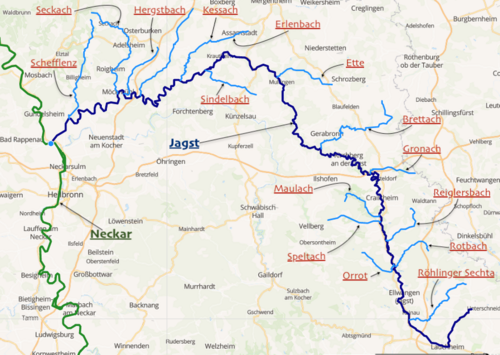
Hydrological Profile
The Jagst drains a basin covering 1,838 square kilometers. Its flow is supported by a network of numerous tributaries that feed into the main stem from both the left and right banks. The average discharge of the river is measured at 18.6 cubic meters per second, reflecting the water volume moving through the channel.
| Feature | Detail |
|---|---|
| Country | Germany |
| State | Baden-Württemberg |
| Source Elevation | 519 m (1,703 ft) |
| Length | 190.0 km |
| Basin Area | 1,838 km² |
| Mouth Location | Neckar (near Bad Wimpfen) |
Tributaries of the Jagst
The river system is composed of various smaller streams. Listed from source to mouth, the tributaries are as follows:
- Left Tributaries: Rotenbach, Orrot, Klingenbach, Steinbach, Speltach, Maulach, Grundbach, Ginsbach, and Sindelbach.
- Right Tributaries: Röhlinger Sechta, Rechenberger Rot (Rotbach), Reiglersbach, Gronach, Brettach, Rötelbach, Ette, Erlenbach, Kessach, Hergstbach, Seckach, Schefflenz, and Tiefenbach.
Frequently Asked Questions
Where does the Jagst river originate?
The Jagst originates in the Swabian Alb, in the hills east of Ellwangen, near the border of Bavaria, at an elevation of 519 meters.
Which larger river does the Jagst flow into?
The Jagst is a right tributary of the Neckar, joining it near the town of Bad Wimpfen.
How long is the Jagst river?
The total length of the Jagst is 190.0 kilometers (approximately 118.1 miles).
Which towns are located along the Jagst?
The river winds through several towns, including Ellwangen, Crailsheim, Kirchberg an der Jagst, Langenburg, Krautheim, Möckmühl, and Neudenau.
What is the relationship between the Jagst and the Kocher rivers?
The Jagst and the Kocher flow more or less parallel to each other, with the Jagst entering the Neckar just a few kilometers downstream from the Kocher's mouth.