ISS Integrated Truss Structure: The Backbone of the Space Station
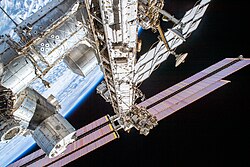
The Integrated Truss Structure (ITS) serves as the essential skeletal framework of the International Space Station (ISS). This linear sequence of connected trusses provides the necessary bus architecture to support unpressurized components, including massive solar arrays, thermal radiators, and logistics carriers. Spanning approximately 110 meters (360 feet) and weighing just under 118 tonnes (260,000 lb), the structure is engineered primarily from stainless steel and aluminium to withstand the harsh environment of low Earth orbit.
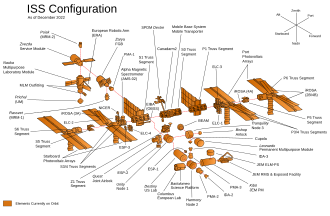
Key Facts
- Total Length: Approximately 110 meters (360 feet).
- Total Mass: Slightly under 118 tonnes (260,000 lb).
- Primary Materials: Aluminium and stainless steel.
- Core Function: Provides power generation, thermal management, and a mounting platform for robotic systems.
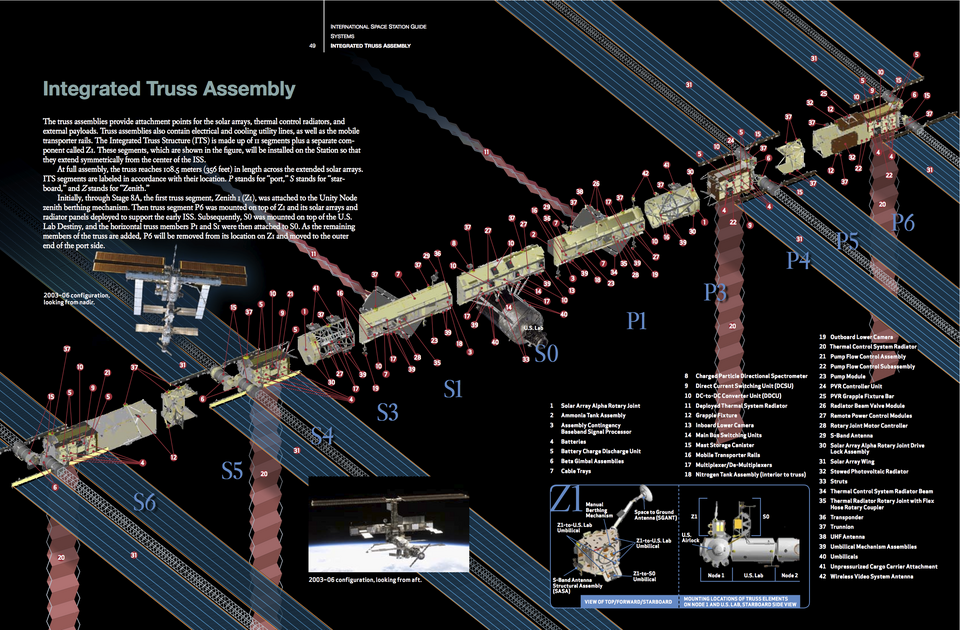
- Naming Convention: Z (Zenith), S (Starboard), and P (Port), with numbers indicating sequential position.
The Architecture of the Truss
The ITS is organized into specific segments that handle different operational needs. While most are named by their position (Starboard or Port), the S0 truss acts as the central hub, and the Z1 truss serves as the zenith-facing attachment point.
The Central Hubs: Z1 and S0
The Z1 truss was one of the earliest additions, originally used to house the P6 truss and provide a Manual Berthing Mechanism (MBM) for temporary docking. Today, it primarily houses communications equipment, plasma contactors, and Control Moment Gyros (CMGs) for station orientation.
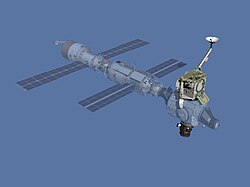
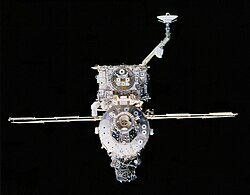
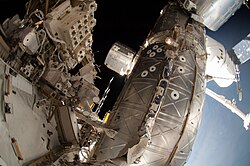
The S0 truss, or Center Integrated Truss Assembly, is the station's central backbone. Attached to the Destiny Laboratory Module via the Module-to-Truss Structure Attachment System (MTSAS), it routes electrical power to the pressurized modules and directs waste heat toward the radiators.
Thermal and Power Segments: P1 through S6
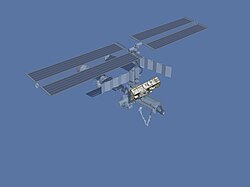
The P1 and S1 trusses are the Side Thermal Radiator Trusses. They utilize anhydrous ammonia—a chemical compound used for its efficient heat-transfer properties—to move heat away from the station through three large radiators. These segments also provide the rails used by the Mobile Transporter to move astronauts and robotic arms.
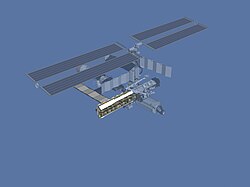
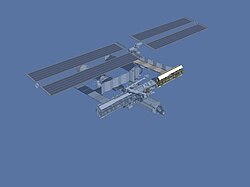
Further outboard are the P3/P4 and S3/S4 assemblies. These are the heaviest modules ever launched by the Space Shuttle. They house the Solar Alpha Rotary Joint (SARJ), a 10-foot diameter mechanism that rotates the solar arrays 360° each orbit to track the sun.
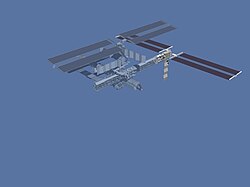
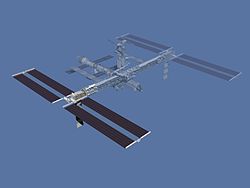
Because of Space Shuttle cargo bay limitations, small connector segments (P5 and S5) were required to extend the structure to the final P6 and S6 segments. These outermost trusses house the primary Solar Array Wings (SAW) and radiators.
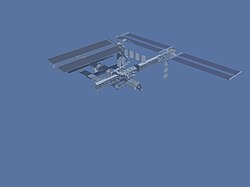
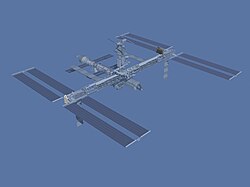
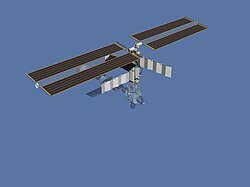
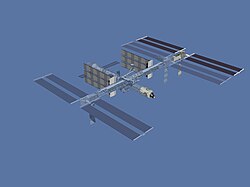
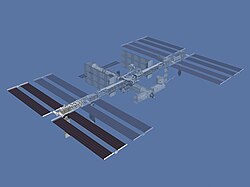
Power Generation and Storage
The ISS relies on four large U.S.-made photovoltaic arrays. To modernize these systems, NASA has recently added iROSA (ISS Roll-Out Solar Arrays) in front of the older arrays on the P4, S4, P6, and S6 trusses between 2021 and 2023 to increase power capacity.
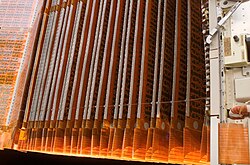
To ensure continuous operation during the "night" portion of the orbit, the station uses battery assemblies located on the S4, P4, S6, and P6 trusses. While the station originally used nickel-hydrogen batteries, these have been upgraded to lightweight lithium-ion cells with a nameplate capacity of 110 Ah and 4 kWh.
Robotics and Maintenance
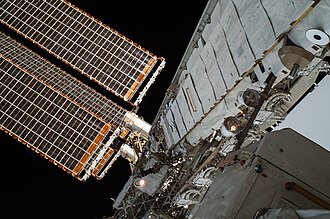
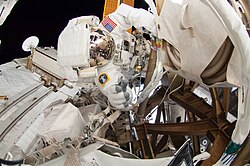
The Mobile Base System (MBS) is a platform that allows the Canadarm2 and Dextre robotic arms to slide along rails between the S3 and P3 trusses. This mobility is critical for inspecting the steel framework and performing repairs, such as the fix applied to a tear in the 4B solar array during mission STS-120.
| Element | Flight | Launch Date | Length (m) | Mass (kg) |
|---|---|---|---|---|
| Z1 | STS-92 | Oct 11, 2000 | 4.6 | 8,755 |
| P6 | STS-97 | Nov 30, 2000 | 18.3 | 15,824 |
| S0 | STS-110 | Apr 8, 2002 | 13.4 | 13,971 |
| S1 | STS-112 | Oct 7, 2002 | 13.7 | 14,124 |
| P1 | STS-113 | Nov 23, 2002 | 13.7 | 14,003 |
| P3/P4 | STS-115 | Sep 9, 2006 | 13.7 | 15,824 |
| P5 | STS-116 | Dec 9, 2006 | 3.37 | 1,864 |
| S3/S4 | STS-117 | Jun 8, 2007 | 13.7 | 15,824 |
| S5 | STS-118 | Aug 8, 2007 | 3.37 | 1,818 |
| S6 | STS-119 | Mar 15, 2009 | 13.7 | 15,824 |
Frequently Asked Questions
What is the purpose of the Solar Alpha Rotary Joint (SARJ)?
The SARJ is a large rotary joint that allows the solar array wings to rotate 360 degrees each orbit, ensuring they remain oriented toward the sun to maximize power generation.
Why were the P5 and S5 trusses necessary?
Because the P3/P4 and S3/S4 assemblies were too large to be launched as a single unit with the outer segments, the P5 and S5 connectors were used to extend the truss length to accommodate the P6 and S6 segments.
How does the ISS manage heat in space?
The station uses the P1 and S1 trusses, which circulate anhydrous ammonia through heat rejection radiators to dissipate waste heat from the pressurized modules into space.
What are iROSAs?
iROSAs are ISS Roll-Out Solar Arrays. These newer, more efficient arrays were installed between 2021 and 2023 in front of the original solar array wings to augment the station's power supply.
What materials are used to build the truss?
The Integrated Truss Structure is primarily constructed from aluminium and stainless steel, with Kevlar panels used in some areas to protect the structure from micro-meteoroids.