Invariant Mass: The Fundamental Constant of Relativistic Systems
In the realm of physics, mass is often thought of as a simple, unchanging quantity. However, according to the theory of special relativity, the way we measure mass depends on the observer's frame of reference. To resolve this, physicists use the concept of invariant mass (also known as rest mass, intrinsic mass, or proper mass). Unlike relativistic mass, which increases as an object approaches the speed of light, invariant mass remains constant regardless of the system's overall motion.
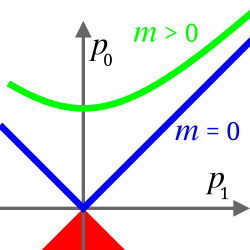
At its core, invariant mass is a characteristic of a system's total energy and momentum that remains identical across all frames of reference related by Lorentz transformations (the mathematical coordinates used to convert measurements between observers moving at different constant velocities). If a system has a center-of-momentum frame—a reference frame where the total momentum is zero—the invariant mass is exactly equal to the system's total mass in that specific "rest frame."
Key Facts
- Constancy: Invariant mass does not change regardless of the observer's velocity.
- Mass-Energy Equivalence: The rest energy of a system is the product of its invariant mass and the speed of light squared (E = mc²).
- Non-Additivity: The invariant mass of a system is not always the simple sum of the rest masses of its individual parts.
- Massless Particles: Particles like photons have zero invariant mass but can contribute to the invariant mass of a larger system.
- Measurement: A scale in the center-of-momentum frame always measures the system's invariant mass.
The Relationship Between Mass and Energy
The concept of invariant mass is inextricably linked to mass-energy equivalence. While the total energy of a system includes its kinetic energy (energy of motion), the rest energy is derived solely from the invariant mass. In any frame where the system is moving, the total mass (relativistic mass) will be greater than the invariant mass, but the invariant mass itself remains the bedrock constant.
Massless and Massive Systems
In the context of Minkowski space (a four-dimensional mathematical model combining space and time), particles are categorized by their four-momentum:
- Massless: Systems with a null vector four-momentum, such as a single photon, have zero invariant mass.
- Massive: Systems with time-like four-momentum possess a reference frame where 3D momentum is zero; these have a positive invariant mass.
- Tachyons: Hypothesized particles that move faster than light would have space-like four-momenta, though these have not been observed to exist.
Invariant Mass in Complex Systems
One of the most counterintuitive aspects of relativity is that invariant mass is not necessarily additive. If the components of a system are in relative motion, the invariant mass of the whole system differs from the sum of the individual rest masses. This is because the system's invariant mass includes the kinetic energy of the constituents and the potential energy of their interactions.
For example, a bottle of gas has an invariant mass that includes the rest masses of the molecules plus the kinetic energy of those molecules moving inside the bottle. Similarly, while a single photon is massless, a system of two photons moving in different directions possesses a positive invariant mass because a center-of-momentum frame exists for the pair.
| Term | Dependence on Motion | Physical Meaning |
|---|---|---|
| Invariant Mass | Independent | The mass measured in the center-of-momentum (rest) frame. |
| Relativistic Mass | Dependent | The total mass-energy of a system, increasing with velocity. |
| Rest Energy | Independent | The energy associated with invariant mass (E = mc²). |
Applications in Particle Physics
In particle physics, invariant mass (m₀) is a critical tool for identifying unknown particles. It is calculated using the energy-momentum relation, where the invariant mass is the pseudo-Euclidean length of the four-vector (E, p). Because energy and momentum are conserved during particle decay, the invariant mass of the decay products equals the mass of the original particle.
Inelastic Scattering and Missing Mass
Experimentalists often use "missing mass" (W) to detect particles that cannot be seen directly. In an inelastic reaction, if the total incoming energy is greater than the detected outgoing energy, the difference is attributed to an undetected particle. By plotting the invariant mass of the detected products, a sharp peak appears at the mass of the missing particle.
Collider Experiments
In high-energy colliders, particles are often described by their transverse momentum (pₜ) and pseudorapidity. For highly relativistic or massless particles, the invariant mass can be calculated using these specific angular and momentum coordinates to determine the nature of the collision products.
Frequently Asked Questions
Is invariant mass the same as rest mass?
Yes, for a single particle or a bound system, the invariant mass is equal to the mass measured in its rest frame, which is why it is commonly called the rest mass.
Why is invariant mass not additive?
Because it accounts for the total energy of the system in the center-of-momentum frame, including the kinetic energy of the parts and their interaction potential energy, rather than just the sum of their individual masses.
Can a system of massless photons have mass?
Yes. While an individual photon has zero invariant mass, a system of photons moving in different directions has a center-of-momentum frame, resulting in a positive invariant mass for the system.
How is invariant mass used to find new particles?
By measuring the energy and momentum of decay products, physicists calculate the invariant mass of the parent particle. A consistent peak in these calculations indicates the existence of a specific particle with that mass.
What happens to invariant mass at the speed of light?
Only particles with zero invariant mass (like photons) can travel at the speed of light. Any particle with a positive invariant mass requires infinite energy to reach the speed of light and therefore must always travel at subluminal velocities.