Spacetime: The Four-Dimensional Fabric of the Universe
For centuries, humanity viewed the universe as a stage where three-dimensional space and one-dimensional time existed independently. Space was the geometry of locations and shapes, while time was the steady ticking of a clock, unaffected by where one was or how fast one moved. However, the dawn of the 20th century shattered this intuition.
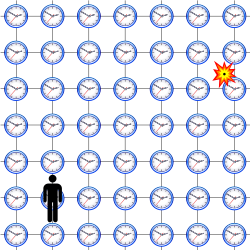
Spacetime, or the space-time continuum, is a mathematical model that fuses these three dimensions of space and one dimension of time into a single four-dimensional continuum. This conceptual shift allows physicists to visualize and calculate relativistic effects—phenomena where different observers perceive the timing and location of events differently based on their relative motion.
Key Facts
- Dimensionality: Spacetime combines three spatial dimensions and one time dimension into a 4D manifold.
- Minkowski Space: The geometric interpretation of special relativity introduced by Hermann Minkowski in 1908.
- The Speed of Light: Acts as the scale factor relating spatial distance to temporal duration.
- Curvature: In general relativity, spacetime is not flat but is curved by the presence of mass and energy.
- Invariance: While space and time measurements vary between observers, the spacetime interval remains invariant.
The Evolution of Spacetime Theory
From Euclidean Space to Relativity
Until the mid-1800s, the world was assumed to be Euclidean, meaning geometry followed standard flat-space rules. However, sensitive measurements like the Fizeau and Michelson–Morley experiments revealed discrepancies that Euclidean geometry could not explain. These findings paved the way for the Lorentz transformation and Albert Einstein's special theory of relativity.
The Contributions of Poincaré and Minkowski
Henri Poincaré was a pioneer in this field, arguing in 1898 that the simultaneity of two events is a matter of convention rather than an absolute fact. He recognized that moving clocks indicate a "local time" and emphasized the principle of relativity.
In 1908, Hermann Minkowski formalized these ideas into a geometric framework. He famously declared that space and time should no longer be viewed as independent entities, but as a union. This Minkowski space provided the essential foundation for the general theory of relativity, which describes how gravity is actually the curvature of spacetime.
Spacetime in Special Relativity
The Spacetime Interval and Reference Frames
In a 3D world, distance is calculated via the Pythagorean theorem. In spacetime, physicists use the invariant interval. Depending on the sign convention used in the literature, this interval allows for the calculation of the "distance" between two events in four dimensions.
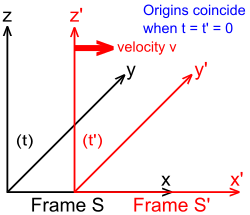
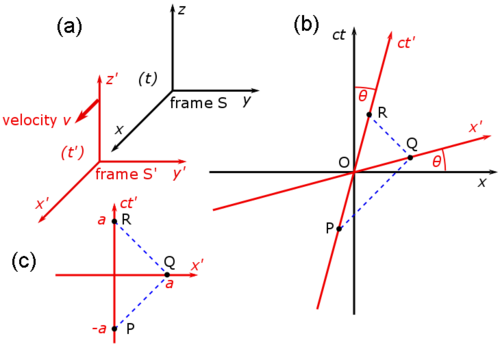
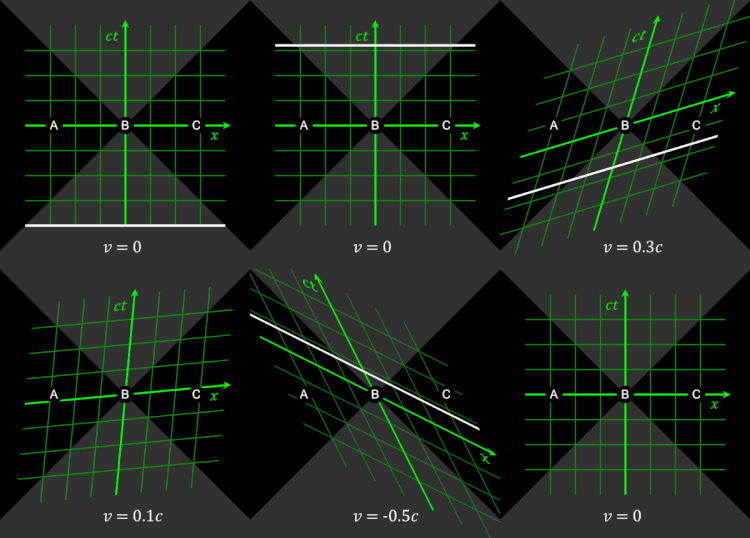
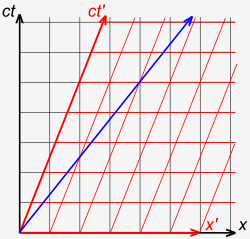
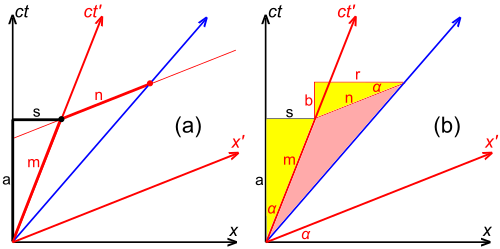
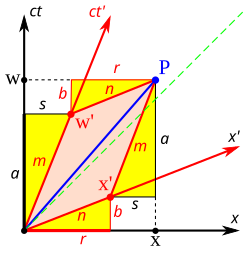
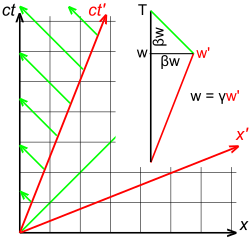
Observers use reference frames to measure these events. When two frames are in standard configuration, their origins coincide at t = 0. However, because the speed of light is constant for all observers, the time axis of a moving observer is tilted relative to a stationary one.
The Light Cone and Simultaneity
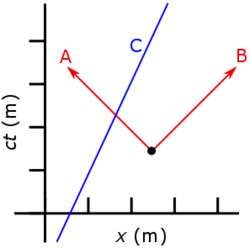
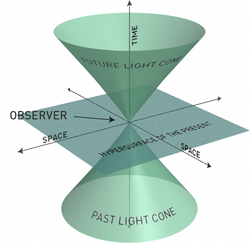
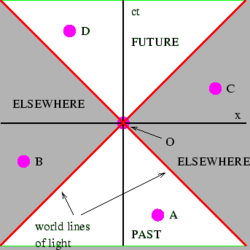
A light cone is a visual representation of the path that a flash of light takes through spacetime. It divides the universe into three distinct regions: the future, the past, and "elsewhere." Events in the "elsewhere" region cannot be reached or influenced by the observer at the origin, as doing so would require traveling faster than light.
Time Dilation and Length Contraction
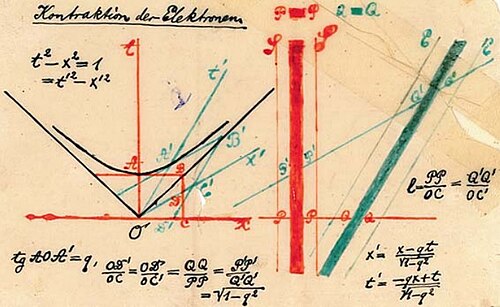
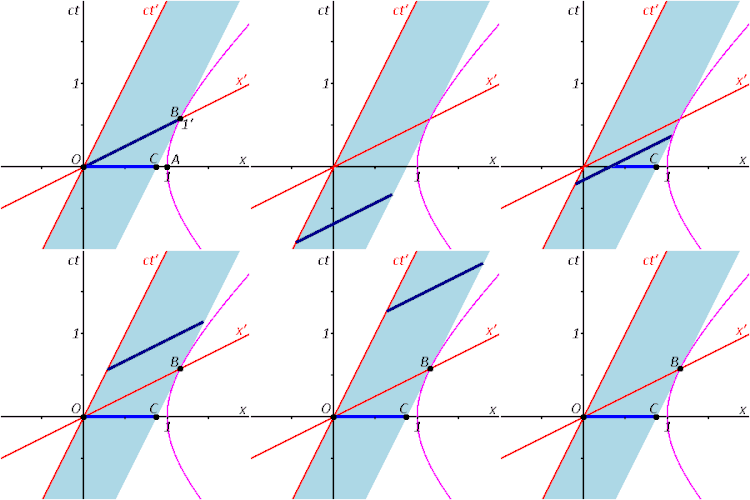
One of the most striking results of spacetime geometry is that time and space are elastic. Time dilation occurs when a clock moving at high velocity is observed to tick more slowly than a stationary clock. Similarly, length contraction occurs when a moving object is measured to be shorter along its direction of motion.
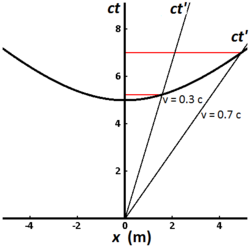
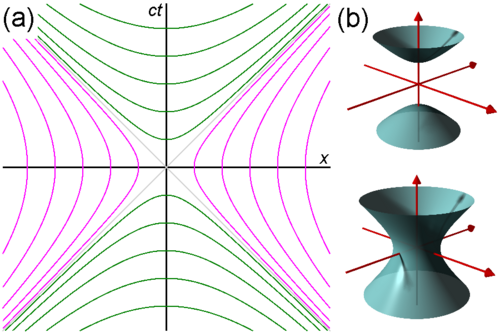
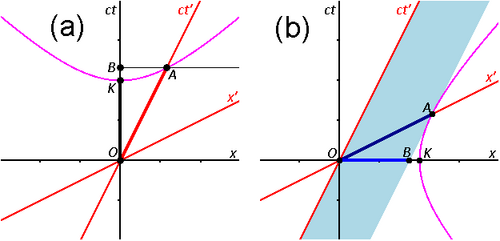
The invariant hyperbola represents all events that can be reached from an origin in a fixed proper time (the time measured by a clock moving along its own world line). As a clock's speed increases, the elapsed time measured by a stationary observer increases, even though the proper time remains the same.
Mathematical Foundations and Dynamics
Lorentz Transformations
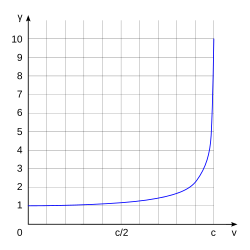
To relate the measurements of two observers moving at a constant velocity, physicists use the Lorentz transformations. These equations incorporate the Lorentz factor (γ), which determines the magnitude of time dilation and length contraction as velocity approaches the speed of light (c).
Energy, Momentum, and the Four-Vector
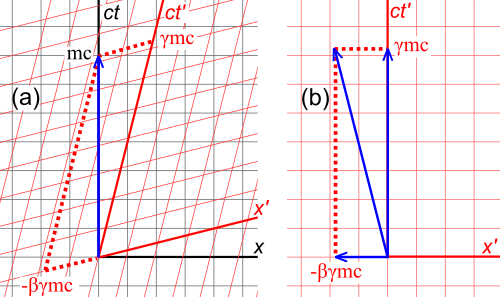
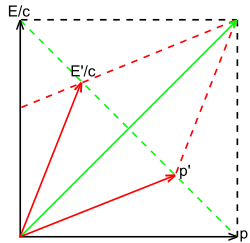
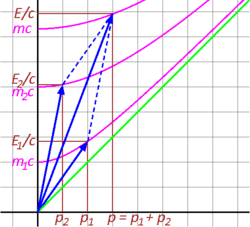
In relativity, momentum is extended into four dimensions as the four-momentum. This framework reveals the famous mass-energy equivalence, where mass itself is a form of energy. This is evident in particle physics; for example, when a charged pion decays into a muon and an antineutrino, the mass difference is converted into the kinetic energy of the resulting particles.
The Nature of Curved Spacetime
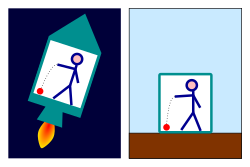
While special relativity deals with "flat" spacetime, general relativity introduces curvature. Spacetime is modeled as a manifold—a space that looks flat locally (like the surface of the Earth) but can have a complex global curvature. This curvature is what we perceive as gravity.
The Importance of 3+1 Dimensions
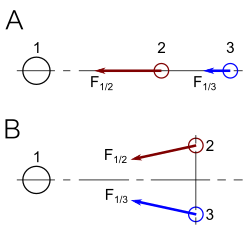
Research suggests that our specific 3+1 dimensional structure (three spatial, one temporal) is unique. Paul Ehrenfest demonstrated that in universes with more than three spatial dimensions, planetary orbits would be unstable, and electrons would either fall into the nucleus or disperse, making stable atoms and solar systems impossible.
![Properties of (n + m)-dimensional spacetimes[65]](/images/9d/e0/9de00dd9641e0e79c7236c4b053cb01487c2c2d5765c2ae06501b5c9bf4d4e73.webp)
| Concept | Definition | Key Effect |
|---|---|---|
| Minkowski Space | 4D fusion of space and time | Geometric basis for Special Relativity |
| Time Dilation | Slowing of time for moving objects | Moving clocks tick slower |
| Length Contraction | Shortening of objects at high speed | Objects shrink in direction of motion |
| Light Cone | Path of light in spacetime | Defines causal boundaries (Past/Future) |
| Curved Spacetime | Manifold warped by mass/energy | Creates the effect of Gravity |
Frequently Asked Questions
What is the difference between space and spacetime?
Space refers to the three-dimensional geometry of locations and distances. Spacetime is a four-dimensional mathematical model that integrates those three spatial dimensions with time, treating them as a single, interconnected continuum.
Why is the speed of light important in spacetime?
The speed of light acts as a universal constant and a scale factor. It defines the relationship between distance in space and duration in time, and it sets the absolute speed limit for the transmission of information and matter.
What is the 'Twin Paradox'?
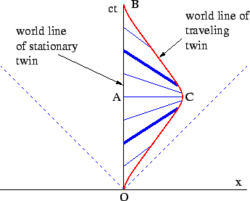
The twin paradox is a thought experiment illustrating mutual time dilation. It describes a scenario where one twin travels to space at relativistic speeds and returns to find their stay-at-home sibling has aged more, due to the difference in their paths through spacetime.
Can spacetime exist with more than three spatial dimensions?
Mathematically, yes, but physically, it is unlikely. Scientific analysis shows that in dimensions other than 3+1, stable orbits for planets and electrons would not exist, meaning the universe as we know it could not form.
What is a manifold in the context of spacetime?
A manifold is a topological space that appears locally flat. Just as a small patch of the curved Earth looks like a flat plane, a small region of curved spacetime appears flat (Euclidean) to an observer.