Hendrik Lorentz: The Architect of Electrodynamics and Relativity
Hendrik Antoon Lorentz was a titan of theoretical physics whose work bridged the gap between classical Newtonian mechanics and the revolutionary theories of the 20th century. A Dutch physicist of immense influence, Lorentz provided the mathematical foundation for the special theory of relativity and fundamentally altered our understanding of how light and electricity interact with matter.
His legacy is etched into the very language of modern physics, from the Lorentz force—which describes the interaction between charged particles and electromagnetic fields—to the Lorentz transformations, the essential equations that describe how measurements of space and time change between observers moving at different velocities.
Key Facts
- Nobel Prize: Shared the 1902 Nobel Prize in Physics with Pieter Zeeman for the discovery and theoretical explanation of the Zeeman effect.
- Core Contributions: Developed the Lorentz transformation, the Lorentz force, and the Lorentz oscillator model.
- Academic Home: Spent much of his career at Leiden University, where he held the Chair of Theoretical Physics.
- Interdisciplinary Impact: Applied his physics expertise to civil engineering for the Afsluitdijk flood control dam.
- Major Awards: Recipient of the Rumford Medal (1908), Franklin Medal (1917), and Copley Medal (1918).
Early Life and Academic Foundation
Born on July 18, 1853, in Arnhem, Netherlands, Hendrik Lorentz was a gifted student who excelled in mathematics, physical sciences, and multiple languages. He entered Leiden University in 1870, where he was deeply influenced by astronomy professor Frederik Kaiser, a mentorship that steered him toward a career in physics.
Lorentz earned his B.Sc. in Mathematics and Physics in 1871 and later completed his Ph.D. in 1875 under Pieter Rijke. His doctoral thesis focused on the reflection and refraction of light, during which he refined the electromagnetic theories originally proposed by James Clerk Maxwell.
The Path to Relativity and Electrodynamics
In the late 19th century, physicists believed light traveled through a medium called the luminiferous aether. Lorentz sought to describe electromagnetic phenomena within reference frames moving relative to this postulated aether. To simplify these transitions, he introduced the concept of "local time," a variable depending on universal time and location.
This "ingenious idea," as described by Henri Poincaré, allowed Lorentz to explain the aberration of light and the results of the Fizeau experiment. To address the Michelson–Morley experiment, Lorentz proposed that moving bodies contract in the direction of their motion—a concept known as the Lorentz–FitzGerald contraction.
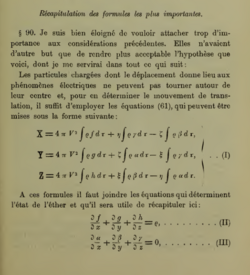
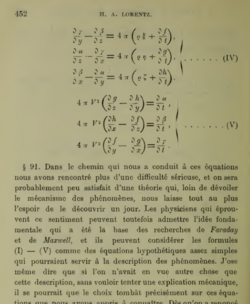
By 1899 and 1904, Lorentz integrated time dilation into his work, resulting in the Lorentz transformations. These equations established a covariant formulation of electrodynamics, meaning that the laws of electromagnetism remain identical across different reference frames, regardless of their relative motion.
The Zeeman Effect and the Nobel Prize
Lorentz's collaboration with Pieter Zeeman led to the discovery of the Zeeman effect, which involves the splitting of spectral lines in the presence of a static magnetic field. This discovery provided critical evidence for the existence of electrons and earned Lorentz and Zeeman the Nobel Prize in Physics in 1902.
Relationship with Albert Einstein
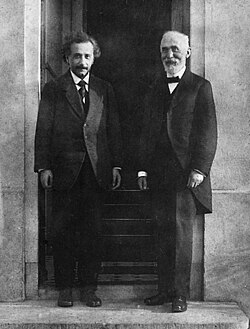
While Lorentz's work laid the groundwork, Albert Einstein's special theory of relativity expanded these concepts by removing the need for the undetectable aether. Despite their different starting points, Lorentz was one of the few scientists who supported Einstein's pursuit of general relativity from its inception.
Lorentz engaged in extensive correspondence with Einstein and published research attempting to reformulate general relativity in a coordinate-free way and combine it with Hamilton's principle. Einstein later remarked that Lorentz's research formed the very basis for the theory of atoms and both special and general relativity.
Beyond Theoretical Physics: Civil Engineering
Lorentz's brilliance extended beyond the abstract. Between 1918 and 1926, the Dutch government tasked him with chairing a committee to analyze the effects of the Afsluitdijk (Enclosure Dam) on water levels in the Waddenzee. Because the project was unprecedented, empirical rules were insufficient.
Lorentz applied basic hydrodynamic equations of motion and solved them numerically using "human computers." His predictions were remarkably accurate, and in recognition of his contribution, one of the dam's lock sets was named after him.
Legacy and Final Years
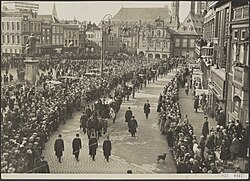
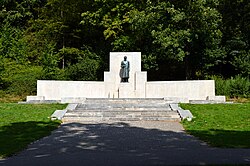
Lorentz remained a respected figure in the global scientific community until his death on February 4, 1928, in Haarlem at the age of 74. His influence persists not only in textbooks but also in the institutions and monuments that bear his name.
| Concept/Theory | Description | Impact |
|---|---|---|
| Lorentz Transformation | Equations relating space and time coordinates between moving frames. | Foundation of Special Relativity. |
| Lorentz Force | Force acting on a charged particle in an electromagnetic field. | Fundamental to Electromagnetism. |
| Zeeman Effect | Splitting of spectral lines in a magnetic field. | 1902 Nobel Prize in Physics. |
| Lorentz Oscillator Model | Classical model for anomalous dispersion in dielectric materials. | Understanding of refractive indices. |
| Afsluitdijk Analysis | Numerical solution of hydrodynamic equations for flood control. | Successful Dutch water management. |
Frequently Asked Questions
What is the Lorentz transformation?
The Lorentz transformation is a set of mathematical equations used to convert the space and time coordinates of an event as measured in one inertial frame of reference to the coordinates measured in another frame moving at a constant velocity relative to the first.
How did Lorentz contribute to the theory of relativity?
Lorentz developed the mathematical transformations and the concept of length contraction that Albert Einstein later used to build the special theory of relativity. While Lorentz initially believed in the aether, his equations provided the necessary framework for Einstein's aether-free theory.
What is the Lorentz force?
The Lorentz force is the combination of electric and magnetic force on a point charge due to electromagnetic fields. It describes how a charged particle moves when subjected to an electric field and a magnetic field.
Why did Lorentz win the Nobel Prize?
Hendrik Lorentz shared the 1902 Nobel Prize in Physics with Pieter Zeeman for their joint work on the Zeeman effect, specifically for the discovery and theoretical explanation of how magnetic fields affect the spectral lines of light.
Did Lorentz work on anything other than theoretical physics?
Yes, Lorentz applied his mathematical skills to civil engineering. He led a committee that used numerical hydrodynamic calculations to predict the impact of the Afsluitdijk dam on the Waddenzee's water levels, providing highly accurate results.