International Treaties: Legal Frameworks and Global Agreements
In the realm of global diplomacy, a treaty serves as a formal, recorded international agreement between sovereign states or other subjects of international law, such as international organizations. While these documents may be referred to by various names—including protocols, covenants, conventions, pacts, or exchanges of letters—they are only classified as treaties under international law if they are legally binding on the participating parties.
Treaties are essential tools for maintaining order and cooperation between nations. They can be bilateral, involving only two countries, or multilateral, involving three or more parties. These agreements provide the legal structure necessary to resolve conflicts, establish trade rules, and protect human rights on a global scale.

Key Facts
- Legal Nature: Only documents that are legally binding are considered treaties under international law.
- Scope: Treaties can be bilateral (two parties) or multilateral (multiple parties).
- Terminology: Common synonyms include conventions, protocols, and covenants.
- Invalidity: Treaties can be declared null and void if they are forced upon a party or contradict peremptory norms.
- Indigenous Relations: Treaties have historically been used to manage land rights and sovereignty between colonial powers and Indigenous peoples.
The Lifecycle of a Treaty
Entry into Force and Implementation
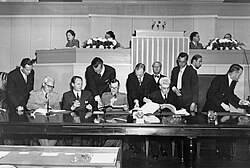
The process of entering a new treaty involves several stages, often facilitated by the United Nations. Once a treaty is signed, it must typically be ratified to become legally binding. The execution and implementation of these obligations depend on the domestic laws of the participating states.
Modifying and Interpreting Agreements
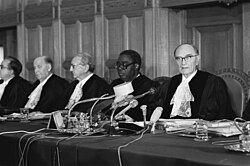
Treaties are not static; they can be amended or expanded through protocols (supplementary agreements). When disputes arise regarding the meaning of a treaty, parties may seek interpretation from bodies like the International Court of Justice.
Ending Treaty Obligations
A treaty may end through withdrawal or termination. Some treaties expressly permit this, while others do not. In cases where no express provision exists, termination may occur if it can be shown that the parties intended to allow for the possibility of withdrawal, or if the treaty is suspended.
Validity and Legal Challenges
Not all agreed-upon treaties remain valid. An agreement may be rejected as a binding instrument if it was obtained through fraud, corruption, coercion, or a fundamental misunderstanding. Furthermore, treaties that are ultra vires (beyond the legal power of the party) or contrary to peremptory norms of international law may be deemed invalid.
A historical example includes the Japan–Korea treaties of 1905, 1907, and 1910. These were protested by various governments as having been forced upon Korea and were later confirmed as "already null and void" in the 1965 Treaty on Basic Relations between Japan and the Republic of Korea.
Treaties Under Domestic Law
The application of international treaties often varies by national jurisdiction. In the United States, the legal status of treaties has been a subject of significant litigation. The Supreme Court has recognized the "supremacy" of treaties in cases like Ware v. Hylton (1796), yet it also ruled in the Head Money Cases (1884) that treaties do not hold a privileged position over acts of Congress and can be modified by legislative action. Additionally, Reid v. Covert (1957) established that treaty provisions conflicting with the U.S. Constitution are null and void under domestic law.
Treaties and Indigenous Peoples
Treaties have played a pivotal role in the relationship between sovereign states and Indigenous populations, though the nature of these agreements has shifted over time.
United States and Canada
In the United States, the government regularly entered into treaties with Native Americans until 1871. The Indian Appropriations Act of March 3, 1871, effectively ended this practice by stating that no Indian tribe would be acknowledged as an independent nation with whom the U.S. could contract by treaty. Subsequent relations were managed through statutes and executive orders.

In Canada, historic treaties between European settlers and First Nations generally fall into three categories: commercial (fur trading), alliance (peace and friendship), and territorial (land rights). Between 1760 and 1923, the Crown and 364 First Nations signed 70 recognized treaties.
Today, Canada recognizes 25 Modern Treaties involving 97 Indigenous groups. These modern agreements have provided significant benefits, including:
- Indigenous ownership of over 600,000 km² of land.
- Capital transfers exceeding $3.2 billion.
- Protection of traditional ways of life and resource management participation.
- Political recognition and self-government rights.
Summary of Treaty Types and Characteristics
| Type | Scope | Legal Status | Common Examples |
|---|---|---|---|
| Bilateral Treaty | Two Parties | Legally Binding | Trade deals, Peace treaties |
| Multilateral Treaty | Three or More Parties | Legally Binding | Geneva Conventions, Vienna Convention |
| Non-binding Agreement | Variable | Not Legally Binding | Memorandums of Understanding (MoUs) |
| Protocol | Variable | Legally Binding | Amendments to existing treaties |
Frequently Asked Questions
What is the difference between a treaty and a non-binding agreement?
The primary difference is legal obligation. Under international law, only documents that are legally binding on the parties are considered treaties. Non-binding agreements do not carry the same legal weight or enforcement mechanisms.
Can a treaty be declared invalid?
Yes. A treaty may be rejected if it was created through coercion, fraud, or corruption, or if it violates peremptory norms of international law. For example, treaties forced upon a state may be declared null and void.
How do treaties interact with a country's national constitution?
This varies by country. In the United States, for instance, the Supreme Court has ruled that treaty provisions that conflict with the U.S. Constitution are null and void under domestic law.
What are "Modern Treaties" in the context of Canada?
Modern Treaties are contemporary agreements between the Canadian government and Indigenous groups. They focus on land ownership, capital transfers, self-government rights, and the protection of traditional ways of life.
What is a protocol in international law?
A protocol is a supplementary agreement that adds to, modifies, or amends the obligations of an existing treaty.