International Law Commission: Shaping the Global Legal Framework
The International Law Commission (ILC) serves as the primary body of experts dedicated to the progressive development and codification of international law. By transforming customary practices into formal legal instruments, the ILC ensures that the rules governing the conduct of nations are clear, systematic, and universally applicable.
Composed of 34 distinguished individuals recognized for their legal expertise, the Commission is elected by the United Nations General Assembly (UNGA) every five years. Its work bridges the gap between theoretical legal principles and the practical requirements of global governance.
Key Facts
- Established: 1947 by the UN General Assembly.
- Composition: 34 experts elected every five years.
- Primary Goal: To develop and codify international law.
- Key Achievement: Instrumental in creating the Vienna Convention on the Law of Treaties and the Rome Statute of the International Criminal Court.
- Meeting Location: Primarily based at the U.N. Office at Geneva.
Historical Origins and Evolution
The ideological foundations of the ILC date back to the 19th century, specifically the Congress of Vienna, where European powers first developed rules to regulate conduct among member states. However, the formal need for a rationalized international legal system became urgent following the Second World War.
On December 11, 1946, the General Assembly passed Resolution 94, establishing a committee of 17 legal experts to advise the UN Secretary-General. This committee convened in 1947 and recommended the creation of a permanent commission. Consequently, the ILC was formed in 1947 under the Charter of the United Nations, holding its first session in 1949. Early work was heavily influenced by the atrocities of World War II, focusing on genocide and acts of aggression.
Working Procedures and Membership
The ILC operates under a formal statute approved by the General Assembly in 1947, with subsequent amendments in 1950, 1955, and 1981. The Commission holds annual sessions, typically in Geneva, to debate complex legal topics and draft principles that may eventually become international treaties.
Membership is based on individual expertise rather than government appointment, ensuring a high degree of professional independence. The current term (2023–2027) includes experts from a diverse range of nationalities, including representatives from Brazil, China, Egypt, France, India, Japan, and Nigeria, among others.
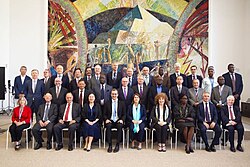
Current Membership (2023–2027 Term)
The Commission currently consists of 34 members, including Dapo Akande (GBR), Carlos J. Argüello Gómez (NCA), Masahiko Asada (JPN), Bogdan Aurescu (ROU), Yacouba Cissé (CIV), and others representing a global cross-section of legal scholarship.
Major Achievements in International Law
The ILC has been responsible for some of the most foundational documents in modern diplomacy and justice. Its work is generally categorized into several key areas of law:
- Sources of Law: The 1969 Vienna Convention on the Law of Treaties provides the essential framework for how treaties are formed and interpreted.
- International Relations: The Commission drafted the Vienna Convention on Diplomatic Relations (1961) and the Vienna Convention on Consular Relations (1963).
- International Spaces: The ILC developed several 1958 conventions regarding the High Seas, the Continental Shelf, and Territorial Waters.
- Global Justice: The Rome Statute of the International Criminal Court (1998) established the first permanent tribunal for genocide and crimes against humanity.
| Category | Key Instrument | Year |
|---|---|---|
| Treaty Law | Vienna Convention on the Law of Treaties | 1969 |
| Diplomacy | Vienna Convention on Diplomatic Relations | 1961 |
| Criminal Law | Rome Statute of the International Criminal Court | 1998 |
| Maritime Law | Convention on the High Seas | 1958 |
| State Liability | Responsibility of States for Internationally Wrongful Acts | 2001 |
Analysis of Annual Sessions and Criticisms
Since 1949, the ILC has maintained a rigorous schedule of annual sessions. While early meetings were held in locations like Lake Success, New York, and Paris, the majority have taken place in Geneva. In recent years, the Commission has adapted to global challenges; for instance, the 72nd session was postponed to 2021 due to the COVID-19 pandemic, and the 76th session in 2025 was shortened due to budgetary constraints.
Despite its success, the ILC has faced criticism regarding its efficiency. Some members, including Georges Scelle as early as 1951, have argued that the brevity of annual sessions (typically 10 to 12 weeks) is insufficient for the thorough study of complex international problems. Critics have suggested reforming the Commission to allow for more frequent meetings as requested by the Secretary-General.
Frequently Asked Questions
What is the main purpose of the International Law Commission?
The ILC is tasked with the progressive development and codification of international law, meaning it helps create new legal rules and formalizes existing customary laws into written treaties.
How are members of the ILC selected?
Members are elected by the United Nations General Assembly every five years based on their recognized expertise and qualifications in the field of international law.
What is the difference between codification and progressive development?
Codification is the process of systematizing existing rules of international law, while progressive development involves drafting new rules to address gaps in the current legal framework.
Where does the ILC usually meet?
The Commission primarily holds its annual sessions at the United Nations Office at Geneva, though some historical sessions were held in New York, Paris, and Monaco.
What is one of the ILC's most significant contributions to criminal law?
One of its most significant contributions is the Rome Statute of the International Criminal Court (1998), which created the first permanent international tribunal to prosecute genocide, war crimes, and crimes against humanity.