Indian Citizenship Act of 1924: The Path to Native American Citizenship
The Indian Citizenship Act of 1924, colloquially known as the Snyder Act, stands as a pivotal moment in American legal history. Enacted on June 2, 1924, this legislation declared that all Native Americans born within the territorial limits of the United States were citizens of the United States. While it may seem like a straightforward application of birthright citizenship, the road to this act was paved with complex legal disputes over sovereignty, jurisdiction, and the definition of national identity.
The act was proposed by U.S. Representative Homer P. Snyder (R-N.Y.) and signed into law by President Calvin Coolidge. One of the primary catalysts for the legislation was the recognition of the thousands of Native Americans who had served with distinction in the U.S. Armed Forces during World War I.
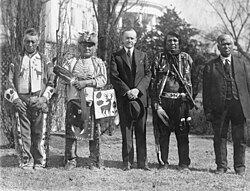
Key Facts
- Official Name: Native Indian Freedom Citizenship Suffrage Act of 1924 and 1925.
- Effective Date: June 2, 1924.
- Primary Sponsor: Representative Homer P. Snyder.
- Signatory: President Calvin Coolidge.
- Core Provision: Granted U.S. citizenship to all non-citizen Indians born in the U.S. without requiring them to relinquish tribal property rights.
- Impact: Applied to approximately 125,000 Indigenous people who had not already obtained citizenship through other means.
The Legal Struggle for Citizenship
Constitutional Exclusions
At the founding of the United States, Native Americans were classified as "Indians not taxed." Because they were governed by distinct tribes that functioned as political entities, they were generally excluded from U.S. representation and taxation. The 1831 case Cherokee Nation v. Georgia reinforced this, suggesting that tribal members residing on tribal land were technically foreigners living as wards of the federal government.
The Fourteenth Amendment Loophole
The Fourteenth Amendment (1868) granted citizenship to all persons born in the U.S. and "subject to the jurisdiction thereof." However, this phrase was interpreted to exclude most Native Americans, as they were seen as subject to the jurisdiction of their own sovereign tribal nations. This exclusion was further solidified in the 1884 Supreme Court case Elk v. Wilkins, which ruled that a Native person born into a recognized tribe did not become a U.S. citizen simply by leaving the tribe and settling among white populations.
Piecemeal Paths to Citizenship
Before the 1924 Act, citizenship was granted only through specific, limited channels:
- Treaties: For example, the 1830 Treaty of Dancing Rabbit Creek allowed some Mississippi Choctaw to become citizens.
- Marriage: An 1888 law granted citizenship to Native women who married white men.
- Military Service: In 1919, Congress allowed honorably discharged World War I veterans to apply for citizenship.
- Land Allotment: The Dawes Act and the Curtis Act of 1898 tied citizenship to the allotment of tribal lands to individuals.
The 1924 Act and Its Implementation
The Indian Citizenship Act of 1924 simplified the process by removing the need for individual applications or the surrender of tribal affiliations. Crucially, the act specified that granting citizenship would not impair the right of any Indian to tribal or other property. This allowed for dual citizenship, enabling individuals to remain members of their sovereign tribal nations while holding U.S. citizenship.
| Feature | Details |
|---|---|
| Public Law | Pub. L. 68–175 (43 Stat. 253) |
| Codification | 8 U.S.C. § 1401(b) |
| Eligibility | All non-citizen Indians born within U.S. territorial limits |
| Tribal Rights | Preserved; citizenship did not affect tribal property rights |
| Voting Rights | Not guaranteed immediately; governed by state laws until 1948 |
Debates and Opposition
Sovereignty and Treason
Not all Native American groups welcomed the act. The Onondaga Nation viewed the forced imposition of citizenship as "treason," arguing that it violated previous treaties—such as the 1794 Treaty of Canandaigua—which recognized the Iroquois as separate and sovereign entities.
The Guardianship Argument
Conversely, groups like the Indian Rights Association supported the act. They believed that U.S. citizenship would provide a necessary layer of federal "guardianship," protecting Indigenous people from being exploited by non-Indigenous Americans seeking their land.
The Gap Between Citizenship and Suffrage
While the 1924 Act granted legal citizenship, it did not automatically grant the right to vote, as suffrage (the right to vote in political elections) was controlled by individual states. Many states used loopholes to deny Native Americans the ballot, arguing that those who were exempt from real estate taxes or maintained tribal affiliations were ineligible.
It was not until 1948 that judicial decisions finally forced states to withdraw these prohibitions, ensuring that Native Americans who qualified under the 1924 Act could actually exercise their right to vote across the country.
Frequently Asked Questions
Did Native Americans have to give up their tribal membership to become U.S. citizens in 1924?
No. The Indian Citizenship Act of 1924 allowed for dual citizenship, meaning Indigenous people could be citizens of both the United States and their respective tribal nations without losing their rights to tribal property.
Why didn't the Fourteenth Amendment already make Native Americans citizens?
The Fourteenth Amendment required persons to be "subject to the jurisdiction" of the United States. Courts interpreted this to mean that members of sovereign tribal nations were not subject to U.S. jurisdiction in the same way as other residents, thus excluding them from birthright citizenship.
Did the 1924 Act immediately give Native Americans the right to vote?
No. While it granted citizenship, voting rights were governed by state laws. Some states continued to block Native American voters using various legal justifications until 1948.
What was the role of World War I in the passing of this act?
The service of thousands of Native Americans in the U.S. Armed Forces during World War I served as a significant moral and political catalyst, prompting Congress to recognize their contributions by granting them citizenship.
Who was the primary sponsor of the legislation?
The act was introduced in the House of Representatives as H.R. 6355 by Homer P. Snyder, a Republican representative from New York.