Indian Army in World War II: Global Deployment and Strategic Evolution
Between 1895 and 1947, the Indian Army served as a cornerstone of the British Empire's military capabilities. During World War II, it expanded into a massive force of 2.5 million men, operating across multiple continents. From the deserts of North Africa to the dense jungles of Burma and the rugged mountains of Italy, Indian troops played a pivotal role in the Allied victory.
Key Facts
- Total Strength: Approximately 2.5 million personnel.
- Allegiance: British Empire.
- Headquarters: GHQ India, located in Delhi.
- Notable Commanders: Archibald Wavell (1st Earl Wavell) and Claude Auchinleck.
- Global Reach: Deployed in North Africa, East Africa, Iraq, Persia, Syria, Lebanon, South-East Asia, Italy, and Greece.
Organizational Expansion and Evolution
The Indian Army underwent rapid expansion between 1940 and 1944 to meet the escalating demands of a global conflict. This growth was not merely numerical but strategic, adapting to diverse terrains and threats.
Early Expansion (1940–1941)
In May 1940, the British and Indian governments agreed to form five new infantry divisions (6th, 7th, 8th, 9th, and 10th) and the 31st Armoured Division. These were primarily intended for the defense of Malaya and Iraq. By March 1941, concerns over Japanese expansion led to the creation of five more infantry divisions (14th, 17th, 19th, 20th, and 34th) and two armored formations: the 32nd Indian Armoured Division and the 50th Indian Tank Brigade.
Mid-War Adjustments (1942–1943)
As overseas commitments grew, the army formed the 23rd, 25th, and 36th infantry divisions, along with the 43rd Indian Armoured Division. The 36th Division was unique, as it was an Indian Army formation composed of British brigades arriving from Britain and the Madagascar campaign. In 1943, the 32nd and 43rd Armoured divisions were amalgamated to form the 44th Indian Armoured Division due to technical staff shortages.
Specialized Training and Airborne Forces (1944)
By 1944, the army focused on specialized warfare. The 116th Brigade became a center for jungle warfare training for the Fourteenth Army, while the 150th and 155th Brigades provided training for the Southern Army and western theaters, respectively. Additionally, the 44th Indian Armoured Division was converted into the 44th Airborne Division, incorporating the 50th and 77th Parachute Brigades and the 14th Airlanding Brigade.
Global Theaters of Operation
The Indian Army's contributions were spread across several critical fronts, often serving in the most challenging environments of the war.
Middle East and Africa
In North Africa, the 4th and 5th Indian Infantry Divisions were instrumental. In East Africa, these divisions participated in the Battle of Keren, leading to the clearance of Italian forces from Eritrea and Abyssinia, resulting in 220,000 prisoners of war. Indian troops also secured strategic locations in Iraq, Persia, Syria, and Lebanon, including the Battle of Damascus in June 1941.
The South-East Asian Campaign
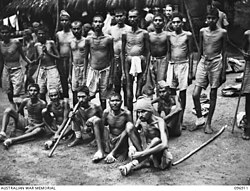
The conflict in South-East Asia was marked by extreme hardship. In the Battle of Singapore (January–February 1942), 55,000 Indian servicemen became prisoners of war. A tragic incident occurred on January 26, 1943, when 195 prisoners from the 16th Punjab Regiment perished aboard the Japanese transport ship Buyo Maru.
In Burma, the Indian Army faced the Japanese Army and the Indian National Army. Key engagements included the Battle of Imphal and the Battle of Sangshak in 1944, where Allied forces successfully repelled the invasion of India. The campaign culminated in 1945 with Operation Dracula, an airborne and amphibious attack on Rangoon.
The European Theater
Indian troops served with distinction in Italy, participating in the crossing of the Sangro, the advance to Florence, and the breaking of the Gothic Line. They also operated in Greece, including the liberation of Rhodes by the Bhopal Regiment.
Summary of Indian Army Contributions
| Region | Key Engagements/Operations | Notable Units |
|---|---|---|
| North & East Africa | Battle of Keren, Tunisia Campaign | 4th & 5th Infantry Divisions |
| Middle East | Battle of Damascus, Iraqforce | 10th Infantry Division |
| South-East Asia | Battle of Imphal, Operation Dracula | 17th, 20th, 23rd Divisions; 44th Airborne |
| Europe | Gothic Line, Battle of the Sangro | 10th Division, Mahratta Infantry |
Valor and Recognition
The bravery of Indian soldiers was recognized with the highest military honors. Numerous personnel were awarded the Victoria Cross (the highest award for gallantry) and the George Cross. Recipients spanned various regiments, including the Gurkha Rifles, the Punjab Regiment, and the Mahratta Light Infantry, reflecting the diverse composition of the force.
Frequently Asked Questions
How many men served in the Indian Army during World War II?
The Indian Army reached a size of approximately 2.5 million men during the conflict.
What was the significance of the Battle of Imphal?
The Battle of Imphal (March–July 1944) was a critical victory where Indian and Allied forces stopped the Japanese Army and the Indian National Army from invading India, driving them back into Burma.
Which specialized units were formed toward the end of the war?
The army developed specialized jungle warfare training through the 116th Brigade and established the 44th Airborne Division for parachute and airlanding operations.
Where did Indian troops serve outside of Asia?
Indian troops were deployed extensively in North Africa, East Africa, the Middle East (Iraq, Persia, Syria, Lebanon), and Europe (Italy and Greece).
What happened to Indian troops during the fall of Singapore?
The fall of Singapore resulted in the capture of the 9th and 11th Indian Divisions, along with several brigades, leading to 55,000 Indian servicemen becoming prisoners of war.