Hyperinflation: Causes, Effects, and History's Most Severe Currency Collapses
In the world of economics, hyperinflation is a state of extremely high and typically accelerating inflation. Unlike standard inflation, where prices rise gradually over years, hyperinflation is a rapid spiral that erodes the real value of a local currency almost instantly. As the nominal cost of goods skyrockets, the purchasing power of money vanishes, forcing citizens to minimize their holdings in the local currency and often switch to more stable foreign alternatives.
This economic phenomenon creates a vicious cycle: as people rush to rid themselves of a devaluing currency, the general price level often rises even faster than the money supply itself. Consequently, the real stock of money—the total circulating currency divided by the price level—decreases significantly.
Key Facts
- Definition: A rapid, accelerating increase in prices that destroys the real value of a currency.
- Primary Drivers: Often triggered by government budget stress, such as wars, sociopolitical upheaval, or a collapse in tax revenue.
- Behavioral Shift: People engage in currency substitution (often called "dollarization") to protect their wealth.
- Extreme Examples: Hungary (1946) and Zimbabwe (2008) hold records for some of the highest monthly inflation rates in history.
- Solutions: Orthodox fixes include effective capital controls and currency substitution, though these often carry high social costs.
The Mechanics of Hyperinflation
Root Causes
Hyperinflation rarely happens in a vacuum. It is typically associated with severe stress on a government's budget. Common triggers include the aftermath of wars, political instability, or a collapse in export prices. When a government faces a sharp decrease in real tax revenue but must maintain high spending—and is unable or unwilling to borrow—it may resort to printing excessive amounts of money to cover its debts.
This increase in the money supply, coupled with a lack of confidence in the currency, leads to a rapid increase in nominal prices. In some cases, supply shocks (a sudden decrease in the availability of goods) further accelerate the price climb.
Economic and Social Effects
The effects of hyperinflation are devastating to the average citizen. Wages and interest rates struggle to keep pace with a rapidly shifting price index. As money loses value by the hour, the economy often reverts to barter or the use of foreign currencies.
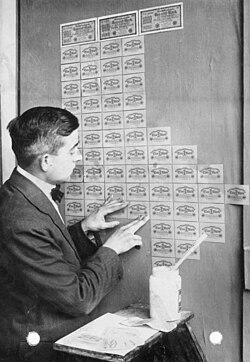
In extreme cases, currency becomes so worthless that it is used for non-monetary purposes. For example, during the 1923 German crisis, banknotes were reportedly used as wallpaper because they were cheaper than actual wallpaper.
Notable Hyperinflationary Periods
The Weimar Republic (Germany)
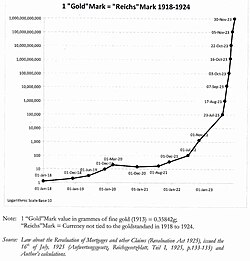
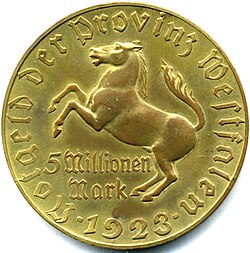
Germany experienced two distinct phases of hyperinflation. The second, more severe phase occurred between August 1922 and December 1923, peaking in November 1923 with a monthly inflation rate of 29,525%. By October 1923, 5 million marks—which would have been worth over $700 in January of that year—were worth only a fraction of a cent.
Hungary (1945–1946)
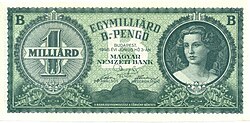
Hungary holds the record for the most severe hyperinflation ever recorded. Peaking in July 1946, the monthly inflation rate reached 4.19 × 10¹²%. This led to the issuance of the 100 quintillion pengő note, the largest denomination ever officially issued for circulation.
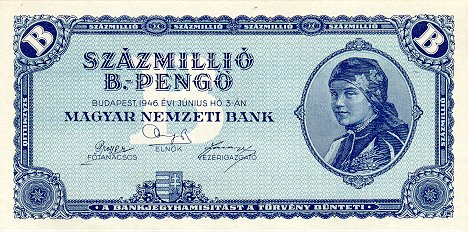
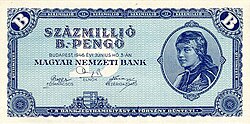
Some notes, such as the 1 sextillion pengő, were printed but never actually issued into circulation.
Zimbabwe (2007–2008)
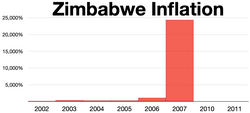
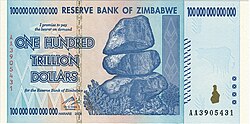
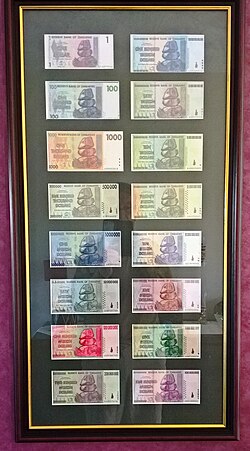
Zimbabwe's crisis peaked in mid-November 2008 with a monthly inflation rate of 7.96 × 10¹⁰%. The government issued notes up to 100 trillion dollars, signed by Governor Gideon Gono, promising to pay the bearer on demand.
Venezuela (2016–Present)
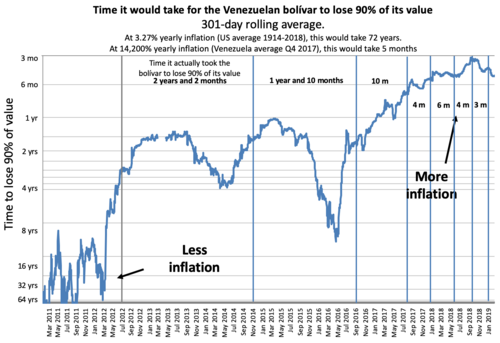
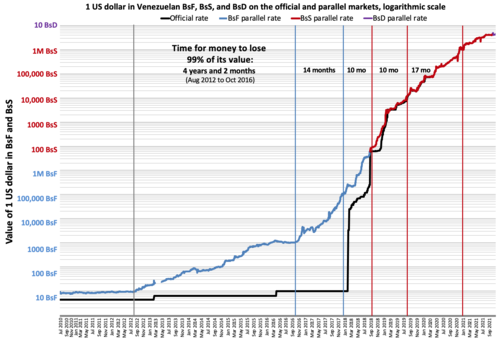
Venezuela has faced a prolonged crisis. By July 2018, inflation sat at 33,151%. Official data from the Central Bank of Venezuela showed inflation jumped from 274% in 2016 to 130,060% in 2018, with cumulative inflation from 2016 to April 2019 estimated at over 53 million percent.
Other Significant Episodes
- Yugoslavia: Experienced severe inflation in the early 1990s, resulting in a 500 billion DIN banknote in 1993.
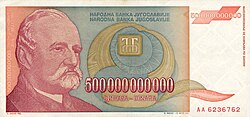
A 500 billion DIN banknote circa 1993, the largest nominal value ever officially printed in Yugoslavia, the final result of hyperinflation - China: Faced two episodes, with the second (1947–1949) peaking at a monthly rate of 5,070% in April 1949.
- Brazil: Suffered high inflation from 1985 to 1994, peaking in March 1990 at 82.39%.
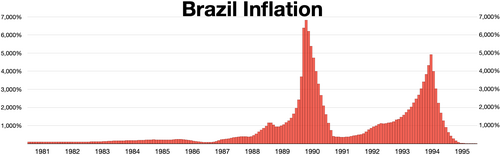
Brazil Inflation 1981-1995 - Argentina: Has dealt with recurring instability, including monthly inflation over 50% in 1989 and 1990.
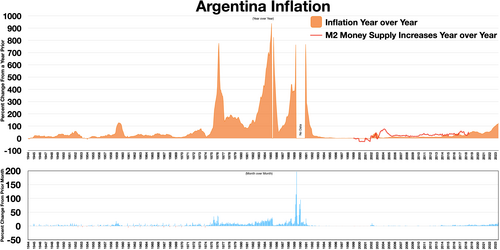
Argentina monthly inflation of over 50% in 1989 and 1990 Year-over-year inflation M2 money supply increases year over year Month-over-month inflation 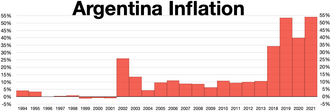
Argentina inflation 1994–2021 - Malaya and Singapore: During the Japanese occupation, "banana notes" were issued, named for the banana tree motif on the 10-dollar bill.
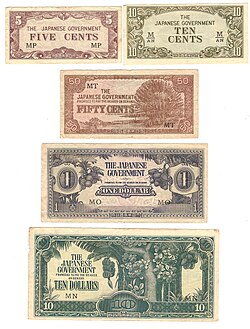
Banana banknotes issued by the Japanese Government during the occupation of Malaya. The term "banana notes" originates from the motif of banana trees on the currency's 10-dollar banknote.
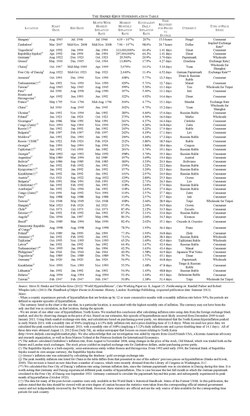
Comparison of Historic Hyperinflations
The following table summarizes some of the most extreme hyperinflationary events in history based on monthly peak rates.
| Country | Currency | Peak Month | Monthly Rate (%) | Price Doubling Time | Highest Denomination |
|---|---|---|---|---|---|
| Hungary | Pengő | July 1946 | 4.19 × 10¹² | 14.82 hours | 100 quintillion |
| Zimbabwe | Zim Dollar | Nov 2008 | 7.96 × 10¹⁰ | 24.35 hours | 100 trillion |
| Yugoslavia | Dinar | Jan 1994 | 3.13 × 10⁹ | 1.39 days | 500 billion |
| Germany | Papiermark | Oct 1923 | 29,500 | 3.65 days | 100 trillion |
| Greece | Drachma | Oct 1944 | 13,800 | 4.21 days | 100 billion |
| China | Yuan | April 1949 | 5,070 | 5.27 days | 6 billion |
Frequently Asked Questions
What is the difference between inflation and hyperinflation?
While inflation is a general increase in prices over time, hyperinflation is an extreme, accelerating version where prices rise so rapidly that the currency loses its functional value almost immediately, often measured by monthly rates exceeding 50%.
Why do governments print money during these crises?
Governments often print money when they cannot collect enough tax revenue and cannot borrow from other sources to fund essential spending, often due to war, political collapse, or economic shocks.
What is "dollarization"?
Dollarization is a form of currency substitution where a country replaces its own failing local currency with a stable foreign currency, such as the US dollar, to stabilize the economy.
How does hyperinflation affect the real stock of money?
The real stock of money decreases because prices rise faster than the government can print new money. As people spend their currency as quickly as possible to avoid losses, the actual purchasing power of the circulating money drops.
Which country had the worst hyperinflation in history?
Hungary experienced the most severe episode, peaking in July 1946 with a monthly inflation rate of 4.19 trillion percent and prices doubling every 14.82 hours.