Enabling Act of 1933: The Legal Path to Nazi Dictatorship
The Enabling Act of 1933, officially titled the Law to Remedy the Distress of People and Reich (Gesetz zur Behebung der Not von Volk und Reich), served as the legal mechanism that dismantled German democracy. By granting the German Cabinet—and specifically Chancellor Adolf Hitler—the authority to enact laws without the consent of the parliament or the president, this legislation transformed the democratic Weimar Republic into a totalitarian state.
This act effectively removed the checks and balances inherent in the constitution, allowing the executive branch to override legislative oversight and paving the way for the absolute rule of the Nazi Party.
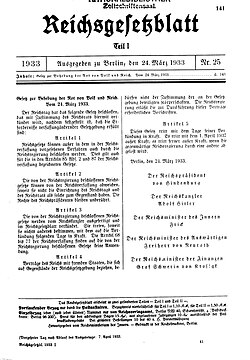
Key Facts
- Official Name: Law to Remedy the Distress of People and Reich.
- Enacted: March 23, 1933.
- Primary Effect: Allowed the Chancellor to create laws without the Reichstag or President.
- Voting Result: 444 in favor, 94 against, 109 absent.
- Repealed: September 20, 1945, via Control Council Law No. 1.
- Signatories: Paul von Hindenburg, Adolf Hitler, and ministers Frick, von Neurath, and Schwerin von Krosigk.
The Road to Absolute Power
The Rise of Hitler and the Reichstag Fire
Adolf Hitler was appointed Chancellor on January 30, 1933. Shortly after, he sought to dissolve the Reichstag (the German parliament) to consolidate power. A critical turning point occurred on February 27, 1933, when the Reichstag building was set on fire. Hitler used this event to accuse communists of attempting to overthrow the government.
Using the fire as a pretext, Hitler persuaded President Paul von Hindenburg to sign the Reichstag Fire Decree. This emergency decree suspended most civil liberties, including freedom of speech, assembly, and the right to due process, enabling a violent crackdown on political opponents, particularly the Communist Party.
The March 1933 Election
In the general election of March 5, 1933, the Nazis allied with conservative and nationalist factions, funded by major German industrialists. The election was characterized by extreme voter intimidation carried out by the Sturmabteilung (SA), the Nazi militia. Despite this, the Social Democrats remained the primary source of opposition.

Legislative Maneuvering and Passage
The Legal Text and its Implications
The Enabling Act consisted of several articles that fundamentally altered the German legal landscape. Article 1 allowed the government to enact laws independently of the constitutional procedure. Articles 1 and 4 specifically gave the government the power to draw up the budget and approve treaties without input from the Reichstag.
While previous governments had used Article 48 emergency decrees, those required the President's approval. The Enabling Act removed the President from the process entirely, creating a unique situation in German history where laws were passed without the head of state's contribution.
Overcoming the Quorum
To pass a constitutional amendment, the Weimar Constitution required a two-thirds quorum of the entire membership (432 out of 647 deputies). To ensure the bill passed, Reichstag President Hermann Göring manipulated the rules by excluding 81 absent Communist (KPD) deputies, reducing the required quorum to 378.
The Final Vote
The vote took place on March 23, 1933. All parties except the Social Democratic Party (SPD) voted in favor. With the KPD banned and many SPD members arrested or in hiding, the final tally was 444 in favor and 94 against. The act passed with 83% support from those present.
| Party | Total Deputies | For | Against | Absent |
|---|---|---|---|---|
| Nazi Party (NSDAP) | 288 | N/A | N/A | N/A |
| Social Democratic Party (SPD) | 120 | N/A | 94 | 26 |
| Communist Party (KPD) | 81 | N/A | N/A | 81 |
| Centre Party | 73 | 72 | N/A | 1 |
| Other Parties | 85 | N/A | N/A | N/A |
| Total | 647 | 444 | 94 | 109 |
Consequences and Legal Violations
The End of Pluralism
Following the act, the Law Against the Formation of Parties (July 14, 1933) made the Nazi Party the only legal political entity in Germany. Although the Weimar Constitution technically remained in effect, it was rendered meaningless as Hitler exercised all legislative powers personally, eventually stopping full Cabinet meetings after 1938.
Constitutional Contradictions
The regime frequently violated its own Enabling Act. For example, the Law on the Reconstruction of the Reich (January 30, 1934) dissolved state parliaments and abolished the Reichsrat (the body representing the states), despite Article 2 of the Enabling Act explicitly protecting the Reichsrat's institutions. Furthermore, when President Hindenburg died in August 1934, Hitler seized the presidency, another move that contradicted the act's provision that presidential powers remain undisturbed.
Legacy and Modern Legal Protections
The Enabling Act was renewed in 1937 and 1939, and later extended through 1947. Historian Richard J. Evans has argued that the act was legally invalid from the start due to Göring's arbitrary reduction of the quorum.
To prevent such a collapse of democracy from recurring, the Basic Law of 1949 (the current German constitution) stipulates that only constitutionally endowed bodies can enact laws. Additionally, the Federal Constitutional Court can label parties as verfassungsfeindlich (hostile to the constitution) to ensure that a popular majority cannot be used to install another autocratic regime.
Frequently Asked Questions
What was the primary purpose of the Enabling Act of 1933?
The primary purpose was to give the German Cabinet, and specifically Adolf Hitler, the power to enact and enforce laws without the need for approval from the Reichstag or the President.
How did the Reichstag fire contribute to the act's passage?
The fire allowed Hitler to implement the Reichstag Fire Decree, which suspended civil liberties and enabled the persecution of political enemies, creating an atmosphere of fear and removing opposition before the vote.
Which political party was the only one to vote against the act?
The Social Democratic Party (SPD) was the only party to vote against the Enabling Act, with 94 deputies casting opposing votes.
Was the Enabling Act legally valid?
While it was passed by the government of the time, some historians, such as Richard J. Evans, argue it was invalid because the quorum requirements for constitutional amendments were illegally manipulated by Hermann Göring.
When was the Enabling Act finally repealed?
The act was repealed on September 20, 1945, under Control Council Law No. 1, which sought to dismantle Nazi laws following the end of World War II.