Hox Genes: The Master Architects of Animal Body Plans
Imagine a construction site where every worker knows exactly where to place a beam or a window, not because they are building it themselves, but because a master blueprint specifies the exact coordinates for every feature. In the biological world, Hox genes serve as this blueprint. A subset of homeobox genes, Hox genes are a group of related genes that specify the regions of an embryo's body plan along the head-tail (anterior-posterior) axis.
Hox proteins do not physically build the organs or limbs; instead, they encode and specify the characteristics of "position." By conferring positional identity, they ensure that the correct structures—such as wings, legs, or specific vertebrae—form in the correct locations. If these genetic instructions are misread, the results can be dramatic, leading to body parts appearing in entirely the wrong places.
To visualize this, think of a play director. The director doesn't act in the scenes or build the sets, but they call out which scene should happen next. If the director calls the scenes out of order, the entire play becomes nonsensical. Similarly, mutations in Hox genes can cause a limb to grow where an antenna should be.
Key Facts
- Function: Specify positional identity along the head-tail axis of animal embryos.
- Mechanism: They act as regulatory switches that control other target genes responsible for actual structure formation.
- Conservation: These genes are found across a vast array of species, from fruit flies to humans.
- Mutations: Errors in Hox genes can lead to homeotic transformations, where one body part is replaced by another.
- Nobel Recognition: The identification of these genes in Drosophila melanogaster earned Ed Lewis, Christiane Nüsslein-Volhard, and Eric F. Wieschaus the Nobel Prize in 1995.
Hox Gene Expression and Development
The timing and location of Hox gene expression vary significantly depending on the organism's life cycle. In ciliated larvae, these genes are often expressed only in tissues destined to become part of the adult body. For species undergoing gradual metamorphosis, Hox genes are activated in larval tissues (usually the trunk) that persist into adulthood. Conversely, in species with complete metamorphosis, expression is primarily found in juvenile rudiments and is absent in transient larval tissues.
Interestingly, not all larvae utilize these genes; for example, the pilidium larva of Nemertea and the hemichordate Schizocardium californicum do not express Hox genes during their larval stage.
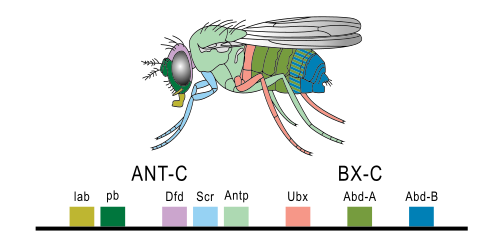
The Case of Drosophila melanogaster
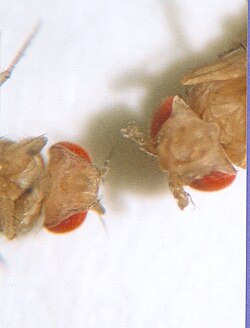
In the fruit fly, specific Hox genes govern the identity of different segments. Key genes include Labial, Proboscipedia, Deformed, Sex combs reduced, Antennapedia, Ultrabithorax, Abdominal-A, and Abdominal-B. A famous example of a mutation occurs in the Antennapedia gene, where a failure in positional signaling can cause legs to grow on the head instead of antennae.
Evolutionary Diversity and Classification
Hox genes are highly conserved, meaning they have remained similar across millions of years of evolution. However, the complexity of these gene clusters has increased in more complex animals. While invertebrates may have a single cluster, vertebrates have undergone genome duplications.
Vertebrate Hox Clusters
Humans and mice possess 39 Hox genes organized into four distinct clusters located on different chromosomes. These clusters (HOXA, HOXB, HOXC, and HOXD) provide the redundant and refined instructions necessary to build complex vertebrate structures, such as the intricate shapes of the spinal vertebrae.
![Hox genes in various species, using a sequence grouping.[22]](/images/40/32/4032ec2182f243e0bc19ed8ee74bd7b9a74df2da71d489cd8b8310118e2d244f.jpg)
Comparative Anatomy in Arthropods
In arthropods, the expression of Hox genes 7, 8, and 9 is critical for segment identity. Through a process called heterochrony (changes in the timing or location of developmental events), these genes can shift by up to three segments between different groups. For instance, segments with maxillipeds (specialized feeding legs) are characterized by the expression of Hox gene 7.
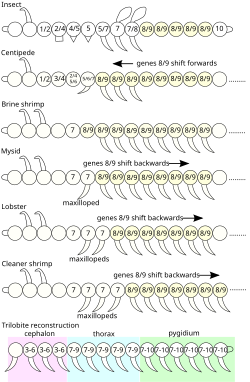
Genetic Regulation and Target Genes
Hox genes exert their influence by regulating other "target" genes. They can either activate a gene to promote a structure or repress a gene to prevent it from forming in a specific region.
| Organism | Target Gene | Normal Function | Hox Regulator | Action |
|---|---|---|---|---|
| Drosophila | distal-less | Limb formation pathway | ULTRABITHORAX / ABDOMINAL-A | Represses |
| Drosophila | decapentaplegic | Gut visceral morphology | ULTRABITHORAX | Activates |
| Drosophila | reaper | Apoptosis (cell death) for head boundaries | DEFORMED | Activates |
| Drosophila | decapentaplegic | Prevents gut cell changes in posterior | ABDOMINAL-B | Represses |
| Mouse | EphA7 | Cell adhesion for digits/carpals/tarsals | HOX-A13 | Activates |
| Mouse | Cdkn1a | Myelomonocyte differentiation | Hox-A10 | Activates |
Frequently Asked Questions
Do Hox genes actually create the body segments?
No. Hox genes do not form the actual segments themselves; instead, they confer a "positional identity" to segments that have already been formed, telling the body what structures should grow in those specific areas.
What happens when a Hox gene mutates?
Mutations can lead to homeotic transformations, where one body part is replaced by another. A classic example is the Antennapedia mutation in fruit flies, which results in legs growing where antennae should be.
How many Hox genes do humans have?
Humans have 39 Hox genes, which are organized into four clusters (HOXA, HOXB, HOXC, and HOXD) across four different chromosomes.
Are Hox genes found in all animals?
Hox genes are widespread across the animal kingdom, including vertebrates and invertebrates. However, some specific larval stages, such as those of certain hemichordates and Nemertea, do not express them.
What is the relationship between Hox genes and homeobox genes?
Hox genes are a specific subset of the larger family of homeobox genes. All Hox genes contain a homeobox sequence, but not all homeobox genes are Hox genes.