Embryology: The Science of Prenatal Development and Its History
Embryology (from the Greek embryon, meaning 'the unborn', and logia, meaning 'study') is the specialized branch of zoology dedicated to the prenatal development of gametes (sex cells), fertilization, and the subsequent growth of embryos and fetuses. This field also encompasses teratology, the study of congenital disorders that occur before birth.
The journey from a single cell to a complex organism is one of nature's most intricate processes. While modern science relies on high-resolution imaging and molecular biology, the quest to understand how life begins has spanned millennia, evolving from philosophical speculation to a rigorous empirical science.
Key Facts
- Epigenesis is the accepted theory that organisms develop from a seed or egg through a sequence of steps.
- Preformationism was an early, now-disproven theory suggesting organisms develop from miniature versions of themselves.
- Karl Ernst von Baer is a pivotal figure in modern embryology, known for observing the mammalian ovum in 1827.
- Germ Layer Theory explains how embryos develop in progressive steps, often appearing similar across different species in early stages.
- Ultrasound technology, introduced in the late 1950s, provided the first accurate developmental chronology of the human fetus.
The Evolution of Embryological Theory
Preformationism vs. Epigenesis
Early scientific thought was divided between two primary concepts. Marcello Malpighi championed preformationism, the idea that an organism exists fully formed in miniature within the gamete. A famous historical illustration of this concept is the "homunculus," a tiny person imagined to reside inside a sperm cell.
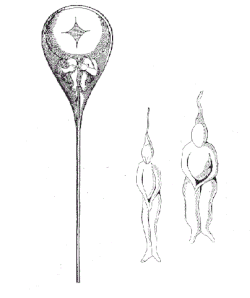
In contrast, epigenesis—a concept proposed in antiquity by Aristotle—posits that an organism develops gradually from a seed or egg through a series of structured stages. This is the foundation of modern developmental biology.
The Birth of Modern Embryology
While Renaissance anatomists like Leonardo da Vinci and Aldrovandi made accurate observations, the field shifted toward a modern scientific footing with Karl Ernst von Baer. In 1827, von Baer's observation of the mammalian ovum corrected previous misconceptions. Along with Heinz Christian von Pander, he proposed the germ layer theory, which describes the progressive stages of embryonic development and explains why embryos of different species often look similar during early growth.
Biological Processes in Early Development
Cleavage and Early Stages
Following fertilization, the embryo undergoes cleavage, a series of rapid cell divisions. This process can be categorized into two main types:
- Holoblastic (Total) Cleavage: The entire egg is divided into blastomeres.
- Meroblastic (Incomplete) Cleavage: Only a portion of the egg divides, typically occurring in eggs with large amounts of yolk.
As these divisions progress, the embryo moves through distinct morphological stages, starting from the morula (a solid ball of cells) to the blastula (a hollow sphere of cells).
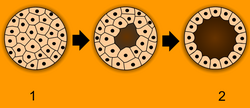
Gastrulation and Germ Layers
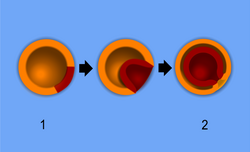
The next critical phase is gastrulation, where the blastula reorganizes into a multi-layered structure called the gastrula. This stage establishes the blastopore and the primary germ layers: the ectoderm (outer layer) and the endoderm (inner layer).
| Stage | Description | Key Characteristic |
|---|---|---|
| Morula | Solid ball of cells | Result of initial cleavage |
| Blastula | Hollow sphere of cells | Formation of the blastocoel |
| Gastrula | Multi-layered embryo | Formation of ectoderm and endoderm |
Historical and Philosophical Perspectives
Ancient and Classical Views
Ancient civilizations had varying interpretations of prenatal life. In Ancient Greece, Hippocrates and Aristotle laid early foundations. Herophilus, in the 5th century BC, identified the brain as the center of intellect rather than the heart and performed early dissections of embryos. Other traditions, such as those in Ancient Egypt and Asia, also contributed to early understandings of reproduction.
Theological and Patristic Debates
Early Christian writers often discussed embryology through the lens of the soul's origin. Three primary views emerged:
- Prohyparxis: The soul pre-exists and enters the embryo at conception.
- Synhyparxis: The soul and body are created simultaneously at conception.
- Methyparxis: The soul enters the body after it has been physically formed.
These debates were often tied to Christological arguments and the interpretation of scriptural texts. For instance, some argued that the soul developed in stages—from a plant-like soul to a sensitive soul, and finally to a rational human soul—mirroring Aristotelian thought.
Frequently Asked Questions
What is the difference between a morula and a blastula?
A morula is a solid cluster of cells produced by early cleavage, whereas a blastula is a later stage where the cells arrange themselves into a hollow sphere.
Who is considered the father of modern embryology?
Karl Ernst von Baer is widely credited with the birth of modern embryology due to his 1827 observation of the mammalian ovum and his development of the germ layer theory.
What is teratology?
Teratology is the branch of embryology that specifically studies congenital disorders and abnormalities that occur during prenatal development.
What was the "homunculus" theory?
The homunculus theory was part of preformationism, suggesting that a fully formed, miniature human existed inside the sperm or egg and simply grew in size during pregnancy.
How did ultrasound change the study of embryology?
The introduction of uterine scanning via ultrasound in the late 1950s allowed scientists to observe the human fetus in vivo, providing the first accurate chronology of human fetal development.