Honey: Production, Properties, and Global Significance
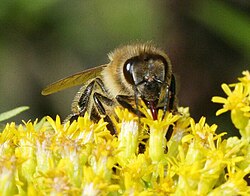
Honey is a sweet, viscous substance produced by various species of bees, most notably the honey bee. Serving as a vital energy source to nourish bee colonies, honey is created through a sophisticated process of gathering and refining sugary secretions from plants—primarily floral nectar—or from other insects, such as the honeydew produced by aphids.
The transformation of nectar into honey involves both biological and physical processes. Bees refine the substance through regurgitation and enzymatic activity within their bodies. Once stored in the hive, the bees facilitate water evaporation, which concentrates the sugars and results in the thick, sticky consistency characteristic of honey.
Key Facts
- Production: Created by honey bees and other bee species through nectar collection and enzymatic refinement.
- Composition: Consists of approximately 82% carbohydrates and 17% water.
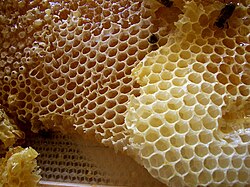
- Storage: Honey bees use hexagonal beeswax cells called honeycombs for storage.
- Global Leaders: China is the world's largest producer of honey.
- Medical Use: Recognized for its antibacterial properties and use in treating wounds and burns.
The Process of Honey Production
Biological Formation
Honey bees stockpile their food within the hive in a structure known as the honeycomb. This structure consists of thousands of hexagonal prismatic wax cells. While honey bees use these combs, other species, such as stingless bees, utilize pots made from a combination of wax and resin.
Human Collection and Apiculture
Humans harvest honey from both wild colonies and domesticated hives. The practice of managing honey bees is called apiculture (or beekeeping), while the specific cultivation of stingless bees is known as meliponiculture.
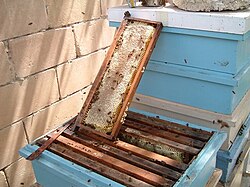
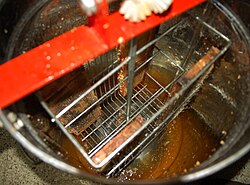
The extraction process typically involves removing the honey from the honeycomb, followed by filtering to ensure purity before packaging.
Physical and Chemical Properties
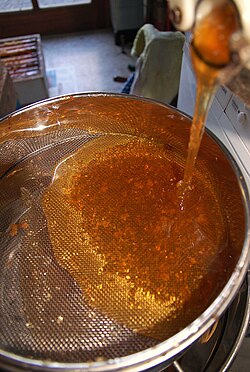
Honey is characterized by its high viscosity and low surface tension, which gives it a distinct sheet-like appearance when poured. Its density typically ranges between 1.38 and 1.45 kg/L at 20 °C (68 °F).
![Pouring raw honey. The sheet-like appearance of the flow is the result of high viscosity and low surface tension, contributing to the stickiness of honey.[49][50]](/images/67/63/676353c2d4fe7e7422fabca13cab529d47f040310779f7b8c3d5e7e9d272e168.jpg)
Phase Transitions and Aging
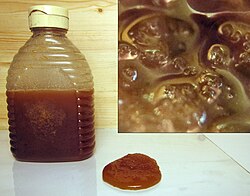
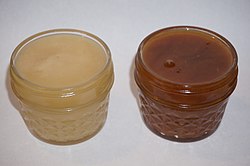
Over time, honey may undergo crystallization, where glucose grains form within the fructose mixture. Additionally, aged honey can change in color and flavor due to the Maillard reaction, a chemical reaction between amino acids and reducing sugars that occurs over time at room temperature.
Classification and Quality Grading
Plant Sources
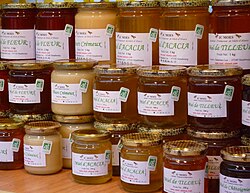
Honey is classified based on its floral origin:
- Monofloral: Derived primarily from the nectar of a single plant species.
- Polyfloral: Derived from a variety of different flower sources.
- Honeydew Honey: Produced from the secretions of insects rather than floral nectar.
USDA Grading Standards
In the United States, the USDA grades extracted honey based on soluble solids, flavor, aroma, clarity, and the absence of defects.
| Grade | Soluble Solids | Flavor and Aroma | Clarity | Defects |
|---|---|---|---|---|
| A | ≥ 81.4% | Good | Clear | Practically free |
| B | ≥ 81.4% | Reasonably good | Reasonably clear | Reasonably free |
| C | ≥ 80.0% | Fairly good | Fairly clear | Fairly free |
| Substandard | Fails Grade C | - | - | - |
Nutrition and Health
Honey is primarily a source of energy, providing 300 calories per 100g. It is composed almost entirely of carbohydrates (glucose and fructose) and contains no fat. While it contains trace amounts of vitamins (such as B2, B3, B5, B6, B9, and C) and minerals (iron, potassium, and zinc), these are not present in significant nutritional quantities.
Medical Applications
Honey is used in both modern and folk medicine. Its antibiotic and antibacterial properties make it effective for treating burns and wounds. It is also commonly used as a remedy for coughs, particularly in children.
Health Hazards
Despite its benefits, honey can pose risks. It may contain spores that cause botulism, making it dangerous for infants. Some varieties of honey can also be toxic depending on the floral source.
Global Production and History
Honey production is a global industry with significant output from several key nations. According to FAOSTAT data, China leads the world in production volume.
| Country | Production Quantity |
|---|---|
| China | 463,500 |
| Turkey | 114,886 |
| Ethiopia | 84,591 |
| Iran | 80,389 |
| Argentina | 73,395 |
| United States | 62,855 |
| World Total | 1,893,805 |
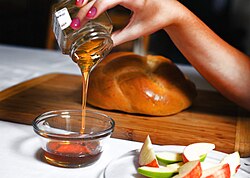
The human relationship with honey is ancient. Evidence of honey seeking appears in 8,000-year-old cave paintings in Valencia, Spain. It also holds deep religious significance; for example, in Judaism, honey is eaten with apple slices during Rosh Hashanah to symbolize a sweet New Year.

Frequently Asked Questions
What is the difference between monofloral and polyfloral honey?
Monofloral honey is produced from the nectar of one specific plant species, resulting in a more distinct flavor profile. Polyfloral honey is derived from many different types of flowers, creating a blended taste.
Why does honey crystallize?
Crystallization occurs when the glucose in the honey separates from the fructose mixture and forms individual grains, changing the texture from a smooth liquid to a semi-solid state.
Is honey safe for infants?
No, honey should not be given to infants because it can contain spores that lead to botulism, a serious form of food poisoning.
What is the Maillard reaction in honey?
The Maillard reaction is a chemical process that occurs as honey ages at room temperature, leading to noticeable changes in the honey's color and flavor over time.
How is honey graded in the United States?
The USDA grades honey (A, B, C, or Substandard) based on its soluble solids content, flavor, aroma, clarity, and the presence or absence of defects.