The Essential Guide to Honey Bees: Biology, History, and Global Importance
Honey bees are among the most fascinating and ecologically significant insects on Earth. Belonging to the genus Apis, these social insects have coexisted with humans for millennia, playing a vital role in the stability of our global food systems. From their complex social structures to their incredible ability to pollinate a vast array of crops, understanding the honey bee is essential to understanding the health of our planet.
![Distribution of honey bees around the world[12]](/images/9e/dd/9eddb17881e336b945d79d7c88d984becc8612a0af2341cde0dd5139f3cc6f59.webp)
Key Facts
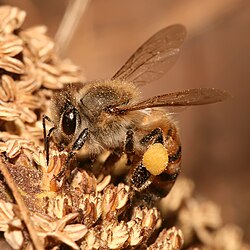
- Scientific Classification: Kingdom Animalia, Phylum Arthropoda, Class Insecta, Order Hymenoptera, Family Apidae, Genus Apis.
- Pollination Impact: Honey bees pollinate 80% of all flowering plants and more than 130 types of fruits and vegetables.
- Global Food Security: Approximately 35% of the world's food crops depend on animal pollinators.
- Social Structure: Colonies consist of distinct castes, including queens, workers, and drones.
- Temporal Range: Honey bees have existed from the Oligocene epoch to the present day.
Taxonomy and Species Diversity
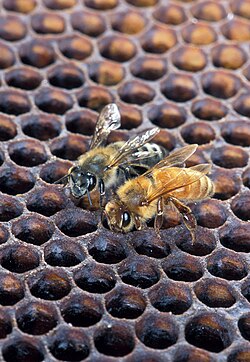
The genus Apis is divided into several subgenera, each containing different species adapted to various environments. The most well-known is the mellifera subgroup, which includes the Western honey bee (Apis mellifera). Other significant groups include the Micrapis subgenus (such as Apis florea) and the Megapis subgenus (including the giant honey bee Apis dorsata).
The evolutionary history of these bees is deep, with fossil evidence such as †A. miocenica indicating that honey bees have been part of the Earth's ecosystem for millions of years.

The Western Honey Bee (Apis mellifera)
The Western honey bee is a highly studied species. While it is not native to the Americas, it was introduced by European colonists. The German honey bee (A. m. mellifera) arrived in 1622, followed later by the Italian honey bee (A. m. ligustica). These bees spread rapidly, often preceding human settlers, and have become central to American agriculture.
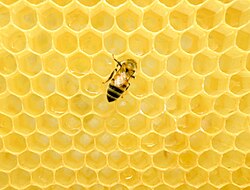
Other Notable Species
- Apis cerana: The Eastern honey bee.
- Apis dorsata: The giant honey bee.
- Apis laboriosa: A large species found in high-altitude regions.
Biology and Social Structure
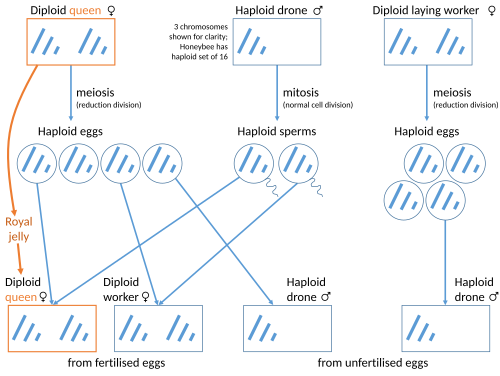
Honey bees are social insects that operate within a highly organized colony. They utilize a haplodiploid system of sex determination, a biological mechanism where males (drones) develop from unfertilized eggs and females (queens and workers) develop from fertilized eggs.
The Three Castes
A healthy colony relies on the specialized roles of three distinct castes:
- Queens: The reproductive heart of the colony.
- Workers: Sterile females responsible for foraging, cleaning, defending the hive, and nursing the brood.
- Drones: Males whose primary role is to mate with a queen.
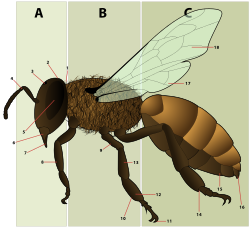
Anatomy and Foraging
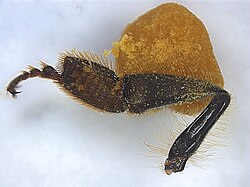
Worker bees are biological marvels designed for efficiency. One of their most impressive features is the corbicula, or pollen basket, located on their hind legs. As foragers collect pollen, they use their legs to transfer the grains from inner combs to this specialized basket for transport back to the hive.

The Importance of Pollination
![Shows active colonies on January 1, 2015 with U.S. state count.[121] The highest states being those like California and Florida with the most colonies.](/images/ce/29/ce2910e240a68e575e19fea4206d6f467038a0957c9ff1a2b227d0275508f9b1.png)
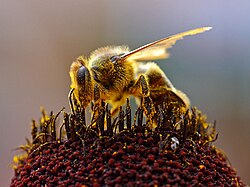
Honey bees are considered crucial to the global food supply. They are responsible for pollinating more than 100 of the crops humans consume, including nuts, vegetables, berries, citrus, and melons. Without these pollinators, the diversity and availability of our food would be drastically reduced.
| Metric | Impact Value |
|---|---|
| Percentage of flowering plants pollinated by honey bees | 80% |
| Types of fruits and vegetables pollinated | 130+ |
| Global food crops depending on animal pollinators | ~35% |
| Total flowering plants depending on animal pollinators | ~75% |
Beekeeping and Management
![Shows active colonies on January 1, 2023 with state count.[122] The highest states being those like California and Texas with the most production.](/images/3f/2a/3f2a9c21beafc04681f97eaeb523db8cbca1b93f1d2ae8e29b47c4da7777e6ae.png)
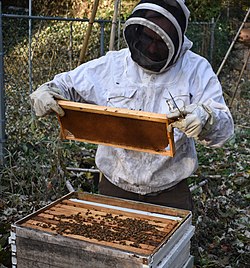
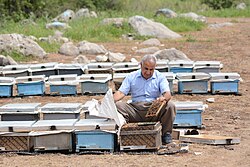
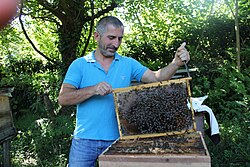
Humans have managed honey bees for centuries through beekeeping. Modern methods often use modular systems, such as the Langstroth hive, which allows beekeepers to inspect frames and harvest honey more easily. Professional beekeepers must constantly monitor hives for health, breeding, and productivity.
Frequently Asked Questions
What are the different types of honey bees?
Honey bees are categorized into several species and subgenera. The most common is Apis mellifera (the Western honey bee), but there are also species like Apis cerana (Eastern honey bee) and Apis dorsata (giant honey bee).
How do honey bees collect pollen?
Foraging worker bees collect pollen from flowers and use their legs to pack it into a specialized structure on their hind legs called the corbicula, or pollen basket, to carry it back to the colony.
Why are honey bees important for food?
Honey bees are essential pollinators. They pollinate 80% of all flowering plants and are responsible for the reproduction of more than 100 different types of crops, including many fruits, vegetables, and nuts that humans rely on for nutrition.
What is the difference between a worker bee and a drone?
Worker bees are sterile females that perform all the labor in the hive, such as foraging and nursing. Drones are males whose sole biological purpose is to mate with a queen.
How do honey bees defend themselves?
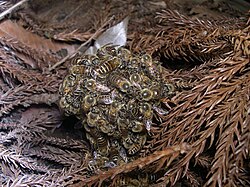
Honey bees can defend their colonies through various methods, including stinging or, in the case of certain species like Apis cerana japonica, forming a "heat ball" around intruders like hornets to kill them with trapped body heat.