Western Honey Bee
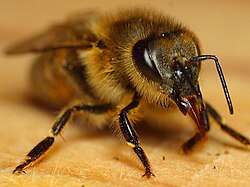
The Western honey bee (Apis mellifera) is one of the most significant insects in human history, serving as a cornerstone for global agriculture and a primary source of honey and wax. As a highly social invertebrate, it operates within a complex colony structure that allows it to thrive across diverse environments, from its ancestral roots in Africa and Europe to its introduction in the Americas.
Humans have shared a relationship with these bees for millennia. Evidence of honey collection appears in rock art from France and Spain dating back to approximately 7,000 BCE, while ancient Egyptian tomb paintings suggest that beekeeping was established before 2600 BC. By 1622, Europeans had introduced the species to North America, forever altering the continent's pollination landscape.

Key Facts

- Scientific Name: Apis mellifera
- Domestication: One of the few invertebrate animals to be domesticated by humans.
- Temperature Needs: Requires an internal body temperature of 35 °C (95 °F) to fly.
- Genome: Fully sequenced and analyzed as of October 28, 2006.
- Conservation Status: Listed as Data Deficient by the IUCN.
- Global Reach: 31 currently recognized subspecies.
Biological Classification and Distribution
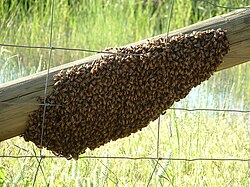
The Western honey bee belongs to the family Apidae and the genus Apis. Its temporal range extends from the Oligocene epoch to the present day. While naturally distributed across various regions, human intervention has expanded its reach globally.

Colony Structure and Life Cycle
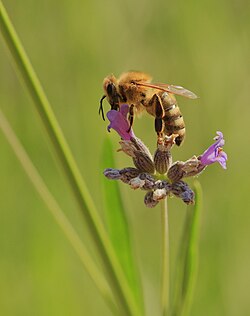
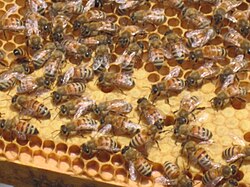
The life of a honey bee is defined by its role within the colony. The population is divided into three distinct castes: the queen, workers, and drones.
The Queen
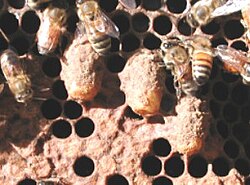
The queen is the reproductive heart of the colony. A colony determines the need for a new queen periodically, often due to the aging of the current queen or the colony's growth. Queen brood cells, which are peanut-shaped, extend outward from the brood comb to house the developing royalty.
Workers and Drones
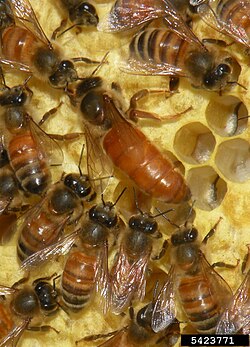
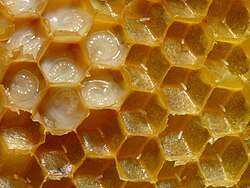
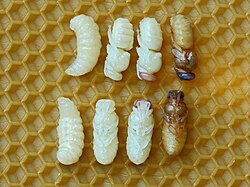
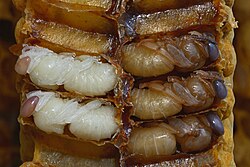
Workers are females that handle the daily operations of the hive, including foraging, nursing, and hive maintenance. Drones are males whose primary purpose is to mate with a queen. The development of these bees progresses from eggs to larvae and finally to pupae before they emerge as adults.
Behavior and Physiology
One of the most remarkable aspects of Apis mellifera is its ability to regulate temperature, a process known as thermoregulation. This is critical for the survival of the brood and the production of wax.
- Optimal Flight Temperature: 35 °C (95 °F).
- Winter Cluster: Internal temperatures can drop to 20–22 °C (68–72 °F).
- Immobility: Bees become immobile below 7–10 °C (45–50 °F).
- Heat Tolerance: Activity slows above 38 °C (100 °F), though they can tolerate up to 50 °C (122 °F) for short durations.
Communication within the hive is managed through complex pheromones and behavioral signals, ensuring the colony acts as a single, coordinated unit.
Domestication and Beekeeping
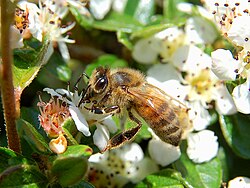
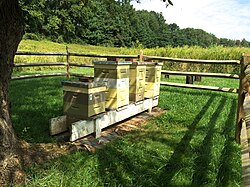
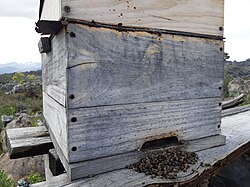
Beekeepers have selectively bred Western honey bees to enhance traits that benefit human agriculture and honey production. Key selected features include:
- Increased honey production and disease resistance.
- Reduced aggressiveness and a lower tendency to swarm.
- The ability to survive cold weather and periods of food scarcity.
- Ease of pacification using smoke.
Products of the Hive
The Western honey bee provides several valuable substances:
- Honey: A functional food produced from floral nectar.
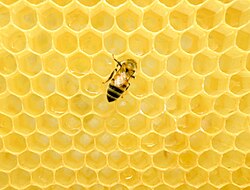
- Beeswax: Secreted by wax glands for hive construction.
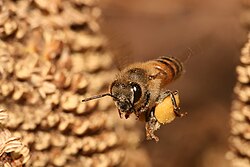
- Bee Pollen: Collected from flowers and stored as a protein source.
- Propolis: A resinous mixture used to seal gaps in the hive.
- Royal Jelly: A nutrient-rich secretion used to feed larvae and the queen.
Ecological Role and Modern Challenges
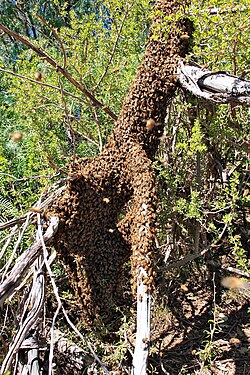
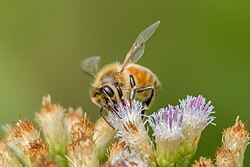
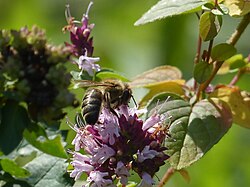
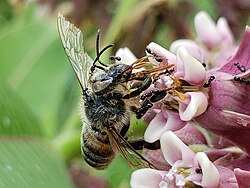
Beyond honey production, these bees are vital pollinators. By transferring pollen from one flower to another, they enable the reproduction of countless plant species and crops.
However, the species faces significant modern threats. Since 2007, researchers have focused on Colony Collapse Disorder (CCD), a phenomenon characterized by the sudden decline of bee colonies in various regions. Other hazards include parasites, pesticides (such as neonicotinoids and glyphosate), and predators.
| Feature | Detail |
|---|---|
| Scientific Name | Apis mellifera |
| Flight Temp | 35 °C (95 °F) |
| Key Products | Honey, Wax, Propolis, Royal Jelly |
| Domestication Origin | Likely Ancient Egypt |
| Genome Status | Fully sequenced (2006) |
Frequently Asked Questions

What is the ideal temperature for a honey bee to fly?
The Western honey bee requires an internal body temperature of 35 °C (95 °F) to be capable of flight.
How do beekeepers manage honey bee aggressiveness?
Beekeepers use selective breeding to reduce aggressiveness and often use smoke to pacify the bees during hive inspections.
What is Colony Collapse Disorder?
Colony Collapse Disorder is a decline in Western honey bee colonies observed in several regions since 2007, attributed to a variety of stressors including pesticides and parasites.
What are the different castes in a honey bee colony?
A colony consists of one queen (the reproductive female), drones (males for mating), and workers (non-reproductive females that perform all hive labor).
When were honey bees first introduced to North America?
European settlers brought Western honey bees to North America in 1622.