Hitler Youth: The Rise and Fall of the Nazi Party's Youth Wing
The Hitler Youth (German: Hitlerjugend, abbreviated as HJ) served as the official youth wing of the Nazi Party. Established to ensure the ideological loyalty of the next generation, the organization evolved from a small group of volunteers into a massive, state-mandated apparatus of indoctrination—the process of teaching a person or group to accept a set of beliefs uncritically. By the height of the Third Reich, it was the sole legal youth organization for boys in Germany, blending athletic training with paramilitary discipline.
Key Facts
- Founded: July 4, 1926 (officially renamed).
- Dissolved: October 10, 1945, by the Allied Control Council.
- Peak Membership: Approximately 8 million members by 1940.
- Structure: Divided by age and gender, including the Deutsches Jungvolk (boys 10–13) and the League of German Girls (BDM).
- Legal Status: Currently an "unconstitutional organisation" under Section 86 of the German Criminal Code.
Origins and Early Development
The roots of the organization trace back to 1922 with the establishment of the Jugendbund der NSDAP and the Jungsturm Adolf Hitler, the latter of which focused on recruiting for the Sturmabteilung (SA), the Nazi Party's primary paramilitary wing. Following the failed Beer Hall Putsch in 1923, these groups operated clandestinely until the party was reorganized.
On July 4, 1926, the organization was officially named the Hitler-Jugend, Bund deutscher Arbeiterjugend (Hitler Youth, League of German Worker Youth). Under the guidance of figures like Kurt Gruber and Hans Severus Ziegler, the HJ grew steadily, reaching 25,000 members by 1930. In 1931, the HJ was formally integrated into the SA under the command of Ernst Röhm.
Expansion and Mandatory Membership
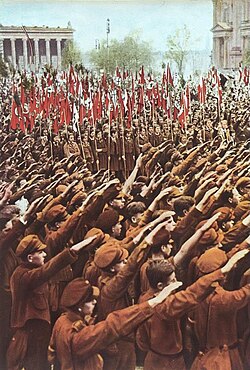
The ascent of the Nazi Party to power in 1933 triggered a dramatic surge in membership. Under the leadership of Baldur von Schirach, the first Reichsjugendführer (Reich Youth Leader), the HJ began forcibly absorbing other youth groups. A notable example was the integration of the 600,000-member Evangelische Jugend (Evangelical Youth) in 1934.
By December 1936, a new law declared the Hitler Youth the only legal youth organization in Germany. Membership became mandatory for those deemed "Aryan." This was further solidified in March 1939 with the Jugenddienstpflicht (Youth Service Duty), which conscripted all German youths regardless of parental objection. Parents who resisted faced government investigation.
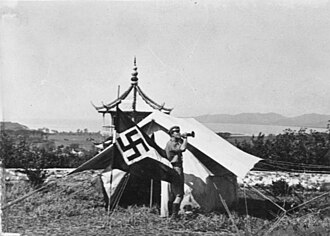
Pressure to join was immense. Students who remained outside the HJ were often forced to write essays explaining their absence, faced taunts from peers and teachers, and were frequently denied diplomas or apprenticeships. The HJ also seized control of all youth sports facilities, effectively isolating non-members from social and athletic life.
Organizational Structure and Doctrine
The HJ was strictly stratified by age and gender. Boys aged 10 to 13 belonged to the Deutsches Jungvolk (DJ), while those aged 14 to 18 were part of the Hitler Youth proper. Girls aged 10 to 18 were organized into the League of German Girls (BDM).
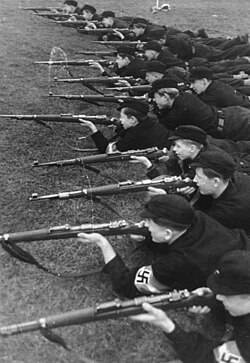
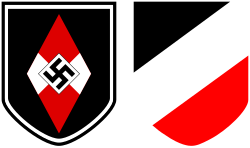
The organization utilized a complex system of ranks and uniforms to instill military discipline. Different colors of Paspel (piping) on uniforms denoted specific specializations, such as light blue for flyers, pink for motor units, and yellow for communications.
| Category | Details |
|---|---|
| Boys (10-13) | Deutsches Jungvolk (DJ) |
| Boys (14-18) | Hitler Youth (HJ) |
| Girls (10-18) | League of German Girls (BDM) |
| Peak Membership | 8 Million (1940) |
| Key Leaders | Baldur von Schirach, Artur Axmann |
Role in World War II
As the war progressed, Artur Axmann, who succeeded Schirach as leader in 1940, shifted the HJ toward an auxiliary military role. Members served in fire brigades, postal services, railway services, and anti-aircraft defense crews.
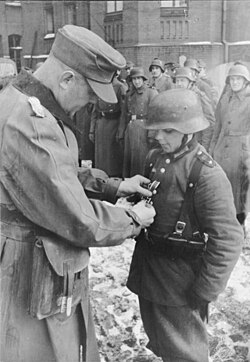
By 1942, Hitler established "Hitler Youth defence training camps" led by Wehrmacht officers to create a military reserve. This culminated in the creation of a Waffen-SS division composed of HJ members born in 1926, a plan approved by Hitler in February 1943.
Post-War Dissolution and Legal Aftermath
Following Germany's surrender in 1945, the Hitler Youth ceased to exist. On October 10, 1945, the Allied Control Council officially outlawed the organization. While the HJ itself was not declared a criminal organization, its adult leadership was prosecuted for the corruption of youth.
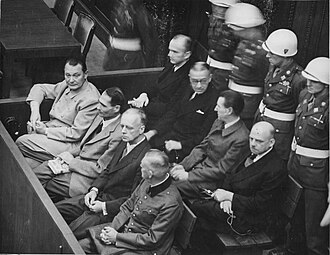
Baldur von Schirach was sentenced to 20 years in prison, though his conviction was based on his actions as Gauleiter of Vienna rather than his leadership of the HJ. Artur Axmann received a 39-month sentence in 1949 and was later fined by a West Berlin court in 1958 for the indoctrination of German youth.
Frequently Asked Questions
Was membership in the Hitler Youth voluntary?
Initially, membership was voluntary. However, by December 1936, it became mandatory for Aryans, and by March 1939, the Youth Service Duty conscripted all German youths, making membership a legal requirement regardless of parental consent.
What happened to the Hitler Youth after World War II?
The organization was disbanded and outlawed by the Allied Control Council on October 10, 1945. In modern Germany, the use of its symbols is illegal under the Criminal Code except for educational or research purposes.
Who were the primary leaders of the organization?
The most prominent leaders were Baldur von Schirach, the longest-serving Reichsjugendführer, and Artur Axmann, who served as the final leader and transitioned the group into a wartime auxiliary force.
Did the Hitler Youth include girls?
Yes, although they were in a separate wing called the League of German Girls (BDM), which operated in parallel to the boys' organizations.
What was the purpose of the Deutsches Jungvolk?
The Deutsches Jungvolk (DJ) served as the junior branch of the Hitler Youth, specifically for boys aged 10 to 13, preparing them for entry into the HJ proper at age 14.