Nazi Book Burnings: The Campaign of Cultural Genocide
In the 1930s, Nazi Germany and Austria witnessed a systematic campaign of intellectual destruction known as the Nazi book burnings. Orchestrated by the German Student Union (Deutsche Studentenschaft, DSt), these events were not merely spontaneous acts of anger but ceremonial purges designed to eliminate any ideology that contradicted Nazism. By targeting the written word, the regime sought to erase the intellectual foundations of its opponents and enforce a rigid, state-mandated cultural purity.
Key Facts
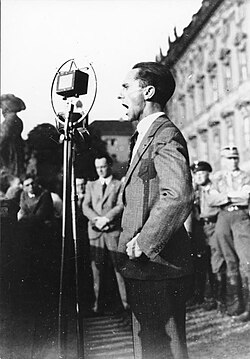
- Primary Organizers: The German Student Union (DSt) under the influence of the Nazi Party.
- Main Target: Books deemed "un-German," including works by Jewish, communist, socialist, and pacifist authors.
- Key Date: May 10, 1933, marked the most prominent mass burnings in university towns.
- Scale: Tens of thousands of volumes were destroyed based on a list of approximately 4,000 titles.
- Cultural Impact: The campaign extended to occupied territories, such as Poland, as part of a broader cultural genocide.
The Path to the Purge
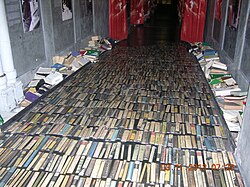
The mass burnings of 1933 were preceded by smaller, violent raids. In Dresden, on March 7 and 8, 1933, the Sturmabteilung (SA) attacked a bookstore and a newspaper office linked to the Social Democratic Party (SPD), destroying fiction, leaflets, and files.
On April 8, 1933, the German Student Union officially announced the "Action against the Un-German Spirit." This campaign was framed as a "cleansing" (Säuberung). To justify the action, the Student Union published the "Twelve Theses," attempting to draw a historical parallel to Martin Luther's 1517 burning of a papal bull. However, historians note this was a false comparison; while Luther's act was a symbolic protest involving a single document, the Nazi campaign was an act of mass censorship and theft of private property.
The Execution of the Burnings
The campaign began in earnest on May 6, 1933, with an attack on the Institute for Sexual Research (Institut für Sexualwissenschaft) in Berlin. Founded by the Jewish sexologist Magnus Hirschfeld, this was the world's first medical center dedicated to gender and sexuality. The Nazis looted thousands of volumes, patient records, and research documents.
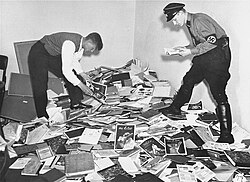
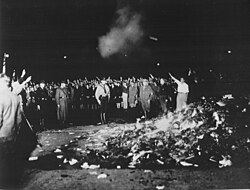
On May 10, 1933, these looted materials were transported to the Bebelplatz (then known as Opernplatz) in Berlin and set ablaze. Over 25,000 volumes were burned in Berlin alone, accompanied by torch-lit parades and live music. Joseph Goebbels, the Minister of Propaganda, addressed a crowd of 40,000, labeling the targeted authors as "intellectual filth" and "Jewish asphalt literati."
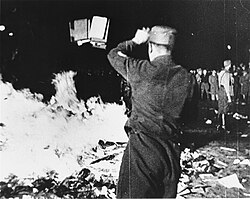
While May 10 was the primary date, some burnings were delayed by rain or moved to June 21 (the summer solstice). In total, 34 university towns participated in these scripted rituals, where students threw banned books into bonfires while reciting "fire oaths."
Targeted Literature
The regime specifically banned literature that fell into the following categories:
- Marxism, Communism, and Bolshevism.
- Pacifist writings.
- "Decadent" or constructivist art and literature (e.g., Bauhaus, George Grosz).
- Any work written by Jewish authors, regardless of the subject.
- Pornography and explicit literature.
- Anything deemed to degrade "German purity."
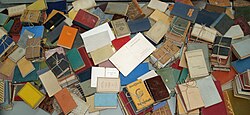
Notable authors whose works were targeted included Albert Einstein, Helen Keller, H.G. Wells, Karl Marx, and Erich Kästner.
Cultural Genocide in Occupied Territories
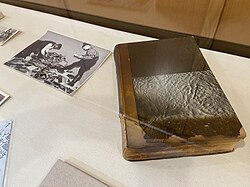
The destruction of knowledge extended beyond German borders. In occupied Poland, the Nazis conducted a campaign of cultural genocide, destroying an estimated 80% of school libraries and 75% of scientific libraries. While millions of books were burned, some rare and ancient Jewish texts were seized to be displayed in a planned museum on Judaism, intended to exist only after the "Final Solution" was complete.
Global Responses and Preservation Efforts
The international community responded with horror. Helen Keller wrote an "Open Letter to German Students," asserting that while books could be burned, the ideas within them would endure. This sentiment echoed the warning of poet Heinrich Heine: "Where they burn books, in the end they will also burn people."
To combat this loss, intellectuals in exile established "Freedom Libraries." In 1934, Alfred Kantorowicz founded the Library of the Burned Books in France. This institution served as a center for anti-Nazi intellectual activity until it was closed and its archives seized by the Nazis following the fall of France.
Similarly, the American Library of Nazi Banned Books opened in Brooklyn, New York, on November 15, 1934. This library collected works by banned authors like Sigmund Freud and Thomas Mann and became a strong advocate for Zionism, viewing the burnings as proof of the urgent need for a Jewish homeland.
Post-War De-Nazification and Memorials
Following World War II, Allied occupation authorities engaged in their own form of censorship during the de-Nazification process. In 1946, they confiscated and destroyed millions of copies of over 30,000 titles that promoted militarism or Nazism. Some critics at the time noted that this process mirrored the Nazi burnings in principle, though the intent was the eradication of fascist ideology.
Today, several memorials stand as reminders of this era:
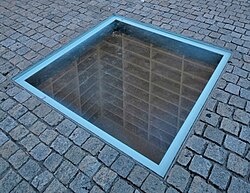
- The Empty Library: An underground room with empty shelves at Bebelplatz, Berlin, designed by Micha Ullman.
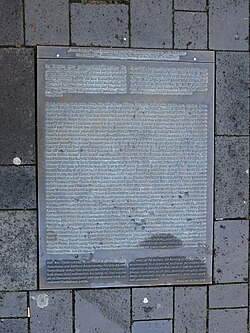
- The Blacklist: A memorial in Munich listing the names of banned authors.
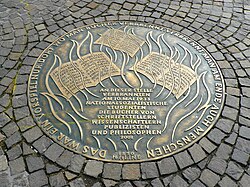
- Römerberg Square: A memorial located in Frankfurt, Hesse.
| Category | Details |
|---|---|
| Primary Date | May 10, 1933 |
| Key Location | Bebelplatz (Opernplatz), Berlin |
| Organizing Body | German Student Union (DSt) |
| Targeted Groups | Jewish, Communist, Socialist, Pacifist, LGBTQ+ authors |
| Estimated Loss | Tens of thousands of volumes; millions in occupied Poland |
Frequently Asked Questions
Who was responsible for the book burnings?
The campaign was primarily conducted by the German Student Union (Deutsche Studentenschaft), acting in alignment with the Nazi Party's goals of cultural and ideological purification.
Why did the Nazis target the Institute for Sexual Research?
The institute, founded by Magnus Hirschfeld, was a pioneer in the study of gender and sexuality. Because its research and library were viewed as decadent and contrary to Nazi morality, it was one of the first targets of the purge.
What was the "Action against the Un-German Spirit"?
It was the official name of the nationwide campaign proclaimed on April 8, 1933, which aimed to "cleanse" German libraries and bookstores of literature that did not align with National Socialist ideology.
How did the world respond to the destruction of these books?
Many intellectuals fled Germany, and others, like Helen Keller, publicly condemned the acts. Efforts were made to preserve the banned works through the creation of "Freedom Libraries" in France and the United States.
What is the significance of the memorial at Bebelplatz?
The memorial, titled "The Empty Library," consists of a glass pane looking down into an underground room of empty white shelves, symbolizing the intellectual void left by the mass burning of books on that site in 1933.