Hegemony Through History: From Ancient City-States to Global Superpowers
Throughout human history, the struggle for hegemony—the political, economic, or military predominance of one state over others—has shaped the rise and fall of civilizations. Unlike a traditional empire that relies on direct annexation and administration, hegemony often involves a dominant power exerting influence over subordinate states that may retain a degree of internal autonomy. From the early city-states of Mesopotamia to the complex geopolitical tensions of the 21st century, the pursuit of dominance has remained a constant driver of global conflict and cooperation.
Ancient Roots of Hegemony
Sumer and the Early City-States
As early as the 30th to 27th centuries BC, the political landscape of Sumer was defined by shifting hegemony. Power moved from city to city, with the title "King of Kish" representing the dominant authority. This era also produced some of humanity's earliest literary reflections on power; the Epic of Gilgamesh serves as an early example of anti-hegemonic resistance, depicting a protagonist who fights to overthrow the hegemon of his world.
The Greek World and the Persian Empire
In the 5th century BC, the Greek city-states experienced various periods of dominance. Sparta led the Peloponnesian League, while Athens acted as the hegemon of the Delian League (478–404 BC). Later, King Philip II of Macedon established hegemony over the League of Corinth in 337 BC, a position he passed to his son, Alexander the Great. Above these sub-regional struggles, the Persian Achaemenid Empire (550–330 BC) exerted super-regional dominance. It was during this period that historians like Herodotus and Xenophon pioneered the use of the term hēgemonía in its modern sense.
Hegemony in Ancient East Asia
During China's Spring and Autumn period (c. 770–480 BC), the decline of the Eastern Zhou dynasty allowed for the rise of the "Five Hegemons" (Ba). These figures acted as lord protectors or chiefs of feudal lords, occupying a status between a king of an independent state and the Emperor of All under Heaven. By 364 BC, the state of Qin emerged as a dominant force. For over a century, Qin commanded other lands, eventually moving from hegemony to total conquest and annexation in 221 BC, unifying China under the First Emperor.
The Evolution of Mediterranean and European Power
The Roman Transition
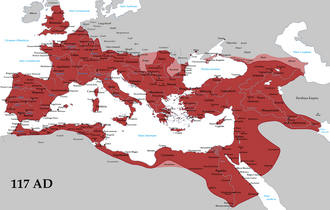
Rome established hegemony over the Mediterranean after defeating the Seleucid Empire in 189 BC. Initially, Rome utilized a system of client states that preserved their sovereignty and international rights. However, this hegemonic phase eventually transitioned into an imperial one. When client kings violated Roman orders—such as in Macedonia (148 BC) and Pontus (64 BC)—Rome shifted toward direct annexation. The process concluded in 30 BC when Augustus annexed the Ptolemaic Kingdom.
Medieval and Early Modern Dominance
Between the 7th and 12th centuries, the Umayyad and Abbasid Caliphates dominated vast territories, with the Byzantine Empire often paying tribute. In India, King Harsha (AD 606–647) maintained hegemony over the north by allowing conquered kings to remain on their thrones in exchange for homage. In Europe, Charlemagne's empire achieved dominance from the late 9th to early 11th century, while the maritime republics of Venice and Genoa controlled Mediterranean trade until the Age of Discovery.
The Era of European Rivalries
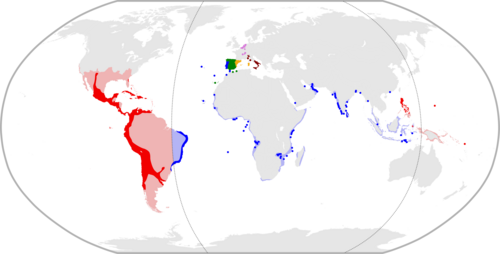
From the 16th to the 19th centuries, hegemony in Europe was a rotating prize contested by several powers. Portugal and Spain initially dominated, followed by the Dutch Republic, which pioneered commercial hegemony through mercantilism and the Amsterdam stock market. France attempted hegemony under Louis XIV and Napoleon I, though British naval power often limited their success.
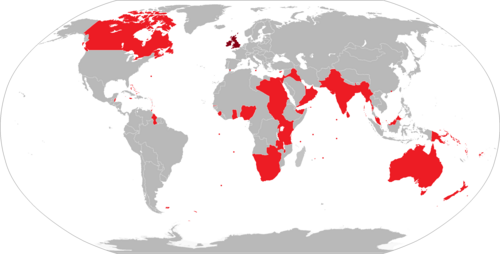
Following Napoleon's defeat, the British Empire became the largest in history. At its zenith under Queen Victoria, it controlled one-quarter of the world's land and population. While Germany became the strongest continental power after 1871, Otto von Bismarck explicitly avoided pursuing European hegemony to ensure German security and avoid conflict among major powers.
The Modern Era: Bipolarity and Unipolarity
The Cold War and Dual Hegemony
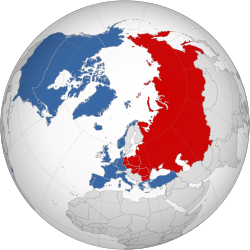
The 20th century began with multiple Great Powers but no single global hegemon. Following World War II, the world entered a bi-polar dynamic known as the Cold War, dominated by the United States and the Soviet Union. This period of "dual-hegemony" was characterized by ideological conflict between capitalism and communism, manifesting in an arms race and various proxy wars, including the Korean and Vietnam Wars.
The Unipolar Moment and Current Challenges
With the dissolution of the Soviet Union in 1991, the United States emerged as the world's sole hegemonic power. Some scholars, such as Hubert Védrine, described the U.S. as a "hyperpower" due to its unilateral military capabilities. However, the 21st century has seen challenges to this order. Russia has sought to end American hegemony, citing the Russo-Georgian War and the invasion of Ukraine as anti-hegemonic struggles. Similarly, China has been described by some as moving toward global hegemony, while others suggest a "third-way" Dutch-style commercial dominance.
Key Facts
- Ancient Origins: The term hēgemonía was pioneered by Greek historians like Herodotus and Xenophon.
- Roman Strategy: Rome transitioned from a hegemonic system of autonomous client states to a direct imperial administration.
- British Zenith: The British Empire was the largest in history, ruling 25% of the world's land and population.
- Cold War Dynamic: The mid-20th century was a period of "dual-hegemony" between the US and USSR.
- Modern Shift: Recent geopolitical events, including Russian annexations and Chinese economic growth, are viewed by some as the end of the post-Cold War unipolar order.
| Power/Entity | Period of Dominance | Primary Nature of Hegemony | Key Rival/Challenge |
|---|---|---|---|
| Athens/Sparta | 5th–4th Century BC | Regional Leagues | Each other / Persia |
| Roman Republic | 2nd Century BC | Client State System | Seleucid Empire |
| Dutch Republic | 1580–1688 | Commercial/Mercantilist | France |
| British Empire | 1815–1914 | Seaborne/Global | France / Germany |
| USA & USSR | 1945–1991 | Bipolar/Ideological | Each other |
| United States | 1991–Present | Unipolar/Military-Economic | Russia / China |
Frequently Asked Questions
What is the difference between hegemony and empire?
Hegemony typically involves a dominant state exerting influence over others who maintain their own sovereignty and internal autonomy. An empire generally involves direct political control, annexation of territory, and the imposition of a central administration.
How did the Dutch Republic achieve hegemony?
The Dutch achieved commercial hegemony through the development of wind power for efficient production and delivery, which facilitated the creation of the Amsterdam stock market and dominance over world trade.
What was "dual-hegemony" during the Cold War?
Dual-hegemony refers to the period when two dominant states—the United States and the Soviet Union—stabilized their respective spheres of influence while competing through arms races and proxy wars.
Why did the Roman hegemonic system fail?
According to historian Edward Luttwak, the transition from a hegemonic system (based on client states) to an imperial system (based on direct rule and taxation) proved fatal and contributed to the eventual fall of the Roman Empire.
Is global hegemony still possible in the 21st century?
Opinions vary; some scholars like Mearsheimer argue that projecting power over large bodies of water makes global hegemony unlikely, while others point to the current competition between the US, China, and Russia as a struggle to define the next world order.