The Incredible World of Hawk Moths: Nature's High-Speed Pollinators
If you have ever seen a large, fast-moving insect hovering near a flower, you might have mistaken it for a hummingbird. In reality, you may have been witnessing the remarkable flight of a hawk moth. Belonging to the family Sphingidae, these moths are among the most agile and specialized flyers in the insect world.
Named by French zoologist Pierre André Latreille in 1802, hawk moths (also known as sphinx moths) are a diverse group of approximately 1,450 species spread across roughly 200 genera. While they are most abundant in the tropics, they can be found in every region of the world. From their streamlined bodies to their extraordinary proboscises, every aspect of their biology is tuned for speed and precision.
Key Facts
- Diversity: Approximately 1,450 species across 200 genera.
- Flight Speed: Some species can exceed 5.3 m/s (19 km/h).
- Feeding: Many possess long proboscises (tongues) ranging from 1 cm to 28 cm.
- Evolutionary Marvel: Hovering flight in sphingids is an example of convergent evolution, appearing independently from hummingbirds, certain bats, and hoverflies.
- Lifespan: Adults typically live between 10 to 30 days.
Physical Characteristics and Flight Mechanics
Hawk moths are distinguished by their moderate to large size, narrow wings, and streamlined abdomens. These physical adaptations allow for rapid, sustained flight. Interestingly, some species exhibit "swing-hovering" or "side-slipping"—the ability to move rapidly from side to side while hovering. Scientists believe this maneuver evolved as a defense against ambush predators hiding within flowers.
Their flight is controlled by sophisticated sensory capabilities. Using their antennae as biological gyroscopes, hawk moths can detect Coriolis forces (inertial forces caused by rotation). When the moth performs an aerial maneuver, the deflection of the antennae is detected by the Johnston's organ at the base, allowing the insect to distinguish its rotation across different axes and maintain precise course control.
Anatomy and Sensory Organs
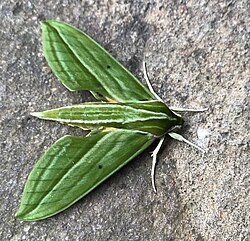
Unlike many other moths, hawk moth antennae are not particularly feathery, and some species even possess clubbed antennae similar to butterflies. While most lack tympanal organs (hearing organs), members of the group Choerocampini have developed hearing organs on their heads. To prepare for flight, most species shiver their flight muscles to warm up; during active flight, their body temperatures can exceed 40 °C (104 °F).
Sexual dimorphism—visible differences between males and females—is common. For instance, in the Convolvulus hawk-moth (*Agrius convolvuli*), males feature thicker antennae and more mottled wing markings than females. Additionally, only males possess a specific combination of a frenular hook and a retinaculum to join their wings.
The Life Cycle: From Hornworms to Adults
The life cycle of a sphingid is often multivoltine, meaning they can produce several generations in a single year if the weather allows. The process begins when females lay translucent, greenish, flattened eggs on host plants. These eggs typically hatch within three to 21 days.
Caterpillars and "Hornworms"
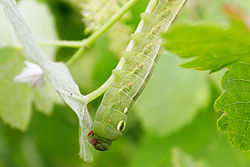
The larvae, often called hornworms, are stout and medium to large. A defining characteristic for many species is a "horn" located at the posterior (rear) end, though this may be reduced or absent in the final stage of growth. To avoid predators, many caterpillars use cryptic coloration (camouflage) to blend into leaves, while others use bright colors to signal danger. Some tropical larvae even mimic snakes.
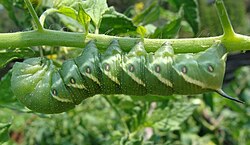
Larvae are often specialized feeders. For example, the Tobacco hornworm (*Manduca sexta*) can detoxify and rapidly excrete nicotine from the plants it consumes. Once fully grown, the larvae typically burrow into the soil to pupate, remaining in that stage for two to three weeks before emerging as adults.
Pupation and Emergence
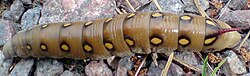
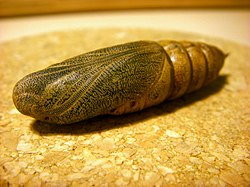
During the pupal stage, the insect undergoes a complete transformation. While most pupae are found underground or in cocoons, some sphingids have a free proboscis that is not fused to the pupal case. In many species, the pupa serves as the overwintering stage, allowing the insect to survive harsh seasons.
Feeding Habits and Evolutionary Coevolution
Most adult hawk moths are nectar feeders. They often prefer pale, sweet-smelling flowers with long corolla tubes (the tubular part of a flower). This relationship is known as sphingophily. Because their proboscises can reach lengths of up to 28 cm, they can access nectar that other pollinators cannot reach.
This has led to fascinating examples of coevolution. In the 19th century, Charles Darwin famously predicted that a moth with an incredibly long proboscis must exist to pollinate the Angraecum sesquipedale orchid, which has a nectar spur of nearly 30 cm. Decades later, the Madagascan subspecies Xanthopan morganii praedicta was discovered, confirming his theory.
| Feature | Description |
|---|---|
| Wingspan | 4 cm to over 10 cm |
| Proboscis Length | 1 cm to 28 cm |
| Primary Activity | Crepuscular (dawn/dusk) or Nocturnal |
| Flight Style | Agile, sustained, and capable of hovering |
Summary of Notable Species
The Sphingidae family includes many well-known species that play vital roles in their ecosystems:
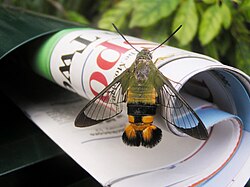
- Hummingbird hawk-moth: Famous for its hovering ability.
- Death's-head hawk moth: Known for stealing honey from bees.
- Tobacco hornworm: A specialist capable of processing nicotine.
- Privet hawk moth: A common representative of the family.
Frequently Asked Questions
Why are they called "sphinx moths"?
The name comes from the way many caterpillars hold their legs off the surface and tuck their heads underneath while resting. This "praying position" resembles the Great Sphinx of Giza.
Are hawk moths dangerous to humans?
While some larvae can regurgitate sticky or toxic contents to deter predators like ants, they are not considered dangerous to humans.
How do hawk moths fly so accurately?
They use their antennae as sensory tools to detect Coriolis forces during flight. This allows them to sense their body's rotation and make rapid, precise adjustments to their course.
Do all hawk moths fly at night?
Most are nocturnal or crepuscular (active at dawn and dusk), but some species, such as certain African varieties, are diurnal, meaning they fly during the day.
What is the difference between a hawk moth and a hummingbird?
While they share the ability to hover, they are entirely different animals. Hawk moths are insects (Lepidoptera) with wings covered in scales, whereas hummingbirds are birds. Their similar appearance is a result of convergent evolution.