Hawk Moths: The High-Speed Aviators of the Insect World
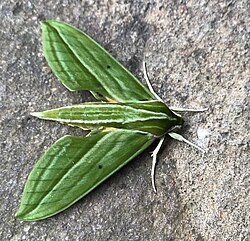
The Sphingidae, commonly known as hawk moths or sphinx moths, are a family of moderate to large insects renowned for their extraordinary aerial agility. With approximately 1,450 species across 200 genera, these moths are found globally, though they are most diverse in tropical regions. Their streamlined bodies and narrow wings allow them to fly with a precision and speed that often leads observers to mistake them for hummingbirds.
This resemblance is more than superficial; it is a prime example of convergent evolution. Convergent evolution occurs when unrelated species independently evolve similar traits to adapt to similar environments. In the case of hawk moths, the ability to hover in midair while feeding on nectar is a trait shared by only four nectar-feeding groups: hummingbirds, certain bats, hoverflies, and sphingids.
Key Facts
- Species Diversity: Roughly 1,450 species across about 200 genera.
- Flight Speed: Some species can exceed 5.3 m/s (19 km/h).
- Proboscis Length: Varies from 1 cm up to a remarkable 28 cm.
- Distinctive Larvae: Many caterpillars are known as hornworms due to a posterior horn.
- Thermal Regulation: Moths shiver their flight muscles to warm up, sometimes exceeding 40°C (104°F) during flight.
Anatomy and Physical Characteristics
Hawk moths are built for performance. Their thorax, abdomen, and wings are densely covered in scales, and they possess a frenulum and retinaculum—specialized structures that couple the hindwings and forewings for more efficient flight. While most moths have feathery antennae, sphingids have simpler antennae, and some species even possess clubbed antennae similar to those of butterflies.
One of their most striking features is the proboscis, a tubular mouthpart used to drink nectar. The length of this organ varies wildly between species, allowing hawk moths to access nectar in deep corolla tubes (the tubular part of a flower) that other pollinators cannot reach.
Sensory Capabilities and Flight Control
The flight of the hawk moth is managed by a sophisticated sensory system. In species like Manduca sexta, the antennae act as gyroscopes. As the moth rotates during aerial maneuvers, Coriolis forces (inertial forces acting on objects in motion within a rotating frame) cause the antennae to deflect. These deflections are detected by the Johnston's organ at the base of the antenna, allowing the moth to distinguish rotation across different axes and maintain rapid course control.
Life Cycle and Development
Most hawk moths are multivoltine, meaning they can produce several generations in a single year if the weather permits. The cycle begins with translucent, greenish eggs laid on host plants.
The Hornworm Stage
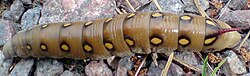
The larvae, or caterpillars, are stout and typically lack hairs. Most are characterized by a "horn" at the posterior end, though this may be reduced or absent in the final instar (the final stage of larval development). Many larvae use countershading—a form of camouflage where the top is darker than the bottom—to hide from predators.
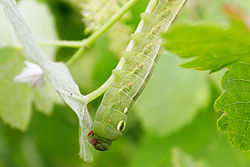
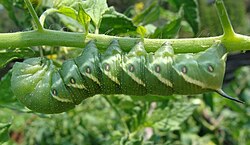
When threatened, these caterpillars may adopt a "praying position," tucking their heads underneath their bodies. This posture, resembling the Great Sphinx of Giza, is how the family earned the name "sphinx moth." To defend themselves, they can regurgitate sticky, often toxic, foregut contents on attackers.
Pupation
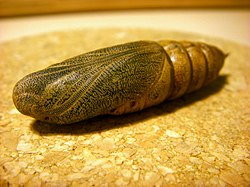
Before transitioning to adulthood, the larvae burrow into the soil or create a loose cocoon among rocks. The pupa is typically the overwintering stage. Interestingly, some sphingid pupae have a free proboscis rather than one fused to the pupal case.
Diet and Ecological Relationships
Larval Feeding and Toxicity
Sphingid larvae are generally specific feeders. They consume soft young leaves and can often tolerate high concentrations of plant toxins. For instance, the tobacco hornworm (Manduca sexta) detoxifies and excretes nicotine. While some species, such as Hyles euphorbiae, sequester (store) toxins in their tissues, these are not passed on to the adult stage.
Adult Pollination and the Darwin Prediction
Adults primarily feed on nectar. Night-flying species prefer pale, sweet-smelling flowers with long tubes, a relationship known as sphingophily. This specialization is often driven by the flower; longer corolla tubes limit the number of moth species that can reach the nectar, which in turn encourages the evolution of longer proboscides.
This relationship was famously highlighted by Charles Darwin and Alfred Russel Wallace. After observing the comet orchid (Angraecum sesquipedale) with its 30 cm nectar tube, Darwin predicted a moth with a matching proboscis must exist. Decades later, Xanthopan morganii praedicta was discovered in Madagascar, confirming the prediction. Molecular evidence suggests the moth and orchid diverged approximately 7.4 to 7.5 million years ago.
Summary of Sphingidae Characteristics
| Feature | Description |
|---|---|
| Wingspan | 4 cm to over 10 cm |
| Flight Style | Rapid, agile, capable of hovering and "side-slipping" |
| Activity Period | Mostly crepuscular (dawn/dusk) or nocturnal; some diurnal |
| Adult Lifespan | 10 to 30 days |
| Larval Trait | Posterior horn; "praying" resting posture |
Frequently Asked Questions
Why are they called sphinx moths?
They are called sphinx moths because of the resting posture of their caterpillars, which tuck their heads under their bodies in a way that resembles the Great Sphinx of Giza.
How do hawk moths differ from hummingbirds?
While they share similar hovering behaviors and streamlined shapes due to convergent evolution, hawk moths are insects (Lepidoptera) with scales and proboscides, whereas hummingbirds are avian vertebrates.
Can all hawk moths hover?
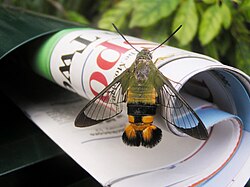
Not all, but several species, such as the hummingbird hawk-moth and the white-lined sphinx, have evolved the ability to hover in midair to feed on nectar.
What is the purpose of the "horn" on the caterpillar?
The horn is a characteristic anatomical feature of most sphingid larvae, though its specific function varies and it may be reduced or disappear in the final stage of larval development.
How do they survive cold temperatures before flight?
Most species shiver their flight muscles to generate internal heat, raising their body temperature to over 40°C (104°F) to enable the rapid muscle contractions needed for flight.