The Secret Engineering of Nectar Spurs: Evolution, Genetics, and Pollination
In the diverse world of flowering plants, nature has developed ingenious ways to attract pollinators and ensure reproduction. One of the most fascinating adaptations is the nectar spur—a specialized, hollow extension of a flower's anatomy. These structures act as biological "vaults," storing sugary nectar to reward specific visitors while ensuring the plant's pollen is efficiently transferred.
Nectar spurs are not limited to a single family of plants; they appear across many different clades of angiosperms (flowering plants). Because these similar structures evolved independently in unrelated groups, they serve as a primary example of convergent evolution, where different species develop similar traits to solve the same environmental challenge.
Understanding the Nectar Spur
At its simplest, a nectar spur is a tubular protrusion that contains nectaries, which are specialized tissues that secrete nectar. Depending on the species, these spurs can emerge from different parts of the flower:
- Petals: The most common origin for spurs.
- Sepals: The outer protective layer of the flower bud.
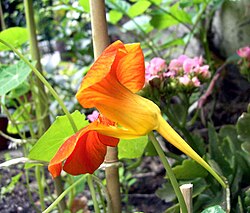
- Hypanthium: The cup-like structure formed by the fusion of the basal portions of the sepals, petals, and stamens.
The Evolutionary Arms Race and Pollinator Shifts
The development of nectar spurs is closely tied to the relationship between plants and their pollinators. This often involves coevolution (where two species influence each other's evolution) or pollinator shifts (where a plant evolves to attract a new type of pollinator).
The length of a nectar spur typically corresponds to the length of the pollinator's feeding organ, such as the tongue of a moth, the proboscis of a fly, or the beak of a hummingbird. By restricting nectar access to only those pollinators with the correct "equipment," the plant limits its range of visitors, which can increase the precision of pollen transfer.
Darwin’s Famous Prediction
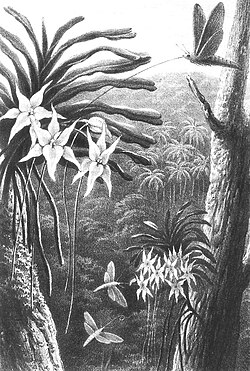
One of the most celebrated stories in evolutionary biology involves Charles Darwin and the orchid Angraecum sesquipedale. Noticing the orchid's extraordinarily long nectar spur, Darwin predicted that there must exist a moth with a proboscis long enough to reach the nectar at the bottom. His prediction was vindicated 40 years later with the discovery of the sphinx moth, Xanthopan morganii praedicta.
Driving Diversification
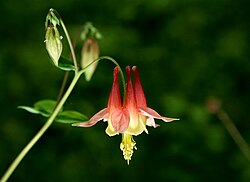
Some scientists view nectar spurs as key innovations—traits that trigger adaptive radiation, a process where a lineage rapidly diversifies into many new species to fill different ecological niches. This has been studied extensively in columbines (Aquilegia). However, recent research suggests that for Aquilegia, factors like climate and habitat may have played a larger role in their diversification than the length of their spurs.
A Tool for Taxonomy
For botanists, the nectar spur is more than just a feeding tube; it is a vital diagnostic tool for taxonomy (the science of naming and classifying organisms). Because spur length is often consistent within a species, it helps in identifying closely related plants.
For example, in the orchid family (Orchidaceae), Yadon's piperia can be distinguished from the very similar Platanthera elegans simply by the unusually short length of its nectar spur.
The Genetic Blueprint of the Spur
How does a plant grow a long, hollow tube? Research shows that the varying lengths of nectar spurs are caused by anisotropic elongation, a process where cells expand more in one direction than in others, stretching the tissue into a tube.
The genetic pathways that trigger this growth vary by plant, further proving that spurs evolved independently:
- KNOX Genes: In plants like Linaria and the model plants Antirrhinum and Arabidopsis, type I KNOX SHOOTMERISTEMLESS (STM) genes are involved. These genes normally control the shoot apical meristem (the growing tip of the plant) by managing cell division.
- TCP Genes: In Aquilegia, however, KNOX genes are not the primary drivers. Instead, certain TCP genes are believed to play the lead role in spur development.
This indicates that nectar spurs are a case of convergent evolution not just in appearance, but at the genetic level, as different plants use different molecular "toolkits" to achieve the same result.
Summary of Plants with Nectar Spurs
| Plant Group/Family | Spur Origin | Examples |
|---|---|---|
| Orchids | Various | Satyrium, Disa, Angraecum, Aerangis, Neofinetia, Piperia |
| Petal-based | Petals | Aquilegia, Delphinium, Viola, Fumarioideae, Lentibulariaceae |
| Sepal-based | Sepals | Impatiens |
| Hypanthium-based | Hypanthium | Tropaeolum |
Note: While Delphinium possesses spurs on both petals and sepals, only the petal spurs are true nectar spurs; the sepaline spur does not produce nectar.