The Fascinating World of Anolis Lizards: Evolution and Adaptation
Native to the Americas, the Anolis genus represents one of the most diverse groups of reptiles on the planet. With approximately 425 species, these lizards are a premier example of how life adapts to specific environments. Whether they are scurrying along tree trunks or clinging to tiny twigs, anoles have mastered the art of survival through remarkable evolutionary processes.
Taxonomy and Scientific Classification
The classification of anoles has undergone significant changes as scientific understanding evolves. While they were previously grouped under the family Polychrotidae, recent studies have placed them within the family Dactyloidae. The genus Anolis is currently considered the world's most species-rich amniote tetrapod genus (a group of animals that lay eggs on land). However, there is ongoing scientific debate regarding their taxonomy. Some researchers suggest that many species should be moved to different genera, which would leave only about 45 species under the Anolis name.
If these subgroups are recognized as separate genera, the family would include groups such as Norops (about 190 species), Dactyloa (circa 95 species), and Ctenonotus (more than 40 species). Despite these debates, the genus remains a central focus for biologists studying evolutionary history.
In 2011, the green anole (Anolis carolinensis) reached a major scientific milestone by becoming the first reptile to have its complete genome published, providing researchers with a blueprint for understanding reptile biology.
Adaptive Radiation and the Rise of Ecomorphs
Anoles are famous among biologists for demonstrating adaptive radiation—a process where a single ancestral species evolves into many different forms to fill various ecological niches. They also showcase convergent evolution, where different species independently evolve similar traits because they live in similar environments.
On isolated islands, anole populations have diverged to occupy specific areas of vegetation, such as the tree canopy, the trunk, or underlying shrubs. These different roles are categorized into ecomorphs, which are distinct body types adapted to a specific habitat. For example:
- Twig ecomorphs: Characterized by short limbs to navigate small branches.
- Trunk ecomorphs: Feature long limbs for moving quickly on larger surfaces.
This pattern of evolution is remarkably predictable. Studies of lizard fossils trapped in amber show that these lizard communities have existed for at least 20 million years. Remarkably, the four modern ecomorph types—trunk-crown, trunk-ground, trunk, and twig—are already represented in these ancient fossils, suggesting that these body types have changed very little over millions of years.
Behavior and Survival Strategies
As ectotherms, anoles rely on external heat sources to regulate their body temperature. They must bask in the sunlight to become active, though they cannot behaviorally warm themselves once temperatures drop at night. This has led to the evolution of rapid cold tolerance. On the island of Hispaniola, for instance, high-altitude populations have adapted to boulder environments where warming is easier, resulting in physical changes to their limbs and skulls.
Anoles have also developed specialized survival skills. Some species that evolved near water have developed the ability to remain submerged for as long as 18 minutes to escape danger.
The Science of the Dewlap
One of the most striking features of many anoles, particularly males, is the dewlap. This is a flap of skin located beneath the jaw or throat that can be extended using hyoid muscles in the throat. Anoles use the dewlap for visual signaling, either through a "pulse" pattern (repeatedly extending the flap) or a "moving flag" pattern (continuous flashing accompanied by body bobbing).
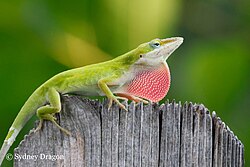
The vibrant colors of the dewlap—often red, yellow, or blue—are produced by two types of pigments: pterins (compounds synthesized from guanine) and carotenoids (pigments acquired through the lizard's diet). For a long time, scientists debated the primary purpose of this display. While it was initially thought to be purely for sexual selection (attracting females), it is also used in intermale competition to threaten rivals and may even serve as a method for species recognition.
Recent research suggests that the effectiveness of the dewlap depends on contrast. Rather than the specific color being the most important factor, the ability of the dewlap to stand out against the background environment is key. This suggests a coevolution between the lizards' visual signals and their sensory systems, as species adapt their dewlap colors to match the lighting conditions of their specific habitats.
Summary of Anolis Characteristics
| Feature | Description |
|---|---|
| Kingdom | Animalia |
| Class | Reptilia |
| Order | Squamata |
| Family | Anolidae |
| Primary Habitat | The Americas (including Caribbean islands) |
| Key Adaptation | Ecomorphs (specialized body types) |
| Visual Signal | Dewlap (throat flap) |
Key Facts
- Anoles are native to the Americas.
- The genus contains approximately 425 species.
- Anolis carolinensis was the first reptile to have its complete genome published.
- Anoles use ecomorphs to occupy different niches, such as twigs or tree trunks.
- Some species can stay submerged underwater for up to 18 minutes.
- The dewlap is used for courtship, territory defense, and species recognition.
Frequently Asked Questions
What is an ecomorph?
An ecomorph is a specific body type that has evolved to suit a particular ecological niche. For example, anoles living on twigs have short limbs for better balance, while those on trunks have long limbs for speed.
Why do anoles flash their dewlaps?
Anoles use their dewlaps as visual signals. This behavior is used to attract mates, defend territory against other males, and help individuals recognize members of their own species.
How do anoles regulate their body temperature?
Anoles are ectotherms, meaning they cannot produce their own body heat. They regulate their temperature through behavior, such as basking in the sun to warm up.
Does the color of a dewlap matter more than its contrast?
Research indicates that the contrast between the dewlap color and the surrounding environment is more important for visibility than the specific color itself. This allows the signal to be effective in different lighting conditions.
How long can an anole stay underwater?
Certain species of anoles that live near water have adapted to stay submerged for as long as 18 minutes to avoid predators.