Harold Arlen: The Architect of American Song Standards
Harold Arlen was a prolific composer, pianist, and vocalist whose work defined the sound of early 20th-century American music. From the jazz-infused atmosphere of the Cotton Club to the cinematic grandeur of Hollywood, Arlen's ability to blend soulful melodies with sophisticated structures created some of the most enduring standards in the Great American Songbook.
Early Career and the Cotton Club Era
Arlen began his professional journey between 1926 and 1934, appearing as a band vocalist and pianist. He performed on records for various artists, including Red Nichols, Joe Venuti, Leo Reisman, and Eddie Duchin, often singing his own original compositions. His first published song, "Minor Gaff (Blues Fantasy)," was written in 1926 in collaboration with Dick George.
By 1929, Arlen achieved his first major success with the song "Get Happy," written with lyricist Ted Koehler. This breakthrough led to a yearlong songwriting contract with the George and Arthur Piantadosi firm. During this period, Arlen also showcased his acting and singing talents as Cokey Joe in the musical The Great Day.
Throughout the early to mid-1930s, the partnership between Arlen and Koehler flourished. They wrote shows for the Cotton Club—a legendary Harlem nightclub—as well as for Broadway and Hollywood. Their collaboration produced timeless standards such as "Let's Fall in Love" and "Stormy Weather." Their final contribution to the Cotton Club Parade in 1934 was "Ill Wind (You're Blowin' Me No Good)," performed by Adelaide Hall.
Hollywood Success and "Over the Rainbow"
In the mid-1930s, Arlen transitioned toward movie musicals in California, where he began a pivotal partnership with lyricist E. Y. "Yip" Harburg. After signing with Samuel Goldwyn in 1935 for the film Strike Me Pink, the duo reached a career pinnacle in 1938.
Hired by Metro-Goldwyn-Mayer for The Wizard of Oz, Arlen and Harburg composed "Over the Rainbow," which won the Academy Award for Best Music, Original Song. Their collaborative output continued with "Down with Love" (from the 1937 Broadway show Hooray for What!), "Lydia the Tattooed Lady" for Groucho Marx in At the Circus (1939), and "Happiness Is a Thing Called Joe" for Ethel Waters in Cabin in the Sky (1943).
Collaborations with Johnny Mercer and Later Works
The 1940s marked a new era of creativity as Arlen teamed up with lyricist Johnny Mercer. Together, they penned a string of hits that remain staples of jazz and pop music, including "Blues in the Night," "That Old Black Magic," "Come Rain or Come Shine," and "One for My Baby (and One More for the Road)."
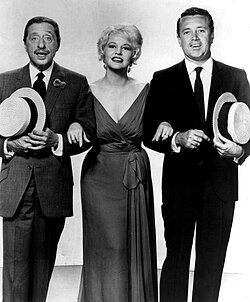
Arlen's versatility extended to various other partnerships. He worked with Ralph Blane on the score for My Blue Heaven (1949), collaborated again with Mercer for The Petty Girl (1950) to produce "Fancy Free," and worked with Dorothy Fields on the 1952 film The Farmer Takes a Wife.
Arlen's music was central to the career of Judy Garland. In addition to "Over the Rainbow," he wrote "The Man That Got Away" for the 1954 film A Star Is Born. Their mutual respect was highlighted at Garland's 1961 Carnegie Hall concert, where she invited Arlen to the stage to receive a standing ovation.
Final Projects and Legacy
In his later years, Arlen wrote the score for the 1962 animated musical Gay Purr-ee with E.Y. Harburg. In 1966, he released his debut vocal album, Harold Sings Arlen (With Friend), featuring guest appearances by Barbra Streisand. His song "Paper Moon," written with Harburg in 1932, later served as the basis for a 1973 Peter Bogdanovich film and a subsequent ABC sitcom.
In recognition of his immense contribution to American music, Arlen was inducted into the American Theater Hall of Fame in 1979.
Key Facts
- Academy Award Winner: Won for "Over the Rainbow" from The Wizard of Oz.
- Major Collaborators: Worked extensively with Ted Koehler, E.Y. "Yip" Harburg, and Johnny Mercer.
- Genre Versatility: Spanned Harlem nightclub acts, Broadway musicals, and Hollywood cinema.
- Hall of Fame: Inducted into the American Theater Hall of Fame in 1979.
- Defining Works: Composed "Stormy Weather," "That Old Black Magic," and "The Man That Got Away."
| Lyricist/Partner | Notable Works | Key Projects |
|---|---|---|
| Ted Koehler | "Get Happy", "Stormy Weather", "Ill Wind" | Cotton Club, Broadway |
| E.Y. "Yip" Harburg | "Over the Rainbow", "Paper Moon" | The Wizard of Oz, Gay Purr-ee |
| Johnny Mercer | "Blues in the Night", "That Old Black Magic" | Various hit singles |
| Dorothy Fields | Film score contributions | The Farmer Takes a Wife |
Frequently Asked Questions
Which song won Harold Arlen an Academy Award?
Harold Arlen won the Academy Award for Best Music, Original Song for "Over the Rainbow," written for the 1939 film The Wizard of Oz.
Who were Arlen's primary lyricists?
Arlen had three major songwriting partnerships: Ted Koehler during his early years and Cotton Club era, E.Y. "Yip" Harburg for many of his film works, and Johnny Mercer during the 1940s.
What was Arlen's connection to the Cotton Club?
In the early to mid-1930s, Arlen and Ted Koehler wrote shows specifically for the Cotton Club, a popular Harlem nightclub, producing hits like "Stormy Weather."
Did Harold Arlen perform his own music?
Yes, Arlen was a pianist and vocalist. He appeared on records with various orchestras in the 1920s and released his debut vocal album, Harold Sings Arlen (With Friend), in 1966.
Which famous singer was closely associated with Arlen's work?
Judy Garland was closely associated with his music, most notably through "Over the Rainbow" and "The Man That Got Away." They shared a deep professional bond, culminating in a public tribute at her 1961 Carnegie Hall concert.