Harmonia axyridis: The Multicolored Asian Lady Beetle
The Harmonia axyridis, commonly known as the harlequin, Asian, or multicolored Asian lady beetle, is one of the most visually diverse beetle species on Earth. While often welcomed for its ability to prey on garden pests, this species has become a global phenomenon due to its adaptability and invasive nature. Native to eastern Asia, it was intentionally introduced to Europe and North America to manage populations of scale insects and aphids, eventually establishing itself across Africa and South America.
In North America, these beetles are sometimes called "Halloween beetles" because of their tendency to swarm into homes during October to find overwintering sites. Although frequently called ladybugs, entomologists prefer the terms ladybird beetles or lady beetles to distinguish them from "true bugs."
![A Harmonia axyridis collected from a flowering plant in Haddock, Georgia. Scale bar represents 1 cm (approx. ⅜ inch).[1]](/images/22/15/2215d04f0dc698c40b8cc364622b9bf2dfe994bcb4da0a450f53d356e3be80d0.jpg)
Key Facts
- Native Range: Eastern Asia, including China, Japan, Korea, and Russia.
- Primary Diet: Carnivorous, primarily feeding on aphids (Hemipteran insects).
- Size: Typically ranges from 5.5 to 8.5 mm in length.
- Distinguishing Feature: A white pronotum (the plate covering the thorax) often featuring a black "M" or "W" shape.
- Chemical Defense: Produces harmonine, an antibacterial compound that protects the beetle and can be toxic to native ladybirds.
Physical Description and Identification
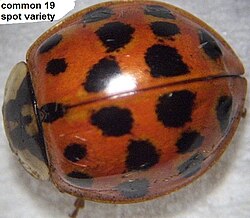
The H. axyridis is a typical coccinellid beetle with a domed shape and a smooth transition between its head, pronotum, and elytra (wing coverings). Its most striking characteristic is its color polymorphism—the ability to appear in many different colors and patterns, which is likely regulated by genetics and environmental temperatures during the pupal stage.
Common Color Forms
- f. succinea: Orange or red with 0 to 22 black spots.
- f. conspicua: Uniformly black with two red markings.
- f. spectabilis: Uniformly black with four red markings.
Identification can be challenging due to this variety. However, the underside of the abdomen remains brown even in black color forms, and the legs are consistently reddish-brown. The pronotum is typically white with variable black patterning.
![Harmonia axyridis. Scale bar represents 1 cm (approx. ⅜ inch). Collected from inside residence in Baldwin County, Georgia, on September 20, 2024.[1]](/images/79/eb/79eb23ae2acfbed9ca900fb25ac8552b099957a87b218ccf3ec5e153c4ba5416.jpg)
Global Distribution and Invasion
Originally found from central Siberia and Kazakhstan to the Pacific coast of Asia, H. axyridis has spread worldwide through human-mediated processes. In the United States, introductions began as early as 1916. While early attempts to establish wild populations failed, a permanent population was observed near New Orleans, Louisiana, around 1988, leading to a rapid spread across the Midwest, Northwest, and Northeast by the mid-1990s.
Genetic markers indicate that North American populations originated from two independent introductions. These North American populations later served as the source for invasions in South America, Africa, and parts of Europe.
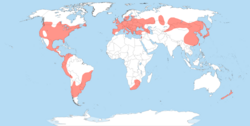
Impact on Native Ecosystems
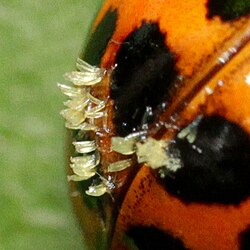
The species is considered one of the world's most invasive insects. It outcompetes native ladybirds by eating their eggs and utilizing a biological advantage: harmonine. This antibacterial chemical in their blood helps them resist diseases and acts as a toxin to native species that consume harlequin eggs. Additionally, they carry a microsporidian parasite that is harmless to them but lethal to other ladybird species.
Biology and Behavior
H. axyridis is primarily carnivorous, though it exhibits an unusual behavior for its family by feeding on fruits like raspberries and grapes to increase resources for winter. They become dormant in cool weather but remain active when temperatures hit approximately 10 °C (50 °F).
When threatened, these beetles engage in "reflex bleeding," releasing hemolymph from their legs. This fluid contains isopropyl methoxy pyrazine, which produces a bitter taste and a foul odor similar to dead leaves. In some humans, this secretion can cause allergic reactions, such as allergic rhinoconjunctivitis.
Life Cycle and Development
The life cycle progresses from mating to the laying of yellow eggs (which turn black just before hatching), followed by five larval stages, a pupa, and finally the adult beetle. Eggs average about 1.2 mm in length.
Biochemical Significance and Control
Beyond its ecological impact, the beetle's biochemistry is of scientific interest. The compound harmonine has shown broad-spectrum antimicrobial activity, including effectiveness against Mycobacterium tuberculosis (the cause of tuberculosis) and chloroquine-resistant strains of Plasmodium falciparum (the cause of malaria).
To control invasive populations, researchers use insecticides, trapping, and mechanical barriers to prevent entry into buildings. Ongoing studies are exploring the use of fungal diseases and parasitic sexually transmitted mites as biological control agents.
| Feature | Details |
|---|---|
| Scientific Name | Harmonia axyridis |
| Common Names | Harlequin, Asian, Multicolored Asian Lady Beetle |
| Size Range | 5.5 mm to 8.5 mm |
| Native Region | Eastern Asia |
| Primary Prey | Aphids and scale insects |
| Key Defense | Reflex bleeding (Harmonine) |
Frequently Asked Questions
Is the Asian lady beetle the same as a ladybug?
Yes, it is a species of lady beetle. While the public uses "ladybug" and "ladybird" interchangeably, entomologists prefer "lady beetle" to avoid confusion with true bugs (Hemiptera).
Why do these beetles enter my house in the fall?
They seek cool, dry, confined spaces to overwinter. They are often attracted to sunlit walls and dark screening material, which provides warmth during the autumn months.
Can the Asian lady beetle bite humans?
Yes, they may occasionally bite humans, likely in an attempt to acquire salt. While usually just a pricking sensation, some individuals may experience allergic reactions to the bites.
How can I tell an Asian lady beetle apart from native species?
The most reliable clue is the pronotum (the area behind the head), which often has a black "M" or "W" shape on a white background. Additionally, they are generally larger than many native species and have reddish-brown legs.
Are they beneficial for gardens?
They are highly effective at controlling aphid populations, which can save farmers significant money. However, their invasive nature can harm local biodiversity by displacing native ladybird species.