Harmonia axyridis: The Complex Biology of the Multicolored Asian Lady Beetle
Commonly known as the harlequin ladybird, Asian lady beetle, or multicolored Asian lady beetle, Harmonia axyridis is one of the most visually diverse beetle species on the planet. While many recognize them as colorful garden visitors, this species is a complex organism with a global footprint, serving as both a beneficial biological control agent and a highly successful invasive species.
Originally native to eastern Asia—spanning from Siberia and Kazakhstan through China and Japan—this beetle has been introduced to North America and Europe to manage agricultural pests. However, its ability to adapt and spread has made it a prominent figure in ecosystems worldwide.
![A Harmonia axyridis collected from a flowering plant in Haddock, Georgia. Scale bar represents 1 cm (approx. ⅜ inch).[1]](/images/22/15/2215d04f0dc698c40b8cc364622b9bf2dfe994bcb4da0a450f53d356e3be80d0.jpg)
Key Facts
- Scientific Name: Harmonia axyridis
- Common Names: Harlequin ladybird, Asian lady beetle, multicolored Asian lady beetle.
- Primary Diet: Primarily carnivorous (aphids and scale insects), but also consumes fruit.
- Size: Typically ranges from 5.5 to 8.5 mm.
- Defensive Mechanism: Uses "reflex bleeding" to release foul-smelling, bitter hemolymph.
- Global Status: Highly invasive in North America, Europe, Africa, and South America.
Physical Description and Identification
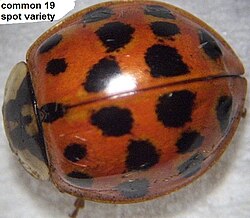
Harmonia axyridis is a typical coccinellid (lady beetle) in structure, characterized by a domed shape and a smooth transition between its head, pronotum (the plate covering the thorax), and its elytra (hardened wing coverings).
One of the most striking features of this species is its extreme color polymorphism—the ability to appear in many different color forms. This variation is likely hereditary and may be influenced by temperature during the pupal stage. Common forms include:
- f. succinea: Orange or red with 0–22 black spots.
- f. conspicua and f. spectabilis: Uniformly black with two or four red markings.
- Extreme forms: Can be entirely black or feature complex patterns of orange, red, and black.
To identify them accurately, look at the pronotum. In the common orange/red forms, the black markings often resemble a letter "W" or "M." Additionally, while colors vary, they almost always possess reddish-brown legs and a dark underside with a reddish-brown border.
![Harmonia axyridis. Scale bar represents 1 cm (approx. ⅜ inch). Collected from inside residence in Baldwin County, Georgia, on September 20, 2024.[1]](/images/79/eb/79eb23ae2acfbed9ca900fb25ac8552b099957a87b218ccf3ec5e153c4ba5416.jpg)
Size and Life Cycle
Adults generally measure between 5.5 and 8.5 mm. Their life cycle follows a standard progression: mating, egg-laying, five distinct larval stages, pupation, and finally, the emergence of the adult. The eggs are approximately 1.2 mm in length and transition from yellow to black just before hatching.
Global Range and Invasive Impact
The spread of H. axyridis is a result of human-mediated processes. Introduced to the United States as early as 1916 to control aphids, they established wild populations in Louisiana by 1988 and rapidly spread across North America. In 2001, they were credited with saving farmers significant money by feeding on soybean aphids.
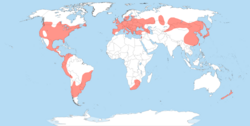
Despite their benefits in agriculture, they are considered one of the world's most invasive insects. They pose a significant threat to native ladybird species by outcompeting them for resources, eating their eggs, and even poisoning them. In the UK, they were declared the fastest-invading species in 2015, having spread across the country in just over a decade.
Biology, Behavior, and Defense
H. axyridis is a generalist feeder. While they primarily hunt Hemipteran insects like aphids, they are unusual among lady beetles for their ability to feed on fruits such as grapes and raspberries. This dietary flexibility aids their survival and helps them prepare for overwintering.
During cooler months, these beetles become dormant. They often seek out warm, dry, confined spaces to overwinter, which frequently leads to large numbers congregating inside human homes, particularly in the corners of windows or within walls. They are attracted to sunlight and dark screening materials for warmth.
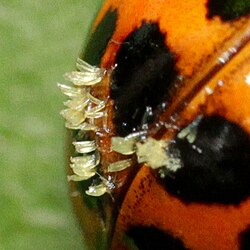
When threatened, the beetle employs a defense mechanism known as reflex bleeding. They release hemolymph (insect blood) from their legs, which contains isopropyl methoxy pyrazine. This liquid has a bitter taste and a foul odor similar to dead leaves. While the bite is usually just a minor irritation, some humans may experience allergic reactions, such as rhinoconjunctivitis.
Biochemical Properties
Scientific research has identified a specific molecule in the beetle's hemolymph called harmonine. This compound possesses broad-spectrum antimicrobial activity. Studies have shown it can inhibit the growth of certain fast-growing mycobacteria, including Mycobacterium tuberculosis, and has shown activity against chloroquine-resistant strains of Plasmodium falciparum (the parasite responsible for malaria).
Summary Table of Species Characteristics
| Feature | Description |
|---|---|
| Size Range | 5.5 mm – 8.5 mm |
| Primary Diet | Aphids, scale insects, and some fruits |
| Defensive Chemical | Harmonine and isopropyl methoxy pyrazine |
| Overwintering Habit | Congregating in crevices, walls, and homes |
| Identification Key | Pronotum markings (M or W shape) |
Frequently Asked Questions
Are Asian lady beetles dangerous to humans?
They are not inherently dangerous, but they can bite if provoked, which usually results in a minor pricking sensation. Some individuals may experience allergic reactions or skin irritation from their defensive secretions.
Why do they enter my house in the fall?
As temperatures drop, the beetles seek out cool, dry, and confined spaces to overwinter. They often congregate in large numbers inside walls or window corners to stay protected during the winter months.
How can I tell the difference between a ladybug and an Asian lady beetle?
While the terms are often used interchangeably, entomologists prefer "lady beetle." You can distinguish H. axyridis by its larger size compared to many native species and the specific "M" or "W" shaped black markings on its white pronotum.
Do they help or hurt the environment?
It is a dual impact. They are beneficial in agriculture for controlling aphid populations, but they are highly invasive and can devastate native ladybird populations by outcompeting them and consuming their eggs.
What is "reflex bleeding"?
Reflex bleeding is a defensive behavior where the beetle releases its hemolymph (blood) when agitated. This liquid is bitter and foul-smelling, serving to deter predators.